Does 16:8 Fasting Lower Blood Sugar? Updated Evidence
Small glucose improvements don't guarantee a lower HbA1c. What a 23-trial review and a year-long eating-window trial tell us about fasting and blood sugar.
By Nazmul Hasan Rupok Published 7 min read

Last updated
You’ve kept an eating window for months. Does that mean your next blood test should look better?
The answer depends on which number you mean, what you compare fasting with, and who was studied. A small improvement in fasting glucose doesn’t guarantee a lower HbA1c. A longer trial helps explain why those two findings can coexist.
The short version
A review of 23 trials found small average improvements in fasting glucose and insulin with 16:8, with low certainty in those findings. It found no clear overall HbA1c improvement. A separate 247-person trial of a nine-hour eating window found no clinically meaningful HbA1c change after four or twelve months, whether participants followed the window or received dietary advice. That trial wasn’t a test of 16:8, but it gives us a reason to avoid promising that enough months of fasting will improve everyone’s blood sugar.
What the 16:8 review actually found
Wong and colleagues’ review in Nutrition Reviews appeared online in December 2025 and in the August 2026 issue. It pooled 23 randomized trials involving 1,280 adults, with interventions lasting four weeks to a year.
Compared with the control diets, the pooled results favored 16:8 for fasting glucose and fasting insulin. The standardized effects were −0.25 for glucose and −0.22 for insulin. These are small statistical effects, not a drop of 0.25 mmol/L or 0.22 units on your laboratory report. Standardizing lets researchers combine studies; it doesn’t give you a personal treatment target.
The authors rated the glucose and insulin evidence low certainty. Most included trials had some risk-of-bias concerns, and participants, comparison diets and exercise arrangements differed. Results may change as better studies arrive.
For HbA1c, nine trials with 681 participants contributed data. The pooled estimate was −0.12 standardized units, with a confidence interval spanning no difference. The authors rated this evidence moderate certainty and described little to no overall benefit. HDL cholesterol showed a small favorable signal, but the lipid evidence was very low certainty and the review detected possible publication bias for HDL. Other cholesterol results were not consistently improved.
Reading the outcomes
These blood tests answer different questions.
Fasting glucose
A measurement at the time of the blood test.
HbA1c
An estimate of average blood glucose over about three months.
A change in one result does not guarantee a change in the other.
Six months isn’t a switch
The review did find a favorable HbA1c result in its longer-duration subgroup. That is a reason to investigate duration, not proof of a deadline after which fasting starts working.
The longer trials weren’t identical to the shorter ones. Differences in participants, food intake, support and activity can travel with differences in duration. A subgroup comparison cannot isolate time as the cause.
HbA1c also doesn’t wait six months to register a change. NIDDK explains that it reflects average blood glucose over roughly three months, with the most recent month contributing more than earlier months. A fasting-glucose test measures a different thing: glucose at a particular testing point after fasting. Neither result can be inferred from how easy your morning feels.
So the useful question is whether your clinician sees a meaningful change in the relevant test, under an appropriate monitoring plan. Staying with an unsuitable schedule just to cross a six-month line isn’t supported by this evidence.
A larger trial followed people for a year
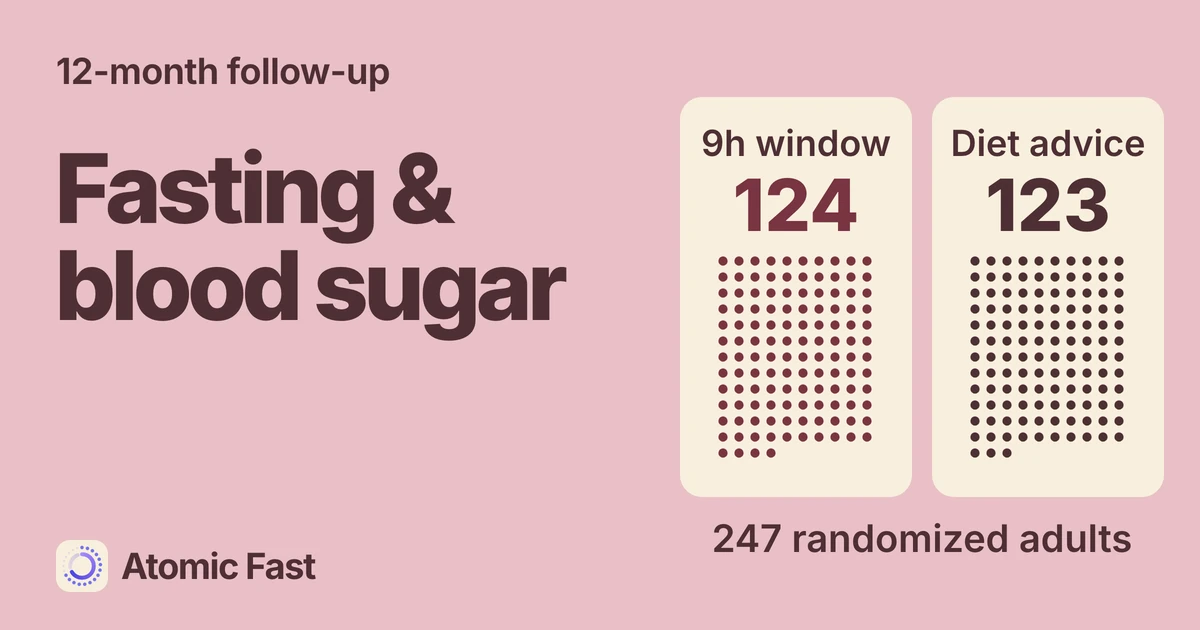
Parr, Charrouf, Hutchison and colleagues reported a randomized trial in Diabetologia, published online in June 2026. It enrolled 247 Australian adults at elevated risk of type 2 diabetes, without diagnosed type 2 diabetes. Their average age was 56, and 77% were women.
One group of 124 people used a self-selected nine-hour eating window, finishing by 7 p.m. The other 123 received individualized dietary guidance about food quality, portions and related habits. Both groups received five telehealth consultations. This was supported behavior change, not an app-only experiment.
The main question was whether the window was acceptably close to dietary guidance for HbA1c after four months. Researchers set that acceptable difference in advance at 0.10 percentage points. This type of study is called a non-inferiority trial.
At four months, the eating-window group met that criterion. The difference between groups was −0.02 percentage points, with a 95% confidence interval from −0.07 to 0.03. Neither approach produced a clinically meaningful HbA1c change.
At twelve months, the difference was 0.05 percentage points, with an interval from −0.02 to 0.11. Because its upper end passed the prespecified 0.10 margin, the researchers could no longer establish non-inferiority. That does not prove the window was worse. It means the uncertainty was too wide to meet the trial’s chosen standard.
Longer follow-up didn’t reveal a delayed, substantial HbA1c benefit. The full trial report and tables also found no clear between-group differences in fasting glucose or insulin.
Weight, food quality and blood sugar can move differently
Both trial groups lost a modest amount of weight and retained much of that loss: about 2 kg in the window group and 3 kg with dietary guidance at twelve months. The between-group difference wasn’t statistically significant.
Dietary guidance improved several measures of diet quality more than the window alone. It also produced greater reductions in total and LDL cholesterol at four months. Those cholesterol differences weren’t clearly established at twelve months.
These findings keep the outcome in focus. A schedule can help someone organize eating or lose some weight without producing a large HbA1c improvement. Timing and food choices also remain separate decisions. Our explanation of what changes when calories are matched looks at that distinction from a different trial design.
What these studies don’t settle
The Australian trial used nine hours, so its results aren’t a direct estimate of 16:8. Participants weren’t taking medicines that could affect glucose metabolism or weight, and the findings don’t establish safety for people using insulin or other glucose-lowering drugs.
The sample was predominantly white and female. Of 247 randomized participants, 194 completed the twelve-month assessment. The main analysis used imputation for missing data, which involves assumptions; sensitivity analyses supported similar conclusions. Dietary intake and adherence also depended on participant reporting.
There was no untreated comparison group. Similar HbA1c results between two supported approaches don’t tell us what would have happened without either intervention, or prove that either prevents diabetes. The trial was government-funded. The earlier review reported no funding or relevant conflicts.
What to do with this
- Choose the outcome before judging the routine. Weight, fasting glucose and HbA1c answer different questions. Use laboratory monitoring agreed with your clinician for blood-sugar goals.
- Keep food quality in the plan. A shorter window doesn’t replace dietary guidance. If timing helps, use it alongside attention to what you eat.
- Keep the schedule workable. There’s no demonstrated need to tighten your window because a blood test didn’t change. Start with a window that fits your day.
- Check medication and health constraints first. Our fasting safety guide explains who should avoid fasting or get individual advice. Don’t adjust medication to fit an app timer.
Atomic Fast’s free timer can record your fasting routine. Its phase labels come from elapsed hours, not a glucose measurement, and can’t tell you whether your HbA1c is improving.
Frequently asked questions
Does a lower fasting-glucose result mean my HbA1c will fall? Not necessarily. One is a measurement at a testing point; the other reflects glucose exposure over months. Your clinician can interpret them together.
Did the newer trial show 16:8 doesn’t work? It tested a nine-hour window, not 16:8. Its findings concern that supported schedule, population and comparison, rather than every form of fasting.
Can an eating window replace a dietitian? The trial doesn’t establish that. Even its timing group received five consultations, and dietary guidance improved some outcomes more. Discuss the approach that fits your needs and available support.
Can I use the timer’s phase label to check my blood sugar? No. Atomic Fast assigns phases by hours elapsed. A phase label isn’t a blood test or continuous glucose reading.
Sources
Sources checked: October 11, 2026.
-
Wong PS et al. (2026), Effect of 8-Hour Time-Restricted Eating (16/8 TRE) on Glucose Metabolism and Lipid Profile in Adults: A Systematic Review and Meta-Analysis. Nutrition reviews — The 23-trial review underlying the glucose, insulin, HbA1c and evidence-certainty discussion.
-
Parr EB et al. (2026), Time-restricted eating versus dietetic guidance on glycaemic outcomes in adults at risk of type 2 diabetes: a non-inferiority randomised clinical trial. Diabetologia — The 247-person, nine-hour-window trial. Four- and twelve-month findings come from the same study.
-
NIDDK — The A1C Test & Diabetes — Explains what HbA1c measures and why it differs from a single fasting-glucose result.
Keep track of your fasting routine with Atomic Fast on the App Store or Google Play.
This article is for general education and isn’t medical advice. If you’re pregnant, managing a health condition, taking medication, have a history of disordered eating, or are considering fasts longer than 24 hours, talk to a healthcare professional first.
Try Atomic Fast free
Track your fasts, log your meals, and see how they affect each other, on iPhone and Android.


 Scan to download