Muscle Cramps While Fasting: Causes, Relief and Red Flags
Getting leg cramps while fasting? See what research says about salt, water and magnesium, why prior cramps predict more, how to ease one and when to get checked.
By Nazmul Hasan Rupok Published 9 min read

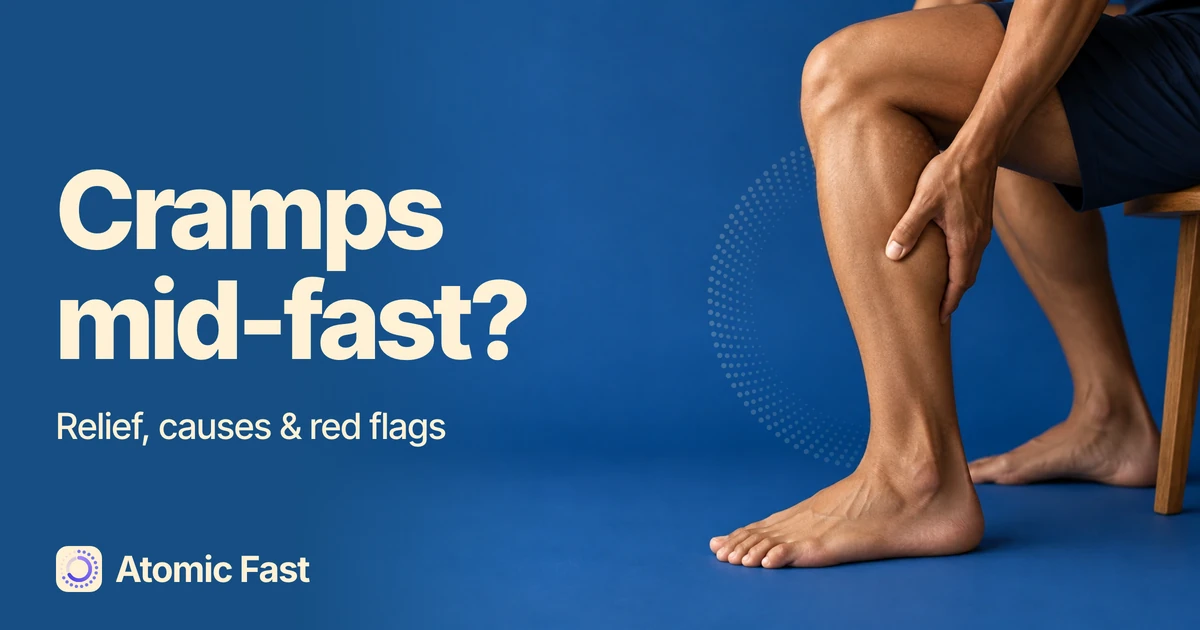
It’s 3 a.m., you’re fourteen hours into a fast, and your calf has locked into a knot. The internet’s answer arrives fast: take salt, take magnesium, drink more water. Before adding anything, it helps to separate three questions: what eases this cramp, what might be contributing, and what could prevent the next one.
The short version
A cramp during a fast doesn’t tell you what caused it. Research on fasting itself is limited, and studies of athletes or older adults with night cramps cannot settle what happens during a typical 16:8 schedule. Gentle stretching may ease an ordinary cramp; recurring cramps deserve a look at exercise, fluid losses, medicines and other symptoms. Magnesium trials have mixed results, so a cramp alone isn’t a reason to diagnose a mineral deficiency or start supplements.
What a cramp is, and why fasting gets blamed
A muscle cramp is an involuntary tightening that hurts and then releases. Calves, feet and thighs are common sites. Ordinary night cramps are different from a persistent painful, swollen leg, which needs assessment rather than a supplement experiment (NHS leg cramps).
An overnight eating schedule overlaps with the hours when many people already get cramps. That makes the timing worth noticing, but it doesn’t establish a cause. A symptom diary can help you describe the pattern without deciding in advance what explains it.
There is also a reason people ask about salt. Prolonged fasting can increase sodium and water excretion, an observation discussed in a 2020 physiology paper. That paper proposes a mechanism; it is not a trial showing that fasting causes cramps. Nor does it establish a salt dose for someone skipping breakfast. Changes measured during days without normal meals cannot simply be assigned to a sixteen-hour overnight fast.
What the fasting-specific study can tell us
A 2019 clinic study followed 1,422 adults during 4–21 days of supervised modified fasting. Participants received 200–250 kcal daily from juice, soup and optional honey, and were asked to drink 3 liters of water or herbal tea. This was a clinical program with screening and ongoing care.
The table records four people with repeated muscle cramps. But the text says 1,311 people returned questionnaires, while the table percentages imply a different denominator. It also required repeated symptoms to count, so isolated cramps could be missed. There was no non-fasting comparison group, and the clinic’s research company funded the work.
Those details prevent a useful-looking number from becoming a reassurance it cannot support. The study doesn’t show whether fasting increased or reduced cramps, or establish their frequency in people doing 16:8 at home. It certainly isn’t a reason to start a multi-day fast without medical guidance. Our guide to ending a long fast explains why returning to food also needs care.
What the athlete studies found
A 2026 systematic review combined nine longitudinal studies involving 11,274 athletes. Prior cramps were associated with further episodes. Blood sodium and body-weight change did not show clear pooled associations; higher potassium and magnesium after events did. These measurements are associations, not tests of electrolyte drinks or a diagnosis of deficiency.
9 longitudinal studies · 11,274 athletes
What tracked with exercise cramps?
4.49× odds
Having cramped before
Cramps versus no cramps: dots show standardized mean differences; lines show 95% confidence intervals.
-
Body-weight change
−0.09 (−0.45 to 0.27) · crosses zero
-
Sodium before the event
−0.13 (−0.42 to 0.16) · crosses zero
-
Sodium after the event
−0.30 (−0.67 to 0.07) · crosses zero
-
Potassium after the event
0.22 (0.18 to 0.26) · higher in those who cramped
-
Magnesium after the event
0.59 (0.07 to 1.11) · higher in those who cramped
Right of zero means the measure was higher in people who cramped. Crossing zero does not establish equivalence or rule out an effect.
The practical distinction is between a blood measurement taken around a race and a treatment that prevents symptoms. A study can compare those who cramped with those who didn’t without ever assigning a drink, a salt dose or a fasting schedule. It cannot tell us that an electrolyte product works, or that replacing genuine losses is unnecessary.
MedlinePlus lists muscle overuse, dehydration, low mineral levels and several health conditions among possible contributors. Fluid losses from illness or heavy sweating deserve attention on their own merits. A cramp by itself cannot tell you which electrolyte is low, or whether any is low at all.
Magnesium: the trials don’t all agree
The often-cited 2020 Cochrane review included 11 randomized trials with 735 participants across several cramp settings. For unexplained cramps, largely in older adults, the pooled four-week estimate was 0.18 fewer cramps per week with magnesium, with a confidence interval from 0.84 fewer to 0.49 more. The authors judged meaningful prevention unlikely in that group. Pregnancy findings conflicted, and the review found no trials of exercise cramps.
That review is not the end of the evidence. A 2021 randomized trial enrolled 184 adults aged at least 45; 173 contributed to its main efficacy analysis. A particular magnesium oxide monohydrate product improved night-cramp frequency more than placebo after 60 days, although the between-group difference was not statistically significant at 30 days. The trial was registered retrospectively, excluded some participants after randomization, relied on self-reports and was funded by the product manufacturer. It did not study fasting.
A newer 2026 Finnish trial randomized 121 adults aged 50–85 to compression stockings, magnesium or placebo; 114 entered the primary analysis. After a four-week run-in and four weeks of treatment, magnesium’s adjusted difference versus placebo was 0.20 fewer cramps per week (95% CI: 1.49 fewer to 1.09 more). That result did not establish a benefit or prove equivalence. Stockings performed better, but that comparison could not be blinded, some people stopped because of discomfort, and participants with several circulation or skin problems were excluded. It isn’t a universal self-treatment recommendation.
Taken together, these studies don’t justify saying every magnesium product is useless. They also don’t establish it as a routine solution for fasting-related cramps. Populations, formulations and treatment durations differ. Treating a diagnosed deficiency is a separate question from giving extra magnesium to everyone who cramps.
Side effects matter too. The Cochrane review found a possible increase in minor adverse events, usually digestive symptoms, but that estimate was uncertain. NIH supplement guidance notes that supplemental magnesium can cause diarrhea and that impaired kidney function increases toxicity risk. Check with a clinician or pharmacist before trying it, particularly if you take medicines or have kidney disease.
Relieving this cramp is different from preventing another
For an ordinary, brief cramp, stop the activity and try a gentle stretch or massage. Those are measures for the episode happening now (MedlinePlus). They don’t prove a daily stretching routine will prevent future episodes, and persistent or unusual pain shouldn’t be forced through a stretch.
The NHS suggests regular calf stretches may reduce cramps, while acknowledging they may not stop them. If you try a routine, notice whether the frequency or discomfort changes instead of assuming every improvement came from the stretch. Symptoms can vary from week to week, as the placebo groups in the magnesium trials also illustrate.
Check what changed around the fast
Look beyond the fasting timer. A few concrete questions make the next step more useful:
- Did the cramp follow unusually hard or long exercise? Note the session and conditions. If cramps recur when you work out during a fast, reducing the workload or changing its timing may make the routine easier to manage. That is a practical adjustment, not a proven fasting-cramp treatment.
- Have you been losing fluid? Vomiting, diarrhea and heavy sweating are different from an ordinary day at a desk. Don’t let keeping a fasting streak delay drinking, eating or getting help when you are unwell.
- Has a medicine changed? Diuretics and statins are among medicines linked with cramps in NHS guidance. Ask the prescriber about symptoms; don’t stop a prescribed medicine on your own.
- Does this also happen on non-fasting days? Record that too. It helps avoid assuming that the event nearest a symptom caused it.
- Are meals becoming difficult to fit in? An eating window should still leave room for adequate meals. A restrictive schedule that makes this difficult is worth revisiting, regardless of whether it explains the cramps.
For an eating schedule that permits water, keep fluid available. This advice does not override religious fasting rules, medical test instructions or an individual fluid restriction. A doctor who has set a fluid or salt limit should guide changes to it.
A useful record, without self-diagnosis
If cramps keep returning, note the date, affected muscle, duration, what you were doing and whether there was swelling or numbness. Add relevant exercise, illness and medicine changes. This gives a clinician something more useful than “it happens when I fast,” while leaving the diagnosis open.
Atomic Fast can show water you log alongside today’s fasts and meals in the Daily timeline. That can help you recall your day. It records entries; it does not measure hydration, identify an electrolyte deficiency or diagnose cramps. Keep symptom notes separately.
A cramp during a fast
Ease a cramp. Know when to get help.
-
Ease it now
- Stretch the muscle gently and massage it
- Stand only if you feel steady and can do so comfortably
- Most cramps stop on their own within minutes; soreness can last up to a day
-
Check what else is going on
- Hard or long exerciseTry an easier session, or train in your eating window.
- Cramps outside the fasting windowRecord those episodes too; timing alone does not establish cause.
- A new or changed medicineDiuretics and statins are listed causes. Ask your prescriber.
- Vomiting, diarrhea or heavy sweatingReal fluid and salt losses. Replace them, and pause the fast if needed.
- A fast longer than a dayDiscuss it with a clinician; clinic studies do not establish home safety.
-
Know when to get help
See a GP or doctor if
- Cramps last longer than 10 minutes
- They often disturb your sleep
- Numbness or swelling in your legs
- Severe, or keep coming back despite stretching
Urgent: not a typical cramp
- Throbbing pain and swelling in one leg: get an urgent appointment
- With chest pain or shortness of breath: call emergency services
- Sudden confusion also needs immediate medical help
Stop fasting if you feel unwell rather than trying to preserve the timer. Sudden confusion needs immediate medical help, not just a suggestion to eat and wait (NHS). Our dizziness guide covers other symptoms that should change your plan.
Frequently asked questions
Does intermittent fasting cause muscle cramps? Direct evidence is limited. The studies discussed here cannot determine whether a 16:8 schedule caused an individual’s cramp. Timing, exercise, medicines and accompanying symptoms all deserve consideration; recurrent symptoms are worth discussing with a clinician.
Should I take magnesium for cramps while fasting? A cramp alone isn’t evidence of magnesium deficiency. Night-cramp trials have mixed results, and they don’t establish a treatment for cramps during fasting. Ask a clinician or pharmacist before adding a supplement, especially with kidney disease or other medicines.
Do electrolyte drinks prevent cramps during a fast? The athlete review doesn’t answer that treatment question. Replacing fluid or salts after substantial losses may be appropriate, but a blood-level association cannot establish that a drink prevents cramps. Choose care for the actual problem rather than a product marketed for fasting.
Why do my cramps happen at night? Night cramps are common and their cause is often unclear. When a fasting window includes sleep, a night cramp also occurs during the fast. That overlap is useful context, not proof of causation.
When should I see a doctor about cramps? Arrange assessment for recurring or severe cramps, sleep disruption, episodes over 10 minutes, numbness or swelling. One-sided leg pain with swelling warrants urgent assessment for a possible clot; with chest pain or breathlessness, call emergency services (NHS DVT guidance).
Sources and product notes
Sources checked: October 31, 2026.
- Costa et al. (2026), Risk Factors for Exercise-Associated Muscle Cramps — Full text and Table 3 checked. Observational athlete evidence; all studies had inadequate confounding control. Supports the first figure, not a fasting or supplementation recommendation.
- Wilhelmi de Toledo et al. (2019), Observations during 4–21 days of supervised modified fasting — Full methods and symptom table checked. Repeated symptoms only, inconsistent questionnaire denominator, no control group and clinic funding limit interpretation.
- Garrison et al. (2020), Magnesium for skeletal muscle cramps — Full methods, bias assessment and outcome analyses checked. Older-adult night-cramp evidence differs from pregnancy and exercise settings; adverse-event estimates are uncertain.
- Barna et al. (2021), Magnesium oxide monohydrate for nocturnal leg cramps — Full text checked. A positive 60-day trial with manufacturer funding, retrospective registration and exclusions after randomization; not a fasting study.
- Kuusipalo et al. (2026), Compression stockings or magnesium for leg cramps — Full methods and outcomes checked. Four-week intervention in older adults; magnesium showed no clear benefit. The stockings comparison was unblinded and involved selected participants.
- Heyman et al. (2020), Fasting-induced natriuresis — Full text checked for the background on sodium and water excretion. A hypothesis paper, not evidence that fasting causes cramps.
- NHS, Leg cramps — Relief, possible contributors and routine assessment guidance.
- NHS, Deep vein thrombosis — Urgent one-leg pain/swelling and emergency chest/breathing warnings.
- NHS, Sudden confusion — Immediate medical assessment advice.
- MedlinePlus, Muscle cramps — Contributing conditions, acute self-care and reasons to contact a clinician.
- NIH Office of Dietary Supplements, Magnesium — Supplement side effects, kidney-related toxicity risk and medicine interactions.
Water logging and the Daily timeline were verified from current iOS and Android source and product documentation. The app records water entries; it does not measure hydration or diagnose cramps. No device walkthrough or medical review is claimed.
Track your fasts and log water alongside them with Atomic Fast on the App Store or Google Play.
This article is for general education and isn’t medical advice. If you’re pregnant, managing a health condition, taking medication, have a history of disordered eating, or are considering fasts longer than 24 hours, talk to a healthcare professional first.
Try Atomic Fast free
Track your fasts, log your meals, and see how they affect each other, on iPhone and Android.


 Scan to download