Can Intermittent Fasting Cause Binge Eating?
Fasting and binge eating: what surveys and trials can establish, why eating without hunger is a different outcome, and when to pause fasting and seek help.
By Nazmul Hasan Rupok Published 10 min read

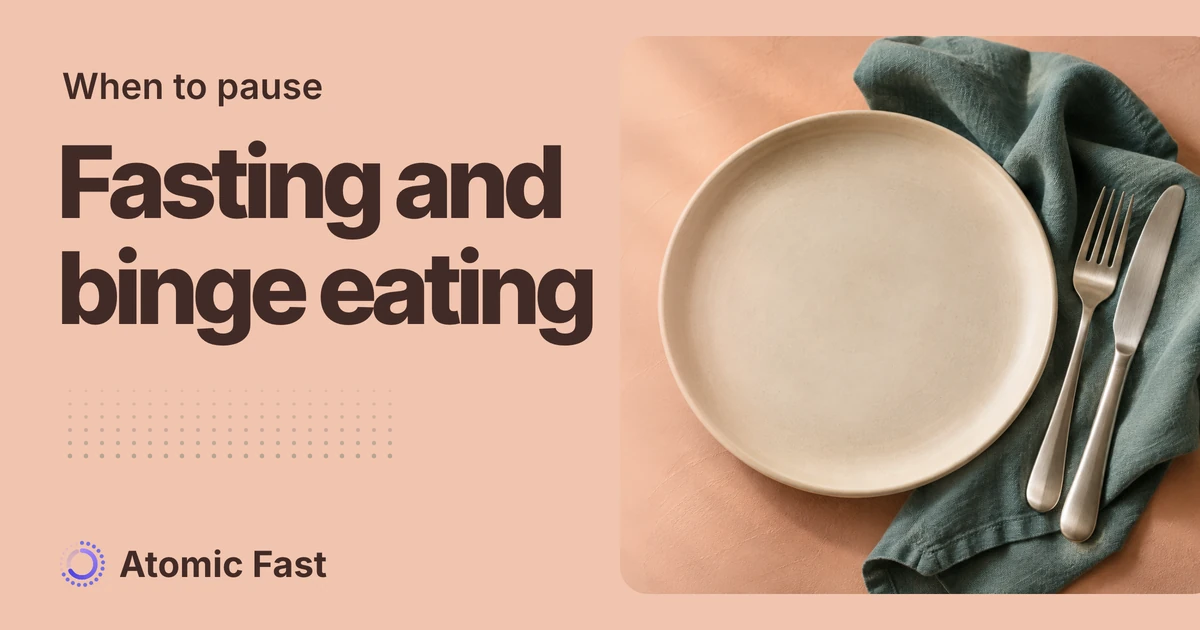
You finish a fast, start eating, and feel unable to stop. Later, you think about making the next fast longer to make up for it. If that sounds familiar, the question isn’t just whether you chose the right eating window. It’s whether the routine is becoming part of a pattern that needs support.
Research doesn’t give a simple yes or no about fasting causing binge eating. It does give reasons to be careful about claims that fasting either causes an eating disorder in everyone or has been proved safe for people who struggle with one.
The short version
Fasting may contribute to a difficult eating pattern for some people, but the studies discussed here cannot establish that intermittent fasting causes binge eating disorder. A survey found more eating-disorder symptoms among fasters, while short intervention studies reported improvements in some questionnaire scores. Those findings concern different populations, study designs and outcomes, so they neither cancel each other out nor establish safety. If eating feels out of control or fasting becomes a way to compensate for eating, pause the fasting routine and speak with a healthcare professional.
What counts as a binge
A large meal alone doesn’t establish that a binge happened. The National Institute of Diabetes and Digestive and Kidney Diseases (NIDDK) describes binge eating as eating an unusually large amount in a short period while feeling unable to control the eating. The loss-of-control part matters.
Eating without hunger is a different description. Someone might eat a slice of birthday cake because it’s a celebration and still feel in control. That example isn’t a diagnosis either way; it shows why a study measuring reasons for eating cannot automatically tell us about binge episodes.
NIDDK describes recurrent episodes at least weekly for three months as a pattern that may indicate binge eating disorder. You don’t have to wait three months, or meet a particular frequency, before asking for help. Distressing loss of control deserves attention even when you’re unsure how to name it.
Other symptoms include eating quickly, eating to uncomfortable fullness, secrecy or embarrassment, and distress afterward. NIDDK also notes that unhealthy restriction, including skipped meals or too little food, may contribute to binge eating for some people. That is a reason for caution, not proof that every eating window causes an eating disorder.
What a survey can tell us
A 2024 online survey in Poland included 214 people aged 16 to 65. Ninety-eight reported fasting. Recruitment spread through researchers’ social-media contacts and participants’ friends; 87% of respondents were women.
Fasters had higher average scores on eating-disorder and orthorexia questionnaires. Orthorexia here refers to problematic preoccupation with eating “healthily,” assessed with a questionnaire rather than a clinical diagnosis. The between-group effects were small. The eating-disorder measure covered several attitudes and behaviors, so its total score wasn’t a count of binge episodes.
The survey measured fasting and symptoms at the same time. It couldn’t establish whether fasting preceded the symptoms, whether people already struggling with food were drawn to fasting, or whether other differences explained the association. Its statistical model did not resolve that timing problem. The sample also wasn’t representative of everyone who fasts.
These are warning signals worth investigating. They cannot supply an individual’s risk estimate or prove a chain from fasting to an eating disorder.
Reading the evidence
Four papers.
Three study designs.
What was compared changes what a result can tell us.
Cross-sectional survey
214 respondents · Poland, 2024
Fasters reported higher symptom scores.
Limit Fasting and symptoms measured together: which came first is unknown.
Before-and-after studies
59 completers / 8 weeks · 30 completers / 4 weeks
Some eating-related scores improved.
Limit No comparison group: the change cannot be attributed to fasting alone.
Randomized comparison
120 adults with type 2 diabetes · 24 weeks
Both supported diet programs improved scores versus control.
Limit Adding an eating window showed no statistically clear advantage. That does not establish equivalence.
Different outcomes and populations prevent a simple “safe or unsafe” verdict.
What intervention studies can tell us
Giving volunteers a schedule isn’t, by itself, enough to establish what the schedule caused. A randomized comparison is different from measuring one group before and after an intervention.
Alternate-day fasting without a comparison group
In a 2015 Chicago study, 74 adults with obesity began eight weeks of modified alternate-day fasting and 59 completed it. Participants received food for the restricted days and ate freely on alternating days. This was a particular research protocol, not a standard daily eating window.
Among completers, the average binge-eating questionnaire subscale fell from 33 to 30 points. Restrictive-eating scores rose from 26 to 31. A lower symptom score isn’t evidence of recovery from a diagnosed disorder, and greater restriction shouldn’t automatically be treated as a benefit for someone concerned about binge eating.
There was no control group. Fifteen people didn’t finish, including six who couldn’t comply with the diet. Changes among completers therefore cannot establish safety for everyone who began, much less everyone considering fasting. One author disclosed a book about alternate-day fasting.
A randomized trial with substantial clinical support
A 2026 trial in Tehran randomized 120 adults with type 2 diabetes to calorie-and-carbohydrate restriction, the same approach with a 10 am–6 pm eating window, or control. The two active programs included exercise and structured behavioral support, with an intensive first 12 weeks followed by maintenance through week 24.
Both active groups improved on an eating-disorder questionnaire compared with control. The window group had a numerically larger improvement, but its difference from the other active group was not statistically significant. That does not prove the approaches were equivalent or that adding a window was harmless for every participant.
The paper assessed broader eating-related attitudes, not recovery from binge eating disorder. Its intensive support also limits what it tells us about fasting alone. A correction concerned author affiliations only. The report contains inconsistent follow-up counts; 120 is the randomized sample, and its stated analysis included all randomized participants.
Eating without hunger is not a binge-eating outcome
A 2026 study of young women followed 36 enrolled participants, of whom 30 completed four weeks. They chose a ten-hour eating window ending by 8 pm. Eligibility included dietary restraint; anyone with a past or current eating-disorder diagnosis was excluded.
Phone surveys asked about eating and reasons for it five times daily. Among occasions when participants ate, the estimated odds of eating without hunger were lower during the intervention than at baseline: odds ratio 0.48 in week one and 0.46 in week four. These are odds of a reported behavior, not the amount eaten, intensity of hunger or chance of binge eating.
One uncontrolled four-week study
Eating without hunger:
lower odds, a limited answer.
Among reported eating occasions, compared with the baseline week.
95% confidence interval: 0.32–0.71
95% confidence interval: 0.29–0.71
Odds ratio · dashed line at 1 means equal odds
It does not measure the amount eaten, hunger intensity or recovery from an eating disorder.
36 enrolled, 30 completed. No control group. Past or current eating-disorder diagnosis excluded.
A separate analysis included every check-in, even those reporting no eating. It found lower rates outside the window and early in it, but no statistically clear difference at later check-ins. That analysis partly reflects reduced opportunities to eat. It cannot be used to claim that hunger or binge urges were halved.
The study had no control group and used one-sided tests for some outcomes. Its short duration, selected participants and exclusion of diagnosed eating disorders make it preliminary evidence. It doesn’t establish a treatment for binge eating.
Why the results don’t settle the question
Putting these papers beside each other is useful only if their differences stay visible.
The outcomes differ. A broad questionnaire score, emotional eating, eating without hunger and a binge episode aren’t interchangeable. A favorable result on one doesn’t establish a favorable result on all the others.
The people differ. A social-media sample, adults receiving diabetes care and young volunteers without an eating-disorder diagnosis represent different circumstances. These studies don’t establish whether fasting is safe for someone with recurrent loss-of-control eating or a history of binge eating disorder.
The comparisons differ. Two intervention studies lacked a control group. In the randomized study, diet, exercise and behavioral support were combined. Neither design is a straightforward test of starting an eating window independently.
Averages and short follow-up leave gaps. Average scores can improve while some participants struggle. Four to 24 weeks doesn’t resolve long-term outcomes. Failure to detect a difference is also not proof that no meaningful difference exists.
You don’t need to establish that fasting caused the problem before changing a routine that feels harmful. Seeking support is a practical response to what is happening, not a verdict on the entire research literature.
When to pause fasting and seek support
NHS guidance recommends seeing a GP if you think you may have binge eating disorder. You can also describe the behavior without naming a diagnosis: “I keep feeling unable to stop eating, and then I restrict to compensate.” A trusted person can come with you if that makes the conversation easier.
Take these experiences seriously:
- Repeatedly feeling unable to control what or how much you eat.
- Hiding eating or feeling substantial shame or distress afterward.
- Extending fasts to compensate for eating.
- Increasingly rigid food rules that are disrupting daily life.
If these fit, pause the fasting routine and ask for professional support rather than choosing a tighter or supposedly safer window. Our guide to reasons to avoid intermittent fasting gives broader safety context. A previous eating disorder is also a reason to discuss fasting with a clinician who knows your history before starting again.
Treatment can help. The NHS treatment page describes guided self-help and cognitive behavioral therapy, including planning regular meals and snacks. It advises against dieting during treatment because that can make stopping binge eating harder. A fasting app is not a substitute for that care.
If you already have Atomic Fast running
You can end an active fast before its goal on iPhone or Android. Tap End Fast, then Save & Close or Save Without Details to save the completed session. Opening the completion sheet alone doesn’t finish the save. Reaching the goal isn’t required.
The optional Add a personal note field can record what you want to remember, but it isn’t an eating-disorder assessment. You can read more about ending and saving an active fast if needed. You don’t need to keep using a timer or record detailed eating data to justify seeking help.
Frequently asked questions
Can I have a problem even if it happens less than once a week? Yes. A diagnostic frequency threshold isn’t a requirement for support. Describe the loss of control, distress or compensatory behavior to a healthcare professional, even if you’re uncertain whether it counts as a binge.
Does eating when I’m not hungry mean I binged? No. Eating without hunger doesn’t establish the unusually large amount and loss of control involved in a binge episode. It’s one reason the phone-survey study cannot answer whether fasting treats binge eating.
Should I switch from 16:8 to a shorter fast? These studies don’t identify a safer fasting duration for someone experiencing loss-of-control eating. Pause the routine and seek support rather than trying to solve that pattern with another timing target.
Can I try fasting after recovering from an eating disorder? Discuss it with a clinician who understands your history. The evidence reviewed here doesn’t establish safety after recovery, and the young-women study explicitly excluded a past or current eating-disorder diagnosis.
Can Atomic Fast tell whether my eating pattern is safe? No. A saved fast, goal completion or note isn’t a clinical assessment. If timing or tracking is adding distress, you can stop using it and discuss that with a professional.
Sources and product notes
Sources checked: November 15, 2026. The four research papers below were read in full text; this is an evidence review, not a medical review.
- NIDDK, Definition and facts for binge eating disorder — Definition, diagnostic frequency context and compensatory fasting. Last reviewed May 2021; does not diagnose an individual reader.
- NIDDK, Symptoms and causes of binge eating disorder — Warning signs and the possible contribution of unhealthy restriction. Last reviewed May 2021; not a trial of eating windows.
- Domaszewski and colleagues (2024), Examining associations between fasting behavior, orthorexia nervosa, and eating disorders — Cross-sectional survey, 214 respondents; small questionnaire differences, convenience sampling and no established causal direction.
- Hoddy and colleagues (2015), Safety of alternate day fasting and effect on disordered eating behaviors — Eight weeks, 74 starters and 59 completers; questionnaire changes without a comparison group. An author disclosed a fasting book.
- Mohammadpour and colleagues (2026), Intensive lifestyle modification with or without time-restricted feeding in type 2 diabetes — Randomized sample of 120; 24-week eating-disorder questionnaire outcomes, combined interventions and nonsignificant differences between active groups. Follow-up counts are inconsistent in the report. Its linked affiliation correction was checked and did not revise results.
- Vizthum and colleagues (2026), Four-week time-restricted eating and dysregulated eating among emerging adult women — Single-arm study; 36 enrolled, 30 completed. Figure estimates come from the eating-occasion model, not the all-check-in analysis. Past/current eating-disorder diagnosis excluded; abstract and results differ on completer count, so the results count is used.
- NHS, Binge eating disorder overview — Recognizing a problem and asking a GP for help. Last reviewed July 2023; care pathways vary by location.
- NHS, Treatment for binge eating disorder — Guided self-help, CBT, regular eating and avoiding dieting during treatment. Last reviewed July 2023; treatment guidance, not a fasting comparison.
Product behavior checked November 15, 2026 in current iPhone and Android source code: End Fast opens the completion sheet; its save actions complete the record without requiring the goal to be reached. No mobile runtime walkthrough or clinical validation was performed.
Atomic Fast is available on the App Store and Google Play. It is a tracking app, not treatment for an eating disorder.
This article is for general education and isn’t medical advice. If you’re pregnant, managing a health condition, taking medication, have a history of disordered eating, or are considering fasts longer than 24 hours, talk to a healthcare professional first.
Try Atomic Fast free
Track your fasts, log your meals, and see how they affect each other, on iPhone and Android.


 Scan to download