How to Get Enough Protein on Intermittent Fasting
Can you eat enough protein in an 8-hour window? What the research says about daily targets, the 30-gram-per-meal myth and keeping muscle when you eat fewer meals.
By Nazmul Hasan Rupok Published 13 min read

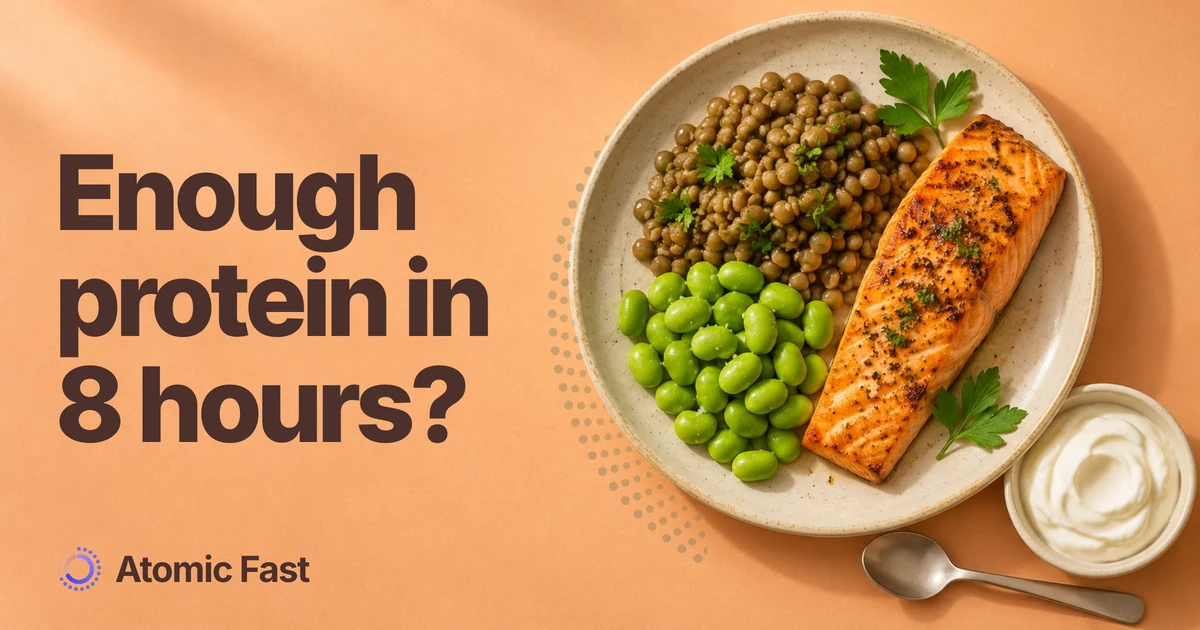
Skip breakfast and you lose one of your three chances to eat protein. Then the gym crowd chimes in: your body can only use about 30 grams at a sitting, so two big meals waste half of it, and an eating window will slowly cost you muscle.
That last claim gets repeated more confidently than the evidence behind it. The research points somewhere more useful: the daily total deserves attention, and fewer meals can make that total harder to reach.
The short version
An eight-week trial found lean-mass gains in women eating in a short window and lifting, but it does not establish that meal timing makes no difference. The often-quoted 30-gram ceiling confuses a short lab measurement with a limit on what your body can use. A 2023 trial found a larger, longer muscle protein synthesis response to 100 grams than to 25 grams after exercise. That does not prove two large meals are best over months. Start with a suitable daily protein target, then plan how it will fit into your meals.
How much protein you’re actually aiming for
The US and Canadian recommended dietary allowance for adults is 0.8 grams of protein per kilogram of body weight per day. The definition of an RDA is an average daily intake sufficient for nearly all healthy people in a life-stage group. It is not each person’s minimum requirement or a target specifically designed to maximize muscle growth.
For people who lift, the most-cited estimate comes from a 2018 meta-analysis in the British Journal of Sports Medicine that pooled 49 randomized trials with 1,863 participants doing resistance training for at least six weeks. Protein supplements added a modest 0.30 kg of fat-free mass on average. The authors estimated a leveling-off near 1.62 g/kg per day, with a wide confidence interval of 1.03 to 2.20. But that particular statistical model did not reach conventional significance (p = 0.079). Treat it as an uncertain estimate across studies, not a firm threshold for your body. The authors suggested that some people trying to maximize gains might choose a higher intake, but the review did not establish that everyone needs 2.2 g/kg.
For an adult doing resistance training, about 1.6 g/kg can therefore be a useful planning example. A 70 kg person (about 154 lb) would reach 112 grams a day at that intake. That is the example used below, not a prescription for every reader. The review excluded energy-restricted diets, so its estimate does not settle the best target during weight loss either. If you have a medical condition or need help choosing a target, discuss it with a clinician or dietitian before trying to fit a number into a fasting schedule.
Where the 30-gram ceiling came from
Earlier studies gave people different protein doses after exercise and measured muscle protein synthesis for a few hours. Around 20 to 25 grams of a fast-digesting protein seemed to max out the response in young adults, and extra amino acids showed up as more oxidation. That turned into a rule of thumb: spread protein evenly, about 25 to 30 grams a meal, because the rest is wasted.
A 2018 review by Schoenfeld and Aragon pushed back. Doses above 20 grams do increase oxidation, they wrote, but not all of the extra protein is burned, and slower proteins eaten with other food are absorbed over a longer stretch. Still, their practical suggestion was to eat about 0.4 g/kg per meal across at least four meals. Four meals may be awkward inside an eight-hour window, especially if work or appetite leaves room for only two.
Then a 2023 trial in Cell Reports Medicine tested a much larger dose. Thirty-six healthy young men did a full-body workout and then drank 0, 25 or 100 grams of milk protein, with researchers tracking where the amino acids went for 12 hours. The 100-gram dose produced a larger and longer response: myofibrillar protein synthesis was about 20% higher than with 25 grams in the first four hours and about 40% higher from hours four to 12. The increase in amino acid oxidation was small relative to the increase in protein synthesis. The response still hadn’t returned to baseline at 12 hours. The authors wrote that their data offer a mechanistic explanation for why larger, less frequent meals are “a viable alternative” to smaller frequent ones.
That’s a strong finding about one afternoon in 12 young men per group. It doesn’t show that two large meals build more muscle over months.
Does spreading protein out still matter?
Some evidence says yes, at least in the short run. In a small 2014 crossover study, eight adults ate the same daily protein either spread evenly (about 30 grams at each of three meals) or skewed toward dinner (about 11, 16 and 63 grams). Over 24 hours, muscle protein synthesis was 25% higher with the even pattern, and the gap held after a week. But eight people, synthesis only, no measure of breakdown and no body-composition outcome.
Schoenfeld and Aragon noted the same tension: studies that follow body composition over weeks or months have not consistently matched what the hour-by-hour studies predict. The way to find out is to run the diet for weeks and measure lean mass, which a few trials have now done with eating windows.
What happened when lifters ate in a short window
In a 2019 trial in the American Journal of Clinical Nutrition, resistance-trained women did eight weeks of supervised lifting while eating either from breakfast through the evening (about 13 hours) or only between noon and 8 p.m. (about 7.5 hours in practice). There were three groups: normal eating, time-restricted eating, and time-restricted eating with the supplement HMB. Everyone was given whey protein and told to reach at least 1.4 g/kg a day, and all groups ended up near 1.6 g/kg. Fat-free mass rose by 2% to 3% in every group, with similar muscle growth and strength gains. Forty women were in the intention-to-treat analysis but only 24 completed per protocol, and the supplements were donated by manufacturers.
The measured gains were similar, but this was a small trial, not a test designed to prove the schedules equivalent. Food intake came from diet records, and the authors caution that self-reporting is imperfect. The result is encouraging for a trained adult who can eat enough within a window; it is much less informative for someone who is sedentary, older or struggling to eat enough.
What each study measured
A meal response is not a muscle-gain forecast
Short lab studies track how muscle responds to a meal. Longer trials track body composition. Neither measurement alone tells you the best meal pattern for your body.
Hours to days
Measured: muscle protein synthesis in the lab
-
Large dose vs moderate dose
36 young men, one workout, 12 hours
100 g gave a larger, longer response than 25 g
Trommelen 2023 · full text
-
Even vs dinner-heavy meals
8 adults, 7-day crossover
24-hour synthesis 25% higher with even meals
Mamerow 2014 · full text
Eight weeks
Measured: fat-free mass, with training throughout
-
Noon to 8 p.m. vs normal eating
40 trained women (24 per protocol), 8 weeks; protein near 1.6 g/kg in all groups
Fat-free mass rose about 2% to 3% in all groups; a small trial does not establish equivalent schedules
Tinsley 2019 · full text
Fat-free mass includes water and other non-fat tissue, so it is not a direct muscle measurement. The eight-week trial combined the eating schedule with supervised training and supplied protein; it did not isolate fasting as a muscle-building strategy.
A better-known trial is less reassuring. In the TREAT study of 16:8 without diet changes, participants had no protein target and no exercise program, and a large share of the small weight loss in the scanned subgroup was lean mass. These trials studied different people and can’t be compared directly. The contrast does not tell us how much any difference came from protein, training, age or other factors. These comparisons do not establish that the eating window itself protects muscle.
The real risk is the daily total
The practical problem is simpler. If 112 grams a day was easy across breakfast, lunch, dinner and a snack, it gets harder when the same total has to fit into two or three meals between noon and 8 p.m. Removing breakfast does not automatically redistribute its food. You have to make room for it in the meals you keep.
Illustrative example · 70 kg / 154 lb adult
The same 112 grams, split into fewer meals
70 kg × 1.6 g/kg = 112 g of protein a day. Each bar is that same total. Fewer meals in the window means each one has to carry more.
-
2 meals 56 g each
-
3 meals about 37 g each
-
4 meals 28 g each
The daily total stays the same. These are planning examples, not a recommendation to eat a particular number of meals.
Two meals means about 56 grams each in that example, which is a large portion of meat, fish, tofu or a mix of foods at one sitting. Three meals brings it to about 37 grams. The tracer study gives a reason not to dismiss a larger serving as wasted, but it does not establish that these patterns produce identical results over months. Appetite and planning still matter: a first meal of toast and coffee leaves the rest of the window to catch up.
Try the arithmetic before changing your schedule. If lunch and dinner each provide 40 grams in this illustrative 112-gram day, you still have 32 grams to find. You could change the meals, add another eating occasion, or choose a wider window that works better for you. Those numbers describe a planning gap, not the protein content of any pictured food. There is no need to force a very large dinner simply to preserve a particular fasting duration.
How much to trust this
- Most participants were young, healthy and lifting. The Cell Reports trial studied men aged 18 to 40 after a workout, and its authors note that less active or clinically compromised people respond less to amino acids. In the 2018 meta-analysis, protein supplements added less lean mass as age increased. The results may not carry over to everyone.
- Different timescales. The tracer experiments measured hours or days; the women’s training trial lasted eight weeks. These studies cannot tell you what a short eating window does to muscle over years.
- Small samples and wide intervals. The women’s window trial had 40 participants in its main analysis and 24 per protocol. Similar results in a small study are not proof that schedules are interchangeable.
- Fat-free mass isn’t muscle. DXA and bioimpedance count water and other non-fat tissue, and bioimpedance is easily thrown off by hydration.
- Industry ties. The 2019 trial received donated whey and supplement funding, one 2023 author works for a dairy company, and a 2018 meta-analysis author later disclosed a supplement-company advisory role. The papers report no role for these companies in the analysis, but readers should know.
What to do with this
- Pick a daily number first. For a healthy adult doing resistance training, the 1.6 g/kg example can help with planning. It is not a universal target, and the RDA is not simply a lower limit everyone should exceed. Check it with a clinician or dietitian if you have kidney disease, diabetes or another condition that affects your diet. NIDDK’s guidance for chronic kidney disease notes that some people with CKD need moderate protein, and too little can cause malnutrition, so this is one to plan with your care team.
- Make the first meal count. Opening the window with a substantial protein food takes pressure off dinner.
- Divide the total by your meals. If you eat twice, each meal carries half. If that’s too much food at once, a three-meal window or a protein-rich snack in the middle is a reasonable fix.
- Keep lifting. The eight-week window trial paired its meal schedule with supervised resistance training. Its result should not be credited to fasting alone. Our look at whether 16:8 burns muscle covers the training side.
- Don’t lengthen the fast to compensate. If fitting meals in is already difficult, extending the fast leaves less time to eat. A workable schedule should leave room for adequate food.
- Check the protein target in your app. In Atomic Fast, Auto Calculate Goals (under Me → Personal Details → Nutrition Goals) sets protein as a share of your calorie target (35% on the Lose setting), not in grams per kilogram. A 1,800-calorie Lose target gives about 157 grams, which is 2.2 g/kg for a 70 kg person but about 1.6 g/kg at 100 kg. If you want a weight-based number, type it into the protein field yourself. The Meals tab then shows the day’s logged protein against that target, and logged amounts are estimates, not lab measurements.
Frequently asked questions
Can your body absorb more than 30 grams of protein at once? Yes. In the 2023 trial of young men after a workout, amino acids from a 100-gram dose were still entering the blood 12 hours later. That is evidence against a fixed 30-gram absorption ceiling. The acute study does not tell us which meal pattern builds more muscle over months.
Is 16:8 bad for building muscle? An eight-week trial in trained women found similar gains with eating spread over about 7.5 or 13 hours, alongside similar protein intake and supervised lifting. It was small and does not prove the schedules equivalent. Do not let the window crowd out adequate food or treat it as a substitute for training.
Should I take a protein shake during my fast? A shake has calories and protein, so it ends the fast by most definitions. If you want one, drink it inside your window, often as part of the first meal. Whether that’s useful depends on whether food alone gets you to your total.
How much protein should I eat per meal in an 8-hour window? Divide your daily target by the number of meals you’ll actually eat. For a 70 kg person aiming at 1.6 g/kg, that’s about 56 grams over two meals or 37 grams over three. These are example numbers, not a prescription.
Do I need more protein if I’m over 50? Possibly. In the 2018 meta-analysis, protein supplements added less lean mass as age increased, and few of these studies included older adults. That’s a reason not to under-eat protein, but the right amount depends on your health and kidney function, so ask a clinician or dietitian.
Sources
Sources checked: November 5, 2026.
-
Morton RW et al. (2018), A systematic review, meta-analysis and meta-regression of the effect of protein supplementation on resistance training-induced gains in muscle mass and strength in healthy adults, British Journal of Sports Medicine — Full text. 49 RCTs, 1,863 healthy adults doing resistance training for 6 weeks or more. Supports the 0.30 kg fat-free-mass effect and an uncertain estimated 1.62 g/kg/day breakpoint (95% CI 1.03 to 2.20; model p = 0.079). Supplementation trials in lifters; energy-restricted diets excluded; a 2020 correction added an author’s supplement-company advisory role.
-
Trommelen J et al. (2023), The anabolic response to protein ingestion during recovery from exercise has no upper limit in magnitude and duration in vivo in humans, Cell Reports Medicine — Full text. 36 young men randomized to 0, 25 or 100 g milk protein after one workout, measured for 12 hours. Supports the larger, longer response with 100 g and minimal oxidation change. Acute, single session, men aged 18 to 40; one author employed by FrieslandCampina.
-
Schoenfeld BJ, Aragon AA (2018), How much protein can the body use in a single meal for muscle-building? Implications for daily protein distribution, Journal of the International Society of Sports Nutrition — Full text. Narrative review supporting the origin of the 20 to 25 g figure, the point that extra protein isn’t all oxidized, the 0.4 g/kg per meal across four meals suggestion, and the gap between acute and longer-term studies. Opinion-level synthesis; predates the 2023 trial.
-
Mamerow MM et al. (2014), Dietary protein distribution positively influences 24-h muscle protein synthesis in healthy adults, Journal of Nutrition — Full text. Eight adults, 7-day crossover of even versus dinner-heavy protein; 24-hour synthesis 25% higher with even meals. Tiny, synthesis only, no body-composition outcome.
-
Tinsley GM et al. (2019), Time-restricted feeding plus resistance training in active females: a randomized trial, American Journal of Clinical Nutrition — Full text. 40 women (ITT), 24 per protocol, 8 weeks of supervised training; noon to 8 p.m. window versus normal eating with protein about 1.6 g/kg in all groups. Supports similar fat-free-mass gains. Small; whey was supplied; industry funding and in-kind supplements disclosed.
-
Lowe DA et al. (2020), The TREAT Randomized Clinical Trial, JAMA Internal Medicine — Full text and the journal’s correction record checked November 5, 2026. Supports the comparison with a timing-only intervention; body scans were limited to 50 participants initially and 46 completers. Protein intake was unmeasured, and the total lean-mass difference between groups was not statistically significant.
-
National Institute of Diabetes and Digestive and Kidney Diseases (accessed 2026), Healthy Eating for Adults with Chronic Kidney Disease — Supports the advice that some people with CKD need moderate protein and should plan intake with a dietitian. General guidance.
-
NIH Office of Dietary Supplements, Nutrient Recommendations and Databases — Defines the RDA as an intake sufficient for nearly all healthy individuals, rather than each person’s minimum. Checked November 5, 2026.
-
Atomic Fast nutrition goals — Manual protein goals, calorie-based auto-calculation and the Meals protein total were verified against current iOS and Android code and product documentation on November 5, 2026. Logged nutrients are estimates; an app target is not an assessment of your individual protein requirements. No device walkthrough or medical review was performed.
Track your eating window, meals and protein with Atomic Fast on the App Store or Google Play.
This article is for general education and isn’t medical advice. If you’re pregnant, managing a health condition, taking medication, have a history of disordered eating, or are considering fasts longer than 24 hours, talk to a healthcare professional first.
Try Atomic Fast free
Track your fasts, log your meals, and see how they affect each other, on iPhone and Android.


 Scan to download