How to Fast Around Dinners Out, Drinks and Weekends
How to adapt an eating window for dinners out, drinks and weekends, with practical examples, research limits and ways to return to your usual routine.
By Nazmul Hasan Rupok Published 12 min read

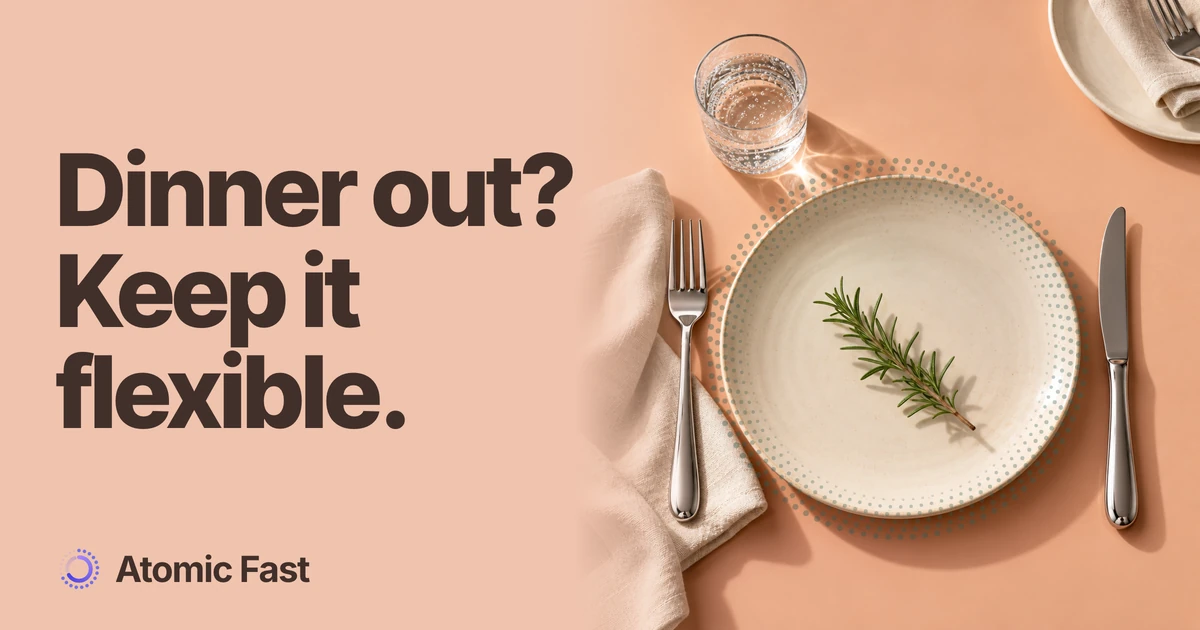
Your window closes at 8. The table is booked for 8:30, someone orders a bottle of wine, and dessert lands around 10. You can sit there with sparkling water, eat anyway and feel you’ve blown it, or decide in advance what the evening is going to be. The clock and the invitation don’t always agree.
The short version
Social plans commonly disrupt eating windows in research. For a late dinner, you can move the window, widen it, or set it aside and return to your routine afterwards. Studies haven’t tested which option works best, and moving the first meal later can lengthen the preceding fast. If you take insulin or another medicine that can lower blood sugar, plan changes to eating times with your care team.
What actually gets in the way
Researchers at the Salk Institute went through 66 published time-restricted eating trials and found that only 10 described what made the schedule hard to follow. In 8 of those 10, social commitments were on the list. Among trials that reported it, the share of days on which people kept to their window ranged from 47% to 95% (O’Neal et al., Frontiers in Nutrition, 2023).
A qualitative review adds participants’ perspectives. A systematic review of 13 qualitative studies, covering 225 people, including 22 health professionals and dietitians, found social life was the barrier both men and women raised most often: meals at friends’ houses, restaurants, gatherings and holidays. The reviewers rated their confidence in most of these themes as moderate (Fernández-Rodríguez et al., Obesity Reviews, 2026).
A 12-week London study of 50 adults with obesity, who chose their own eight-hour window, gives a more specific picture. The most common barriers were dining out, having visitors and drinks after work, and those barriers tended to grow over the 12 weeks. By the end, 29 of the 50 were still keeping to the window on at least five days a week (Przulj et al., PLOS ONE, 2021).
What the studies recorded
What adherence research actually counts.
Two studies, two different questions. One counts trial reports; the other counts people following a window.
8 of 10 trials that reported barriers listed social commitments among them.
29 of 50 people were still keeping their window on at least 5 days a week at week 12.
These are descriptions, not effects. None of the counts shows what a missed evening does to results, and these are not pooled results. The first counts reports of barriers; the second uses self-reported adherence.
A shared meal has a social timetable as well as a start and finish. Planning around the people you’re eating with can make more sense than trying to negotiate a new rule over dessert.
A missed window is not a failed plan
One late dinner doesn’t tell you whether a routine is useful over weeks or months. The London study counted at least five days a week as adherence, even though participants were asked to follow the window daily. That was a research definition, not an instruction to fast on weekdays and stop at weekends.
There were also missing follow-ups: 39 of the original 50 people provided data at week 12. The headline figure of 29 adherent participants uses all 50 as its denominator. It isn’t a success rate from a trial comparing flexible and rigid schedules.
These distinctions matter when you see claims about “consistency.” None of the studies below measured the effect of one birthday dinner, or established how many nights off preserve a particular benefit. You can decide how to handle an invitation without pretending the research provides that level of precision.
Three ways to handle one late dinner
Plan the evening before you sit down. Planning in advance was the most common facilitator in the London study, and a recurring strategy in the trials the Salk review summarized (Przulj et al., 2021; O’Neal et al., 2023). There are three reasonable options.
Move the window later. For example, noon to 8 pm could become 2:30 pm to 10:30 pm: both are eight hours. But if you last ate at 8 pm the previous night, waiting until 2:30 pm would extend that fast to 18½ hours. Moving the window is optional. Keep your usual meal if delaying it would leave you unwell, unusually hungry, or conflict with medication; use a wider window or take the evening off instead.
Widen the window for one night. Keep your usual first meal and let the window stretch to cover dinner. Noon to 10:30 pm is a 10½-hour window. This keeps the first meal in place while making room for dinner. It changes the day’s eating-window length; it hasn’t been shown to produce the same effects as your usual schedule.
Take the night off. You may prefer to set aside the window for a wedding, a holiday meal, a friend’s birthday. Decide that beforehand, enjoy it, and start your usual routine the next morning. Several interviewees in the qualitative review described exactly this kind of flexibility for special occasions as what made the schedule sustainable (Fernández-Rodríguez et al., 2026).
Illustrative example · one late dinner
Three ways to fit a dinner that ends at 10:30 pm
The usual window here is 12 pm to 8 pm. Dinner is booked for 8:30 and finishes around 10:30.
Usual day 12 pm to 8 pm · 8 hours
Move the window 2:30 pm to 10:30 pm · 8 hours
Widen it for one night 12 pm to 10:30 pm · 10 hours 30 minutes
Or take the night off
Enjoy dinner without a window target, then return to your ordinary meals and routine when it suits you.
The next morning needs no make-up fast. 10:30 pm to 12 pm is 13 hours 30 minutes. This is an example, not a minimum to reach.
Whichever you choose, the next morning needs no make-up fast. A dinner that ends at 10:30 followed by your usual noon start gives a 13½-hour overnight fast. That is an example of the timing, not a minimum you need to reach. Eat earlier if you need to, and don’t use a longer fast to compensate for dinner.
If you’re new to eating windows, picking one you can keep can help you build a practical routine. A window that already includes your usual dinner time may need fewer adjustments.
Weekends and regular social nights
A one-off dinner is easy to plan around. A Friday every week is a pattern, and patterns deserve a decision.
Research on regular timing is worth keeping separate from advice about one dinner. A French observational study followed 104,806 adults for a median of 8.1 years. It measured the absolute weekend–weekday difference in the midpoint between the first and last eating occasions, not just the time dinner ended. Each extra hour was associated with a higher rate of cardiovascular disease overall (hazard ratio 1.08, 95% CI 1.02 to 1.14). After sleep adjustment in a smaller sample, the estimate was 1.07 (0.99 to 1.15), which was not statistically significant (Le Folcalvez et al., Communications Medicine, 2026).
The association was statistically significant in men but not women. However, the test for a difference between the sexes was not significant either, so the paper doesn’t establish a male-only effect. Hazard ratios describe relative rates over follow-up, not an individual’s absolute risk.
The researchers assumed weekends were days off, lacked actual work schedules, and studied volunteers who weren’t representative of the general population. These findings cannot show that shifting a Saturday window causes heart disease, or tell you how far it is safe to move one. A predictable routine can simplify planning; a heart-protection claim needs stronger evidence.
The London study offers some encouragement here. Participants’ problems with planning and sticking to the window on weekends decreased over the 12 weeks, even as the social occasions got harder (Przulj et al., 2021). That describes participants’ reports over time, rather than proof that any particular planning strategy worked.
For a regular social evening, a practical approach is to give that day a later or longer window as part of the plan, rather than treating it as an exception you have to recover from every week.
Drinks, and what counts as eating
Drinks after work were one of the most common barriers in the London study. Alcohol has calories, as do most mixers, so a glass of wine or a beer belongs inside your eating window. Water, sparkling water, and black coffee or plain tea are the usual zero-calorie options during a fast, and the list of what breaks a fast covers the grey areas such as diet soda.
If you take insulin or certain other diabetes medicines, alcohol needs extra care. The National Institute of Diabetes and Digestive and Kidney Diseases lists drinking too much alcohol without enough food as a cause of low blood glucose, and advises eating some food when you drink (NIDDK). In that situation, drinking during a fast is a poor plan. Talk to your care team before combining fasting with alcohol or changing your meal times around medication.
Telling the people you eat with
In the qualitative review, support from partners, family and friends emerged as a key facilitator in most accounts (Fernández-Rodríguez et al., 2026). In one trial summarized by the Salk review, spouses changed their own eating times to match the participant’s schedule (O’Neal et al., 2023).
You don’t need to announce a diet at every dinner. Telling the people you eat with most often, especially a partner or housemates, makes shared meals easier to plan. If a host keeps offering food, you can accept it, politely decline, or ask for water or plain tea. You don’t owe anyone a detailed explanation. Decide what suits you rather than treating either the host’s wishes or a timer as an obligation.
How much to trust this
The evidence describes real difficulties, with important limits.
- No one tested these strategies. None of the studies compared moving, widening or skipping a window around social events. The three options above are reasonable applications of what participants described, not a proven protocol.
- Most of it is self-report. Adherence was mostly recorded by participants themselves, and interview studies tend to attract motivated volunteers. The qualitative review’s authors list both as limitations.
- The London study had no control group. It was a single-arm pilot of 50 people, with 39 providing week-12 follow-up. It cannot compare the benefits of flexible and rigid schedules.
- Barrier counts depend on what was asked. Only 10 of the 66 trials in the Salk review reported barriers at all. Social plans being the most mentioned barrier doesn’t mean they’re the most important one for you.
- The weekend finding is observational. It does not prove cause and effect or a difference between men and women, and actual work schedules were unavailable.
What to do with this
- Decide before you go. Choose between moving, widening or setting aside that day’s window. Avoid delaying a needed meal just to make the times fit. A decision made at 10 pm with dessert in front of you is harder.
- Keep the next morning normal. Return to ordinary meals and your usual routine when it suits you. There’s no fast to make up.
- Make regular evenings part of the plan. If Friday dinner happens every week, give Friday a later window in advance rather than counting it as a failure every time.
- Use the app’s start options for a late night. In Atomic Fast on iOS and Android, open More fasting options next to the main start button, choose a goal, then choose a start option. Since Last Meal backdates the timer to your latest eligible recorded meal time: less than 12 hours ago and not before the previous fast ended. It may be unavailable. Schedule for Later sets a one-time start up to 24 hours ahead; it isn’t a recurring schedule. If you already started a fast too early, you can edit its start time instead of abandoning it.
If you keep a streak in the app, it counts consecutive local dates with a completed fast ending on them. A night off can leave a gap, depending on those end dates. That count is a record of what you did, not a measure of your health. Don’t extend a fast or skip a celebration just to protect a number.
Frequently asked questions
Is it better to skip the dinner or skip the fast? Neither is required. You can usually shift or widen that day’s window to include the dinner. If you’d rather eat freely for the evening, start your normal routine the next day. Skipping a meal you’d enjoy to keep a perfect record isn’t what the habit is for.
Do I need to fast longer the next day to make up for it? No make-up fast is required. The studies here did not test compensating for dinner with extra fasting. Return to ordinary meals and your usual routine without delaying food you need; follow your care team’s advice if you have a medical eating plan.
Can I fast on weekdays only? The London study asked people to follow the window daily; its five-day adherence threshold wasn’t a weekdays-only treatment. The research reviewed here cannot establish that weekdays-only fasting and daily fasting have equivalent effects. Choose a manageable routine and discuss medical constraints with your care team.
Does a glass of wine break a fast? Yes. Wine, beer and spirits contain calories, so treat them as part of your eating window. If you use insulin or another medicine that can cause low blood sugar, don’t drink without food, and check with your care team before combining alcohol and fasting.
How do I explain fasting to friends without making it a thing? A short, plain answer usually works: you’re eating later today, or you’d like water or plain tea. Telling the people you eat with regularly saves explaining at every table.
Sources
Sources checked: October 29, 2026.
- O’Neal MA, Gutierrez NR, Laing KL, Manoogian ENC, Panda S (2023), Barriers to adherence in time-restricted eating clinical trials: An early preliminary review, Frontiers in Nutrition 9:1075744 — Full text read. Supports the 66-trial count, the 10 trials reporting barriers, social commitments in 8 of them, the 47% to 95% adherence range and the participant strategies it summarizes. A non-systematic mini review of mostly small trials; its account of weekend adherence in the Przulj study conflicts with the original paper.
- Fernández-Rodríguez R, Boira-Nacher B, Visier-Alfonso ME, Torres-Costoso A, Martínez-Vizcaíno V, Ruiz JR (2026), Understanding Participants’ and Health Professionals’ Perceptions and Experiences of Time-Restricted Eating: A Systematic Review of Qualitative Evidence, Obesity Reviews 27(5):e70061 — Full text read via PMC (PMC13070892). PROSPERO CRD420250649633. Supports social life as the most frequently reported barrier, flexibility and support as facilitators, and the moderate GRADE-CERQual confidence. Thirteen studies, only two from randomized trials, with motivated self-selected participants.
- Przulj D, Ladmore D, Myers Smith K, Phillips-Waller A, Hajek P (2021), Time restricted eating as a weight loss intervention in adults with obesity, PLOS ONE 16(1):e0246186 — Full text read. Supports the 50-person cohort, 29 of 50 adherent on at least five days a week at 12 weeks (39 provided follow-up), the social barriers and the decrease in weekend problems. Single-arm pilot without a control group; adherence self-reported.
- Le Folcalvez X, Obeid E, Palomar-Cros A, et al. (2026), Eating jetlag based on meal timing discrepancies and risk of cardiovascular disease using the prospective cohort NutriNet-Santé, Communications Medicine 6:453 — Full text read. NCT03335644. Supports the eating-midpoint exposure and overall hazard ratios before and after sleep adjustment. The sex interaction was not significant (p = 0.3); subgroup significance does not establish a sex difference. Observational; weekends assumed to be days off; volunteers not representative of the French population.
- National Institute of Diabetes and Digestive and Kidney Diseases, Low Blood Glucose (Hypoglycemia) — Clinical guidance page read. Supports alcohol without enough food as a cause of low blood glucose in people taking insulin or some diabetes medicines, and the advice to eat when drinking.
Product notes: the Since Last Meal and Schedule for Later start options, start-time editing and the streak rule were checked against Atomic Fast’s current iOS and Android source and the product capability reference. This was not a device walkthrough.
Keep a record of your fasting times with Atomic Fast on the App Store or Google Play.
This article is for general education and isn’t medical advice. If you’re pregnant, managing a health condition, taking medication, have a history of disordered eating, or are considering fasts longer than 24 hours, talk to a healthcare professional first.
Try Atomic Fast free
Track your fasts, log your meals, and see how they affect each other, on iPhone and Android.


 Scan to download