Should You Walk After Breaking Your Fast?
Can walking after a meal lower its blood sugar rise? See what small trials show about timing, ten-minute walks and the limits of applying this to fasting.
By Nazmul Hasan Rupok Published 12 min read

You’ve finished the meal that ends your fast, and the couch is right there. Somebody says ten minutes on your feet will “flatten the spike.” Does a walk really change the meal’s glucose response, and how much does its timing matter?
The short version
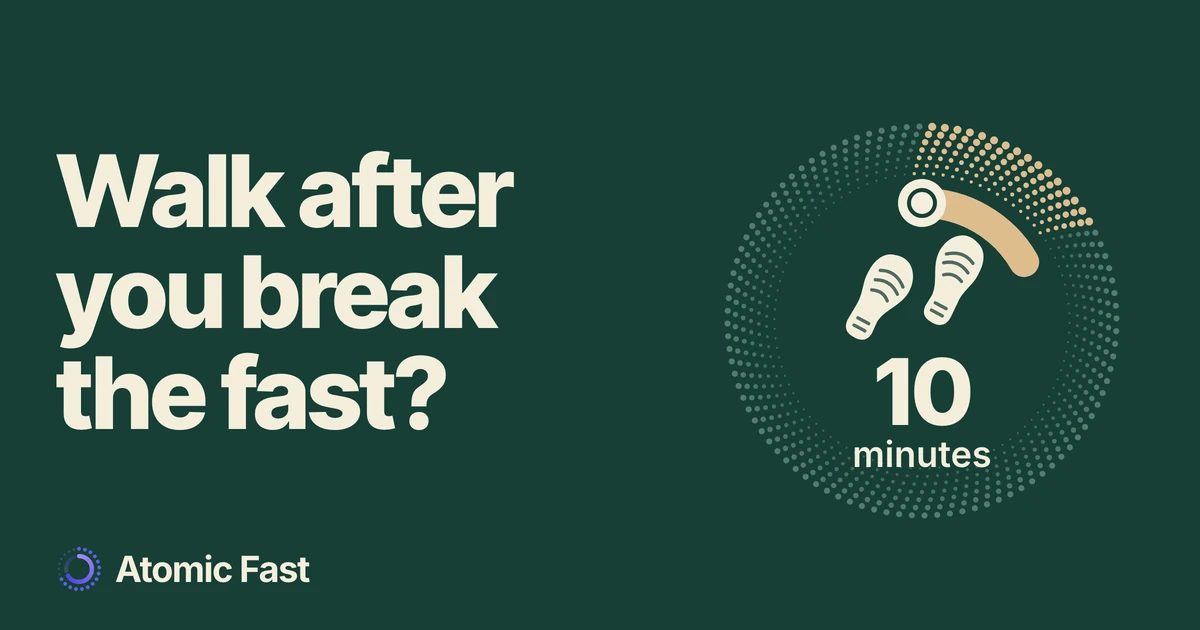
A short walk after eating can be a useful habit if it suits your health and mobility. In 41 adults with type 2 diabetes, ten minutes after each main meal reduced the total three-hour glucose rise by 12% versus one daily 30-minute walk, with the clearest result after dinner. Smaller trials favor walking soon after eating over walking beforehand. Ten minutes is a tested routine, not a proven minimum; these studies did not test a 16:8 regimen or establish long-term health benefits.
Why the meal that ends a fast gets the attention
If your first meal follows a long stretch at a desk, a short walk can be an easy way to break up the sitting. But the meal that ends a fast isn’t automatically your largest meal, and it doesn’t need a special glucose-lowering ritual. The relevant research compares activity around meals; it doesn’t establish an extra benefit from pairing a walk with intermittent fasting. For the eating window itself, see what 16:8 does to blood sugar.
Walking is relevant because working muscle takes up glucose. When you move while sugar from a meal is arriving in your blood, some of it can be used straight away. Before a meal, the same walk mostly draws on stored fuel, which is one explanation researchers give for why timing seems to matter (Engeroff et al., 2023). Treat that as a plausible mechanism, not a measured one in your body.
What the walking trial found
The most practical study comes from the University of Otago in New Zealand. Andrew Reynolds, Jim Mann and colleagues randomized 42 adults with type 2 diabetes; 41 completed both periods, with an average age of 60. Participants received two sets of walking advice for two weeks apiece, in random order, with a 30-day break in between (Reynolds et al., 2016).
Both sets of advice added up to 30 minutes of walking a day. One said to walk 30 minutes at any time. The other said to walk for 10 minutes after each of the three main meals, starting within five minutes of finishing. People ate their usual food and lived their normal lives. A continuous glucose monitor sampled every five minutes for a week of each period, and an accelerometer recorded how much people moved.
The main outcome was the total glucose rise above the pre-meal level over three hours, measured from the start of the meal. This incremental area under the curve (iAUC) captures both the height and duration of the rise; it is not just the highest glucose reading. With post-meal walks, that rise was 12% smaller on average (95% confidence interval 1% to 22%). The difference was concentrated after dinner, where the rise was 22% smaller (9% to 33%). Dinner was the meal with the most carbohydrate, and the accelerometers showed it was also when people sat the most. After lunch and breakfast the estimates pointed the same way, but the confidence intervals included no difference.
Two-week crossover trial · 41 adults with type 2 diabetes
Ten minutes after each meal, or one 30-minute walk
Total glucose rise above baseline over three hours from the start of a meal on the post-meal walking plan, shown as a ratio of the rise on the once-a-day plan. Below 1.0 means a smaller rise after post-meal walks. Lines show 95% confidence intervals.
All meals 0.88 (0.78 to 0.99) 12% smaller rise
Breakfast 0.87 (0.72 to 1.05) Interval includes no difference
Lunch 0.94 (0.80 to 1.10) Interval includes no difference
Dinner 0.78 (0.67 to 0.91) 22% smaller rise
← Smaller rise with post-meal walksLarger rise →
Minutes spent walking in the hour after dinner
- Post-meal plan
- 11.4 min
- 30-minute plan
- 6.8 min
Part of the dinner result may simply be that people walked more. In the hour after dinner, participants walked about 11 minutes during the post-meal period versus about 7 minutes on the 30-minute plan. Overall physical activity was also higher during the post-meal plan, despite equal prescribed walking time. The study therefore tests two sets of practical advice; it cannot isolate timing from how much people actually moved.
Several other measures showed no clear difference in those two weeks. Average glucose across the day, fasting glucose, glycated albumin (a two-to-three-week glucose marker), BMI, waist size and blood pressure showed no statistically significant difference between the two walking plans. The authors say plainly that two weeks was too short to know whether the smaller meal rises add up to better overall control.
Sooner after eating seems to work better than before
If muscle activity overlaps with the arrival of glucose from a meal, its timing could matter. A study from the University of Birmingham in the UK tested that directly (Solomon et al., 2020). In its walking arm, 16 healthy, active adults came in after an 8-to-10-hour overnight fast, drank a 500-calorie breakfast shake and did a 30-minute brisk walk at one of four times on separate days: right before breakfast, right after, starting 30 minutes after, or later in the day, once the two-hour measurement was over, as the comparison.
That breakfast was, in effect, the meal that broke an overnight fast, which makes this study closer to our question than most, even if the fast was shorter than a 16:8 gap. Walking right after breakfast lowered average glucose and the total glucose exposure over the next two hours compared with walking later. Walking right before breakfast, or starting 30 minutes after, didn’t produce a statistically significant change on those measures.
One lab study · 16 healthy, active adults
Same walk. Different timing.
A 30-minute brisk walk, before or after a breakfast shake. Each result is compared with walking later in the day, after the two-hour glucose measurement.
Right before
No clear difference from the comparison day
Right after
Lower average glucose and total glucose exposure
Starting 30 minutes after
No clear difference from the comparison day
Sequence shown, not a time scale. Each walking dot represents 5 minutes. Participants finished breakfast within 10 minutes.
“No clear difference” is not “no effect.” The comparison did not reach statistical significance. That alone does not tell us whether the timing has no effect or the estimate was too uncertain.
A non-significant result in 16 people isn’t proof that a delayed walk does nothing. It means this study couldn’t detect an effect at that timing. The breakfast was also a liquid shake, which empties from the stomach faster than solid food, so the best window after a normal plate could be later.
A meta-analysis pulls these timing studies together, including the Birmingham study, so it is a synthesis rather than independent confirmation. Tobias Engeroff and colleagues found eight randomized crossover trials, 116 participants in total, that compared exercise before a meal, the same exercise after it, and no exercise (Engeroff et al., 2023). Exercise after eating lowered the meal’s glucose response compared with no exercise (standardized effect 0.55, 95% CI 0.34 to 0.75) and compared with exercise before eating (0.47, 0.23 to 0.70). Exercise before the meal showed no clear effect on that meal’s glucose. Across studies, longer gaps between finishing a meal and starting to move went with smaller effects.
The authors rated the included trials at high risk of bias, the studies used different meals, exercises and delays of up to an hour, and in the diabetes subgroup the after-versus-before confidence interval included no difference. In a reply to a letter about the paper, the authors repeated that the evidence base is very small and that the best timing may differ between people (Engeroff et al., 2023).
What standing breaks can and cannot tell us
A walk after every meal isn’t realistic for everyone. Breaking up sitting during the day is a related idea with its own evidence. A meta-analysis of seven one-day lab studies, mostly in adults with overweight or obesity, compared sitting for hours with interrupting it every 20 to 60 minutes (Buffey et al., 2022). Short bouts of light walking lowered glucose and insulin after meals compared with uninterrupted sitting. Standing breaks had a smaller effect on glucose, with no clear insulin difference; light walking performed better than standing on both measures. These were controlled lab days, with varied break lengths and possible publication bias.
In the Birmingham study, standing still for 30 minutes right after breakfast also lowered total glucose exposure, though it was borderline (P = 0.05) and didn’t significantly change average glucose. That is limited support for standing breaks, not proof that washing dishes, tidying or any other household activity will have the same effect. Standing and light walking are different activities, and neither is a reason to push through feeling unwell.
How much to trust this
Taken together, these short studies favor activity after eating for reducing that meal’s glucose response. They do not show that walking before eating is useless, or that every post-meal walk will have the same effect.
- The studies are small and short. The free-living trial ran two weeks per plan. Most of the lab studies had 7 to 16 people and lasted a single day.
- The populations differ from most people who fast. The 12% figure comes from adults with type 2 diabetes, most of whom took glucose-lowering medication. The size of the effect should not be assumed to apply to people without diabetes.
- A smaller glucose rise isn’t a health outcome by itself. No study here showed lower HbA1c, weight loss or fewer heart problems from post-meal walking. Researchers consider after-meal glucose important, but that’s a separate question these studies weren’t built to answer.
- These walking trials did not test a 16:8 regimen. One used breakfast after an 8-to-10-hour overnight fast. It does not tell us whether a 16-hour gap changes the response.
- There is no evidence here of a fasting bonus. The meal has already ended the fast. These studies did not measure how walking changes ketosis or any other claimed fasting benefit.
Who should be careful
If you take insulin or a medicine such as a sulfonylurea, both fasting and extra activity can push your glucose too low. The NIH’s diabetes institute notes that activity beyond your usual routine can lower glucose for up to 24 hours afterward, and that skipping or delaying meals, or fasting while still taking glucose-lowering medicines, also raises the risk (NIDDK). Combining a fast with a new walking habit is worth planning with your care team.
Choose a pace you can comfortably manage; the studies varied in intensity, and Birmingham used brisk walking. Stop if you feel dizzy, shaky or unwell. If you are at risk of hypoglycemia, check your glucose and follow your care team’s treatment plan rather than trying to walk it off. If walking worsens reflux or abdominal discomfort, stop and let it settle. Our guide to easing heartburn while fasting covers meal size and timing if reflux is the problem.
What to do with this
- Start soon after you finish. The free-living trial asked people to start within five minutes. That is the tested instruction, not a deadline you must meet when you feel uncomfortable.
- Ten minutes is one tested routine. The free-living trial used it after each of three meals. It did not establish a minimum effective duration, or the same benefit from just one daily walk.
- Choose a meal you can pair with a walk. Dinner had the clearest result in the trial. Starting with that meal may be practical if you normally sit afterward, but the study didn’t test a dinner-only plan.
- Choose a comfortable pace. You do not need to copy a lab treadmill speed. Start with movement that suits your fitness and health, and keep your usual exercise routine too.
- Keep pre-meal walks if they suit you. The acute glucose comparisons favor walking afterward, but that doesn’t erase other reasons to walk beforehand. Our guide to fasted workouts looks at that separate question.
- Consider brief standing breaks if comfortable. They have some evidence compared with prolonged sitting, but are not an equivalent substitute for walking and are not suitable for everyone.
If you track your fasts in Atomic Fast, you can use End Fast, save the record, and then log the meal. After you log it, the app shows a “Digestion complete by” time. That’s an estimate based on when you ate and what the meal contained. It doesn’t measure your glucose, and it isn’t a cue to walk or to start the next fast. The walk, if you take one, happens away from the screen.
Frequently asked questions
Should I walk before breaking my fast instead of after? For that meal’s blood sugar, the evidence favors after. In the timing studies, exercise done just before eating showed no clear effect on the glucose rise that followed. A fasted walk can still suit you for other reasons, such as fitting your schedule or how you feel.
How long after eating should I start walking? As soon as is comfortable. The trial that showed a benefit in daily life asked people to start within five minutes, and in a lab study a walk that began right after breakfast lowered glucose while one that began 30 minutes later wasn’t measurably different. The meta-analysis found effects shrank as the gap grew, though the exact best window isn’t known and may be later after a solid meal.
Will walking after meals help me lose weight? These studies don’t show that. The two-week trial found no clear difference in BMI or waist size between the plans. It was too short to establish a weight-loss effect. Walking can fit into a broader activity routine, but these glucose results do not predict how much weight you will lose.
Does this matter if I don’t have diabetes? The effect has been seen in healthy adults too, including a study where people walked after a breakfast that ended an overnight fast. But the short studies reviewed here do not establish a long-term health benefit in people without diabetes.
Is it bad to walk right after a big meal? Most people can walk gently after eating. Stop if you feel unwell or the walk worsens discomfort. Dizziness or shakiness needs attention, not a switch to standing. People who take insulin or a sulfonylurea should plan activity around fasts with their care team, because both can lower glucose.
Sources
Sources checked: October 27, 2026.
-
Reynolds AN, Mann JI, Williams S, Venn BJ (2016), Advice to walk after meals is more effective for lowering postprandial glycaemia in type 2 diabetes mellitus than advice that does not specify timing: a randomised crossover study, Diabetologia 59:2572–2578 — DOI 10.1007/s00125-016-4085-2, PMID 27747394, ACTRN12613000832774. Full paper read, including all four tables. Supports the 12% and 22% differences, the uncertain breakfast and lunch estimates, walking minutes and non-significant secondary comparisons. Unmasked, two weeks per plan, adults with type 2 diabetes; no 16:8 regimen tested.
-
Engeroff T, Groneberg DA, Wilke J (2023), After Dinner Rest a While, After Supper Walk a Mile? A Systematic Review with Meta-analysis on the Acute Postprandial Glycemic Response to Exercise Before and After Meal Ingestion in Healthy Subjects and Patients with Impaired Glucose Tolerance, Sports Medicine 53:849–869 — DOI 10.1007/s40279-022-01808-7, PMID 36715875, PROSPERO CRD42022324070. Full text read. Supports the pooled before-versus-after comparisons and the timing moderator; eight small crossover trials at high risk of bias with mixed exercise types.
-
Engeroff T, Groneberg DA, Wilke J (2023), Response to: Comment on “After Dinner Rest a While, After Supper Walk a Mile?”, Sports Medicine 53:1839–1840 — DOI 10.1007/s40279-023-01883-4. Full letter read. Supports the authors’ description of the mechanism and of the evidence’s small size; it is a reply, not new data.
-
Solomon TPJ, Tarry E, Hudson CO, Fitt AI, Laye MJ (2020), Immediate post-breakfast physical activity improves interstitial postprandial glycemia: a comparison of different activity-meal timings, Pflügers Archiv 472:271–280 — DOI 10.1007/s00424-019-02300-4, PMID 31396757. Full text read. Supports the four walking times and the standing result; 16 healthy active adults per activity, a liquid breakfast and a two-hour window.
-
Buffey AJ, Herring MP, Langley CK, Donnelly AE, Carson BP (2022), The Acute Effects of Interrupting Prolonged Sitting Time in Adults with Standing and Light-Intensity Walking on Biomarkers of Cardiometabolic Health in Adults: A Systematic Review and Meta-analysis, Sports Medicine 52:1765–1787 — DOI 10.1007/s40279-022-01649-4, PMID 35147898. Full text read. Supports walking and standing breaks versus uninterrupted sitting in seven one-day lab studies; breaks were spread through the day rather than tied to one meal.
-
National Institute of Diabetes and Digestive and Kidney Diseases, Low Blood Glucose (Hypoglycemia) — Clinical guidance page read. Supports the hypoglycemia precaution about activity, fasting, insulin and sulfonylureas.
Product notes: the End Fast and save flow, meal logging and the “Digestion complete by” estimate were checked against Atomic Fast’s current iOS and Android source and the product capability reference. This was not a device walkthrough.
Track when your fast ends and log the meal that breaks it with Atomic Fast on the App Store or Google Play.
This article is for general education and isn’t medical advice. If you’re pregnant, managing a health condition, taking medication, have a history of disordered eating, or are considering fasts longer than 24 hours, talk to a healthcare professional first.
Try Atomic Fast free
Track your fasts, log your meals, and see how they affect each other, on iPhone and Android.


 Scan to download