Does 16:8 Work If You Change Nothing Else?
Does 16:8 work on its own? The TREAT trial found no clear weight-loss advantage over three meals a day. Here’s what its body scans and limitations tell us.
By Nazmul Hasan Rupok Published 12 min read

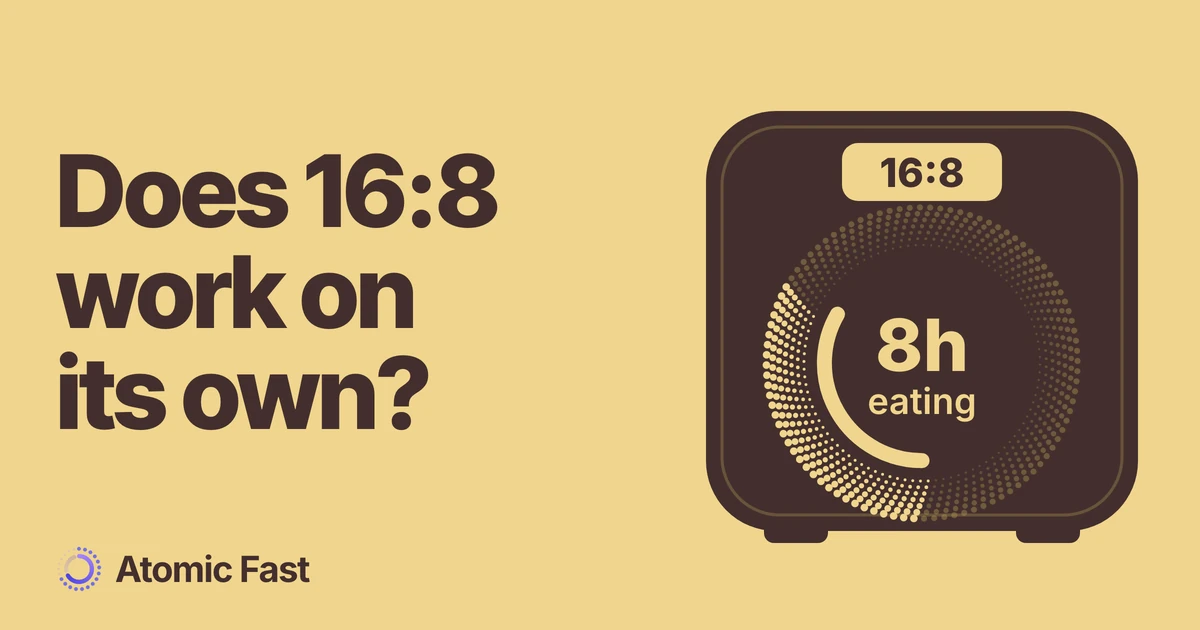
The appeal of 16:8 is that it asks for one rule. Skip breakfast, eat between noon and 8 p.m., and let the clock do the work. No food scale, no macro targets, no new gym habit.
A team at the University of California, San Francisco tested a version of that idea. They gave people a phone app, a Bluetooth bathroom scale and either a 16:8 schedule or three ordinary meals a day, without calorie or protein targets or an exercise program. The comparison tested whether that timing advice produced an advantage over a structured meal schedule.
The short version
TREAT randomized 141 adults with overweight or obesity to noon-to-8 p.m. eating or three structured meals, without calorie or protein targets. Among the 116 who supplied weight data, average losses were about 0.9 kg and 0.7 kg over 12 weeks, with no clear difference between groups. Body scans in a small subset raised an exploratory concern about lean tissue in the arms and legs. The trial does not settle whether 16:8 costs muscle, but it challenges relying on an eating window as the whole plan.
What the TREAT trial tested
TREAT ran from August 2018 to October 2019 and was published in JAMA Internal Medicine in 2020 by Dylan Lowe, Ethan Weiss and colleagues. It enrolled adults aged 18 to 64 with a body mass index between 27 and 43 who lived anywhere in the United States. Everyone was a regular breakfast eater, and people with diabetes, weight-loss surgery or an eating-disorder history were excluded.
Of 141 people randomized, 116 sent back weight data and 105 finished all 12 weeks. The two prescriptions were simple:
- The 16:8 group could eat whatever they liked from 12:00 to 8:00 p.m. and were asked to avoid calories from 8:00 p.m. to noon the next day, drinking only water or unsweetened black coffee or tea outside the window.
- The comparison group ate three structured meals a day, with snacks allowed.
Both groups got app messages. The 16:8 group was reminded when to stop eating, and the comparison group received its own set of messages to control for the effect of being nudged; a 2021 correction to the paper fixed how the Methods described this. Neither group had calorie or protein targets or an exercise program. There was some practical advice: the corrected instructions allowed a small low-carbohydrate snack during the first few days if fasting caused symptoms, and suggested preparing meals ahead for the comparison group. This was a test of a simple timing prescription, not proof that food intake stayed unchanged.
Weight came from the home scale, ideally every morning before eating. A subset of 50 people who lived near San Francisco also came in for body-composition scans (DXA), blood tests and energy-expenditure measurements, and 46 of them completed every visit.
What the trial found
Among people who answered the daily survey, the 16:8 group said they had kept to their window 83.5% of the time, and the meal group said they hadn’t missed a meal 92.1% of the time. Those percentages cover submitted answers from 44 fasting participants and 41 controls, not every participant or day. Missing responses and dropouts leave adherence uncertain.
The 16:8 group lost 0.94 kg on average over 12 weeks (95% CI 0.20 to 1.68 kg), about 1.2% of starting weight. The comparison group lost 0.68 kg (95% CI −0.05 to 1.41 kg). The difference between the groups was 0.26 kg in favor of 16:8, with a 95% confidence interval running from 1.30 kg more loss to 0.78 kg less. That interval includes a modest benefit, no benefit and a modest disadvantage. It does not prove the schedules are equivalent or make every value inside it equally likely.
TREAT trial · 116 analyzed · 12 weeks
Both groups lost a little. The gap between them was too uncertain to call.
Each group dot is its average weight change; the bottom dot is the difference between groups. The line around it is the 95% confidence interval: a range compatible with the data and statistical model.
-
16:8 group
−0.94 kg (−1.68 to −0.20)
-
Three-meal group
−0.68 kg (−1.41 to +0.05) · crosses zero
-
Difference
−0.26 kg (−1.30 to +0.78) · crosses zero
Change in body weight, kg · left of zero means weight lost
The difference row is the trial's main result. Its interval runs from 1.30 kg more loss to 0.78 kg less loss with 16:8, so the study did not detect a difference. That does not show the two approaches are equivalent.
The blood work told the same story. Fasting glucose, fasting insulin, HbA1c, triglycerides and cholesterol didn’t change significantly within or between groups. No significant difference in resting metabolic rate was detected either.
Notice that the comparison group lost some weight too. The authors read that as a lesson about study design: joining a weight study, weighing yourself daily and getting reminders can move the scale a little by themselves. Without a comparison arm, those influences cannot be separated from the eating-window effect.
This isn’t the only trial to find a modest effect. A 2023 meta-analysis of eight randomized 16:8 trials (Huang et al., Food Science & Nutrition), which included TREAT, pooled a 1.48 kg greater loss with 16:8 than with control diets. In the subgroup of trials that did not also restrict calories, the pooled difference was 1.06 kg with an interval that crossed zero, and for later-in-the-day windows like TREAT’s it was 0.82 kg, also crossing zero. The early-window and calorie-restriction subgroups contained the same three trials. Their larger pooled effect cannot tell us which feature mattered; both trial arms had calorie targets in those studies.
The part that made people uneasy: lean mass
The body scans raised a separate question from the weight result.
In the 50-person in-person group, the 16:8 arm lost 1.70 kg on the clinic scale. DXA estimated that 1.10 kg of that was lean mass and 0.51 kg was fat. The authors put it bluntly: about 65% of the weight lost was lean mass, against the 20% to 30% usually seen in weight loss. A 2026 review in Obesity (Dubin, Heymsfield and colleagues) gives the same reference point, about a quarter of diet-induced weight loss coming from fat-free mass, while stressing that the fraction varies substantially. Fat-free mass includes bone; the DXA lean mass reported here excludes it, so the reference is approximate.
TREAT in-person subset · body scans
What the small weight changes were made of
Average losses over 12 weeks. Dotted bars are DXA lean mass, which includes muscle, water and organs. Every bar uses the same scale.
16:8 group
- Weight lost on the clinic scale1.70 kg
- Lean mass lost (DXA)1.10 kg
- Fat mass lost (DXA)0.51 kg
Lean share of weight change: 1.10 ÷ 1.70 ≈ 65%
Three-meal group
- Weight lost on the clinic scale0.57 kg
- Lean mass lost (DXA)0.35 kg
- Fat mass lost (DXA)0.03 kg
Lean share of weight change: 0.35 ÷ 0.57 ≈ 61%
Exploratory difference: lean mass in the arms and legs, 0.64 kg lost with 16:8 versus 0.17 kg with three meals (difference 0.47 kg, 95% CI 0.12 to 0.82). This exploratory test was not adjusted for multiple comparisons.
No significant difference detected: total lean mass (difference 0.75 kg, P = .09), fat mass and weight. These are separate model estimates from scale and scan measurements, not parts of an exact sum. Bone is excluded from DXA lean mass.
Reference point: diet-induced weight loss is typically about one quarter fat-free mass, with wide variation (Dubin et al., Obesity, 2026). Fat-free mass includes bone; DXA lean mass here excludes it. These small ratios are not individual predictions.
Before reading that 65% as “16:8 eats your muscle,” look at what the trial could and couldn’t show.
- The direct comparison is narrower than the headline. The difference between groups in total lean mass (0.75 kg more loss with 16:8) was not statistically significant. An exploratory difference appeared in appendicular lean mass, the lean tissue of the arms and legs: 0.64 kg lost in the 16:8 group versus 0.17 kg in the meal group, a difference of 0.47 kg (95% CI 0.12 to 0.82 kg).
- The 65% is a ratio of two small averages. It divides one within-group change by another, each measured in about two dozen people. The meal group’s even smaller changes give a similar-looking ratio (0.35 kg of 0.57 kg, about 61%), which shows how unstable a percentage of a 1 to 2 kg change can be.
- DXA lean mass is not muscle. It counts water, organs and other non-fat, non-bone tissue. The authors note that hydration can shift the reading, though they argue the change was too large to be explained by water alone.
- No clear strength change was detected. Handgrip strength and leg-extension torque showed no significant change in either group over 12 weeks. Small samples do not establish that strength was preserved.
The result warrants follow-up, not a blanket claim of muscle damage.
Why the window alone might shortchange lean tissue
TREAT never measured what people ate, so nobody knows whether protein intake dropped. If skipping breakfast removes a protein-containing meal without replacing that food later, daily protein intake could fall. TREAT did not measure whether that happened.
Movement may have shifted too. In the in-person group, Oura rings showed the 16:8 participants taking about 2,500 fewer steps a day by the end of the trial, while the meal group’s steps barely changed. The between-group difference, about 2,240 steps, was statistically significant but had a wide interval, came from a small group and was one of many secondary measures. Treat this exploratory finding as a clue that needs replication. Still, it fits a broader point from our guide to why weight loss gets harder over time: everyday movement can drift without anyone deciding to move less.
Neither explanation was tested. Lower protein intake was an author hypothesis; reduced movement is another possible contributor. The trial did not establish either as the cause of lean-mass change.
How this fits with other 16:8 research
TREAT is one trial, and other studies set up differently found something else. In a two-month study of experienced lifters on 16:8, 34 men kept training and reported high protein intake. That study detected no significant fat-free-mass change, while fat mass fell (Moro et al., 2016). The Huang meta-analysis pooled five trials with lean-mass data, including TREAT, and found a 0.48 kg greater loss with 16:8 that was not statistically significant (95% CI 1.02 kg more to 0.05 kg less). The pooled estimate leans toward a loss, but does not settle whether 16:8 changes lean mass. The trials were small and varied, and the interval leaves room for a modest loss.
These comparisons do not prove that adding protein or training would have changed TREAT’s result: the populations and protocols differed. They do show why the rest of the plan belongs in the discussion. Our guide to testing meal timing while matching the food explains a different way to separate those questions.
What the study doesn’t settle
- Twelve weeks is short. Weight and body-composition changes this small can’t predict what happens at six months or a year.
- The window was late. Noon to 8 p.m. is one common version of 16:8, but some researchers think earlier windows behave differently. TREAT didn’t test them.
- Exploratory results need caution. The analysis plan adjusted eight specified secondary outcomes for multiple testing. Other measures, including appendicular lean mass and steps, were exploratory and unadjusted, making chance findings more likely.
- The scans covered few people. There were 22 fasting and 24 comparison-group completers.
- Food intake was modeled, not measured. The authors estimated calorie intake from weight change and found no difference between groups. They had no protein data at all.
- The population was specific. Habitual breakfast eaters aged 18 to 64 with overweight or obesity and without diabetes. People who already skip breakfast, older adults and people with diabetes may respond differently.
What to do with this
If 16:8 is appropriate for you, consider the meals and activity around it as well as the hours.
- Decide what goes in the window. The trial did not detect a weight-loss advantage over three structured meals. If weight loss is the goal, the eating window still needs a plan for portions and food quality.
- Keep protein in the meals you keep. If breakfast was where most of your protein came from, move it to your first meal rather than losing it. Obesity researchers describe protein-rich diets and resistance exercise as the foundations of preserving lean mass during weight loss (Dubin et al., 2026); TREAT tested neither, and it doesn’t tell you how much you need.
- Keep lifting or start. Resistance exercise is the usual tool for holding onto lean tissue while losing weight. If you are older, have a condition that affects muscle, or have kidney disease, ask a clinician or dietitian what’s appropriate for you.
- Watch your daily movement. If eating later or feeling low on energy in the morning is cutting your walks, that is worth noticing early.
- Judge it by more than the scale. Strength, how clothes fit and waist measurements can tell you things a 1 kg change can’t.
Atomic Fast can help with the bookkeeping side of this. The timer records when your fasts start and end, and logged meals show estimated nutrients, including protein, so you can see whether dropping breakfast also dropped most of your protein. The nutrition-goal setup calculates an estimated protein target from your calorie target and goal. These are estimates from food entries, not measurements of your body: the app does not measure muscle or body composition.
Frequently asked questions
Does 16:8 work for weight loss without changing what you eat? TREAT did not detect an advantage over three structured meals. People eating from noon to 8 p.m. without calorie or protein targets lost about 0.9 kg in 12 weeks, close to the 0.7 kg lost by people eating three meals a day. The confidence interval was wide, so a small benefit wasn’t ruled out, but the window alone produced little.
Does 16:8 make you lose muscle? TREAT found more loss of lean tissue in the arms and legs with 16:8 in a 50-person subset, but the difference in total lean mass wasn’t statistically significant, DXA lean mass isn’t the same as muscle, and the small strength tests did not detect a significant change. A small trial in trained men detected no significant fat-free-mass change, but it cannot guarantee preservation for other people.
Is “65% of the weight lost was lean mass” accurate? It’s what the authors calculated for the 16:8 group in the in-person subset: 1.10 kg of lean mass out of a 1.70 kg weight change. It’s a ratio of two small within-group averages in about two dozen people, not a precise estimate you should apply to yourself.
Was the TREAT trial corrected? Yes, twice. A November 2020 correction fixed one figure panel, and a February 2021 correction fixed errors in the Methods, including how the messages sent to each group were described. The corrected Methods disclose practical advice and differences from the approved protocol. The weight and body-composition estimates summarized here are unchanged.
Would an earlier eating window have worked better? TREAT can’t say. It tested only noon to 8 p.m. The meta-analysis found larger pooled weight effects for early windows, but those trials also differed in other ways, including calorie restriction, so the timing itself isn’t isolated.
Sources
Sources checked: October 25, 2026.
- Lowe DA, Wu N, Rohdin-Bibby L, et al. (2020), Effects of Time-Restricted Eating on Weight Loss and Other Metabolic Parameters in Women and Men With Overweight and Obesity: The TREAT Randomized Clinical Trial, JAMA Internal Medicine 180(11):1491–1499 — DOI 10.1001/jamainternmed.2020.4153, PMID 32986097, NCT03393195. Full text, corrected publisher Methods and statistical analysis plan read (with PMC7522780 as a manuscript mirror). Supports the weight, body-composition, adherence, activity and blood-marker results; 12 weeks, one late window, body scans in 46 to 50 people, no measured protein intake.
- JAMA Internal Medicine (2021), Clarification of Messages Delivered to Participants During Trial of Time-Restricted Eating — DOI 10.1001/jamainternmed.2020.8941. February 2021 correction notice for the Methods; an earlier November 2020 notice (DOI 10.1001/jamainternmed.2020.6728) corrected Figure 2 panel C. The corrected article’s reported results match those summarized here.
- Huang L, Chen Y, Wen S, et al. (2023), Is time-restricted eating (8/16) beneficial for body weight and metabolism of obese and overweight adults? A systematic review and meta-analysis of randomized controlled trials, Food Science & Nutrition 11(3):1187–1200 — DOI 10.1002/fsn3.3194, PMID 36911845. Full text read. Eight small RCTs (464 participants) with high heterogeneity for weight; supports the pooled and subgroup estimates only, not individual outcomes.
- Moro T et al. (2016), Effects of eight weeks of time-restricted feeding (16/8) on basal metabolism, maximal strength, body composition, inflammation, and cardiovascular risk factors in resistance-trained males. Journal of Translational Medicine 14:290 — Full text checked. Thirty-four experienced male lifters, eight weeks, standardized training and reported protein near 1.9 g/kg/day. Supports the contrasting training example, not a guarantee for other populations.
- Dubin RL, Sanders TN, Schwab HM, Heymsfield SB, Greenway FL (2026), Glucagon-Like Peptide-1 Receptor Agonist-Based Agents and Body Composition: Filling More Gaps, Obesity 34(Suppl 2):51–63 — DOI 10.1002/oby.70212, PMID 42415595. Relevant full-text sections read. Used only for the roughly one-quarter fat-free-mass reference point, its variability, and the description of protein and resistance exercise as foundations; the review’s subject is weight-loss medication, not fasting.
Product notes: Atomic Fast’s fasting records, meal nutrient estimates and nutrition-goal protein target were checked against current iOS and Android source code. This was not a device walkthrough or a clinical validation of the estimates.
Track your eating window and review your meal nutrient estimates with Atomic Fast on the App Store or Google Play.
This article is for general education and isn’t medical advice. If you’re pregnant, managing a health condition, taking medication, have a history of disordered eating, or are considering fasts longer than 24 hours, talk to a healthcare professional first.
Try Atomic Fast free
Track your fasts, log your meals, and see how they affect each other, on iPhone and Android.


 Scan to download