Why Weight Loss Is Hard: Hunger, Calories and Metabolism
Why does weight loss slow down? Understand changing hunger, energy needs and everyday habits, with human research and practical ways to review a plan that has stalled.
By Nazmul Hasan Rupok Published 18 min read

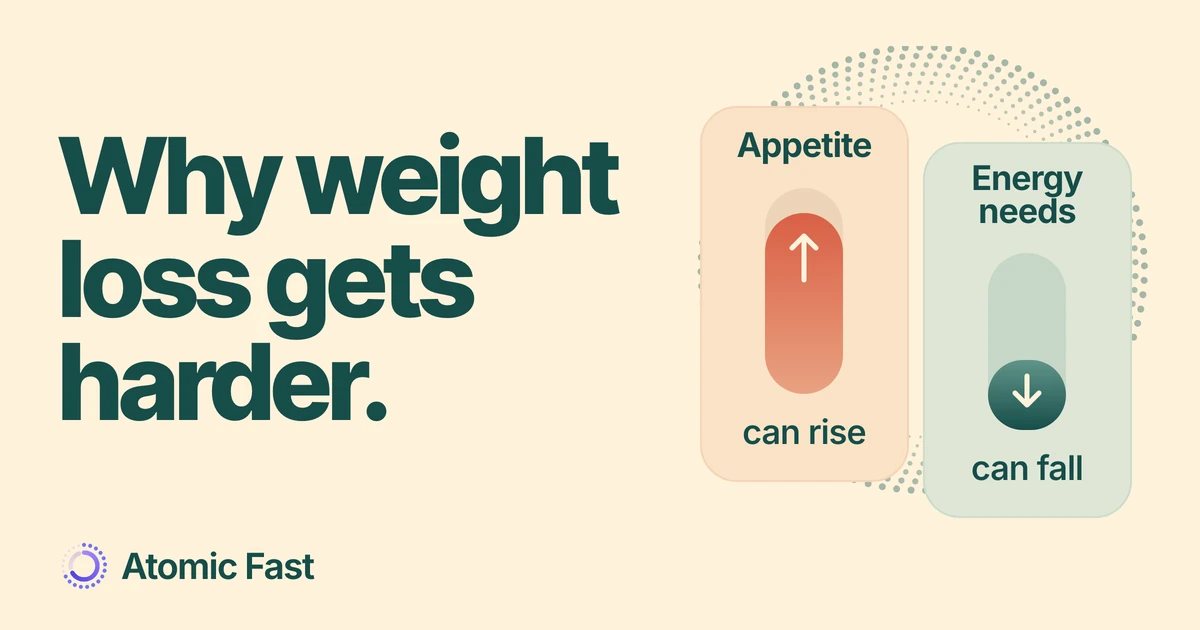
A routine can feel manageable at first and surprisingly difficult a few months later. The meals are familiar. You’re still taking walks. But you’re thinking about food more often, and the scale is moving more slowly. It’s tempting to read that combination as a failure of effort.
There are other explanations worth understanding. The body you’re feeding and moving has changed. So can its energy requirements and the signals that influence appetite. A useful plan has to account for those changes, along with the ordinary demands of work, family, money and health.
The short version
Losing stored body energy requires an energy deficit, but neither appetite nor energy expenditure stays fixed during weight loss. A smaller body generally needs less energy, and some people experience additional reductions in expenditure or stronger hunger. Food choices, suitable activity and sleep can make a routine easier to sustain; fasting is one possible eating structure, with no guaranteed weight-loss advantage. A plateau does not diagnose a damaged metabolism or mean you should automatically eat less or fast longer.
A slower scale does not tell you what changed
Body weight includes much more than fat. Water, glycogen, lean tissue and the contents of your digestive tract contribute to the reading. A change in carbohydrate intake can change glycogen and its associated water, so an early drop need not represent the rate of fat loss you can expect later. These changing components are part of the reason physiological models distinguish body weight from stored energy (Hall et al., 2011).
A few similar readings cannot tell you whether fat loss has stopped. They also cannot identify a hormone problem, muscle loss or an inaccurate food record. Those are different questions requiring different evidence.
If weighing is useful and comfortable for you, compare measurements taken under similar conditions and look at the pattern over several weeks. An unusual week deserves context: travel, an illness, a changed meal pattern or a different exercise routine. You do not need to respond to every fluctuation with a new rule.
Calorie records need the same restraint. A food entry describes an estimate of a portion, and an activity estimate describes another uncertain quantity. Subtracting one from the other produces a number, but it does not turn either estimate into a direct measurement of your energy balance.
Our guide to reviewing a plateau while fasting covers the practical troubleshooting. Here, the question is why maintaining the same routine can become harder in the first place.
Your energy needs change as your body changes
The energy you use in a day goes into several jobs. Your organs and other tissues need energy at rest. Digesting and processing food takes energy. Deliberate exercise uses some, and so does movement outside a workout: walking to a bus, carrying shopping or moving around at work.
As body size and composition change, maintaining and moving that body can require less energy. Eating less also changes the amount of energy spent processing food. A food intake that once created a particular gap between intake and expenditure may therefore create a smaller gap later.
This is why the familiar calculation that a daily 500-calorie cut will produce a pound of weight loss every week is an unreliable long-term forecast. The dynamic model developed by Hall and colleagues accounts for physiological changes that a fixed calculation leaves out. It does not make an individual’s future weight perfectly predictable.
The changing energy gap
Same intake.
A smaller deficit.
If daily energy use falls, the gap can narrow even when food intake stays the same.
Earlier
When energy needs fall
All values are kcal/day. Both examples use the same bar scale, starting at zero.
There can also be changes beyond those expected from having a smaller body. Researchers call expenditure below a body-composition-based prediction adaptive thermogenesis, or metabolic adaptation. It is measured by comparing observed expenditure with a prediction, which makes the prediction method and the conditions of measurement important.
For example, a study of 71 adults with obesity measured resting metabolism after eight weeks of a low-energy diet and again after four weeks of weight stabilization. The mean additional reduction was approximately 92 calories a day after the diet and 38 after stabilization. Individual responses varied considerably, and the measured adaptation was not associated with weight regain at the one-year follow-up (Martins et al., 2020).
That study measured resting expenditure. It does not settle every question about total daily expenditure or demonstrate that adaptation disappears in everybody.
A systematic review of 33 studies found adaptation in many studies, but also substantial differences in methods and results. Better-designed studies tended to report smaller or statistically uncertain effects, and adaptation often diminished after weight stabilized. The defensible conclusion is that additional adaptation can occur; its size and persistence are not a universal number.
Neither ordinary changes in energy needs nor additional adaptation justify diagnosing a permanently damaged metabolism from a flat scale. They explain why an earlier estimate may no longer describe the current situation.
Hunger can increase after weight loss
Appetite involves communication between the brain, digestive tract and stored energy reserves. Hormones are part of that communication, alongside sensory cues, learned meal patterns and the circumstances in which food is available. They influence eating without acting as a single switch that determines every meal.
Leptin is released by fat cells. In a human study of 275 adults, blood leptin concentrations were associated with the proportion of body fat. People with obesity generally had higher levels, illustrating why the story cannot be reduced to having too little of a fullness hormone (Considine et al., 1996). A blood concentration alone does not explain someone’s appetite or tell them how to change it.
Ghrelin, produced mainly in the stomach, is involved in hunger. In a small study with scheduled meals, levels rose before eating and fell afterward (Cummings et al., 2001). An infusion experiment in nine volunteers also found increased appetite and food intake compared with saline (Wren et al., 2001). Neither experiment establishes how long a particular person’s hunger will last or whether symptoms during a fast should be ignored.
GLP-1 is another appetite-related signal. In a randomized crossover experiment in 20 healthy men, an infusion increased reported fullness and reduced intake at a later meal (Flint et al., 1998). Infusion studies help test mechanisms; they are not evidence that an ordinary food reproduces the effects of a prescription medicine.
The appetite conversation
More than one signal.
Your brain integrates information from different parts of the body.
Fat tissue
Leptin
A signal related to stored energy.
Mainly the stomach
Ghrelin
One signal involved in hunger.
The gut
GLP-1
One signal involved in fullness.
Appetite
Your brain combines
the signals.
The response varies between people. Meals, sleep, learned routines and food cues also matter.
What happens when people lose weight? In a study that enrolled 50 adults, a ten-week very-low-energy diet was followed by changes in several appetite-related hormones, including lower leptin and higher ghrelin, and greater reported appetite. Differences in several signals and hunger remained at the follow-up one year after the initial weight-loss period.
That provides evidence that the effort of maintaining a lower weight can change. It does not show that every modest weight loss causes the same response, that one hormone explains it all, or that regain is unavoidable. The intervention was intensive, and the number enrolled should not be mistaken for the number completing every assessment.
There is another useful distinction: feeling more hunger and actually consuming more food are related but different outcomes. Researchers have also used mathematical models to estimate how food intake responds to weight loss. A 52-week analysis involving canagliflozin treatment suggested substantial compensatory intake. The estimate came from a model and a specific treatment context, not a direct measurement of every participant’s appetite. It should not become a formula for calculating how much hungrier you will be.
The practical implication is to ask whether meals and routines still feel adequate. Persistent hunger deserves attention. It is not evidence that you need to demonstrate more determination.
Food choices can make a routine easier to follow
Two eating patterns can provide similar energy while differing in portion size, texture, protein content and how satisfying they feel. Those differences matter when deciding what you can repeat comfortably.
Give meals enough substance
Protein-containing foods and water-rich foods are reasonable places to look when meals feel insubstantial. Think about a meal you already eat: rice with dal, vegetables and fish or tofu, for example, rather than treating the solution as buying a specialized diet product. Portions and preferences still matter; the example is a way to assemble a meal, not a prescribed calorie count.
In a year-long randomized study of 97 women with obesity, both groups received advice to reduce fat intake. One group also received advice to increase water-rich foods, particularly fruit and vegetables. That group reported less hunger and had a different pattern of weight loss over the study (Ello-Martin et al., 2007). This was a supported, multicomponent dietary intervention. It cannot tell us what one extra serving of vegetables will do by itself.
A smaller study of 19 people found greater fullness and lower voluntary intake during a higher-protein dietary sequence (Weigle et al., 2005). Because everyone followed the diets in sequence, it offers less certainty than a large randomized comparison. It also does not establish a universal protein target or justify using supplements without considering the rest of the diet.
The useful question is concrete: does your usual lunch leave you comfortably satisfied, or are you regularly searching for more food soon afterward? A dietitian can help assess that question when medical needs or a history of restrictive eating complicate it.
Consider the whole eating pattern
In a controlled inpatient crossover trial, 20 adults received an ultra-processed menu and an unprocessed menu for two weeks each, in random order. They could choose how much to eat. Average energy intake was about 508 calories a day higher during the ultra-processed menu period (Hall et al., 2019).
That is evidence about those menus under those conditions. It does not isolate sugar, an additive or processing alone as the cause. Nor does it mean every packaged food has the same effect. Food texture, eating rate and the energy in each mouthful deserve attention too; our article on texture and eating speed examines a more specific experiment.
An everyday review can include drinks, sauces and snacks that are easy to omit from memory. The purpose is to understand the pattern you are following, not to make every meal an accounting exercise. You can also make changes without logging: prepare a more substantial lunch, keep a convenient meal available for late workdays, or choose water when you do not particularly want a sweetened drink.
Make the change specific enough to try, and judge whether it helps with ordinary life as well as the scale. An elaborate plan that depends on time, money or cooking facilities you do not have needs redesigning.
Movement and sleep belong in the plan
The rest of the day counts too: NEAT
A workout is only part of daily movement. A change from an active job to desk work, for example, can change your routine even if the gym sessions stay the same. During dietary restriction, activity-related expenditure may also change.
Researchers call the energy used for everyday movement outside deliberate exercise non-exercise activity thermogenesis (NEAT). It includes movement involved in daily tasks, posture and fidgeting (Levine et al., 1999). It is a category of expenditure, not a particular workout or a fixed calorie allowance.
Everyday movement · NEAT
Your workout is one
part of the day.
Non-exercise activity thermogenesis is the energy used for movement outside deliberate exercise.
Planned exercise
A workout is one form of activity.
Movement outside workouts
Getting around
Walking between everyday tasks.
Preparing food
Moving around the kitchen.
Carrying things
Shopping, laundry and daily errands.
Tidying up
The movement built into chores.
Small movements can be part of a routine. Their energy cost varies; there is no universal calorie bonus.
A six-month randomized study of 48 adults found reductions in total expenditure and estimated activity-related expenditure in calorie-restriction groups. The groups were small, and activity-related expenditure was derived from energy measurements; the researchers were not counting every fidget (Redman et al., 2009). This supports considering movement outside exercise, while leaving considerable uncertainty about any individual response.
Choose activity that fits your capacity and circumstances. A short walk, movement breaks or an adapted routine may be more realistic than adding another demanding workout. Exercise has benefits beyond weight change, and it does not need to function as repayment for eating. NIDDK’s activity guidance includes ways to build activity around ability and health needs.
Muscle matters, but its resting energy use is often exaggerated. A study evaluating organ and tissue models supports a commonly used estimate of roughly 13 calories per kilogram of skeletal muscle per day at rest, about 6 per pound (Wang et al., 2010). That is a tissue estimate, not a promise about the exact change in total expenditure after someone gains muscle. Suitable strength work deserves a place for strength and function, without extravagant calorie-burning claims.
Sleep is a practical constraint
In a trial of 80 adults with overweight who usually slept less than 6.5 hours a night, individualized sleep counseling increased sleep by about 1.2 hours relative to the control group. Estimated energy intake was about 270 calories a day lower relative to control during the two-week intervention (Tasali et al., 2022).
This is useful experimental evidence, but two weeks cannot establish years of weight loss. Participants were relatively young adults with short sleep, and the result does not mean everyone should expect the same intake change from an extra hour in bed.
If a routine repeatedly sacrifices sleep, it is worth reviewing the routine itself. That may involve meal preparation, an exercise time or help with a sleep problem. A rigid eating schedule that makes the rest of your day harder has a cost even when you follow it perfectly.
Where intermittent fasting fits
An eating window can provide a structure some people find useful. It also has to accommodate adequate food, medication, work and family meals. Its value depends partly on whether it helps you follow a suitable pattern without making those other needs harder to meet.
The role of an eating window
Timing is one part
of the pattern.
When you eat
An eating window sets a period for meals.
12:12 example
8 am–8 pm eating window
16:8 example
12 pm–8 pm eating window
What and how much you eat
Meals, snacks and drinks still determine food intake within that window.
A shorter window does not guarantee
a larger energy deficit.
In a 12-month trial, 139 adults with obesity were assigned to calorie restriction with an 8 a.m.–4 p.m. eating window or to calorie restriction alone. Both groups lost weight. The estimated additional loss with the window was 1.8 kg, but the confidence interval ranged from 4.0 kg more loss to 0.4 kg less loss; the difference was not statistically significant (Liu et al., 2022).
That does not prove the approaches are exactly equivalent. It means this trial did not establish an extra weight-loss benefit from adding that window under those conditions. It also did not compare every possible schedule or every reason someone might fast.
The broader 2026 Cochrane review found little or no additional weight-loss benefit compared with regular dietary advice, with important limits in certainty. Its search ended in November 2024, despite the later publication date. We examine that evidence separately in our review of whether fasting works.
Fasting should therefore remain an option you can evaluate. If it regularly leaves you struggling to eat adequately, interferes with medication or becomes distressing, extending the fast is not a sensible automatic response. The clock cannot establish that the current plan is appropriate.
What these studies cannot tell you about your plateau
| What the evidence can help explain | What it cannot establish |
|---|---|
| Energy needs can change as weight changes. | Your exact current calorie requirement from an old estimate. |
| Appetite-related signals can change after weight loss. | A hormone diagnosis from hunger alone. |
| Food patterns and sleep interventions can affect intake. | A guaranteed response to a single habit change. |
| Fasting and other approaches can produce weight loss. | Which approach is suitable for your health and circumstances. |
The evidence here includes small experiments, longer trials, models and reviews. They answer different questions. An acute hormone infusion is not a diet trial, a short inpatient menu comparison is not a year at home, and a group average is not your personal forecast. We have kept those distinctions beside the findings because they change what you can reasonably take from them.
What to do with this
Start with the part of the routine that has become difficult. You do not have to overhaul everything at once, and a slower rate of loss is not automatically a problem requiring correction.
- Review the pattern before the target. Consider measurements over time, changes in daily activity and whether your usual food record reflects what you actually eat. An estimate that no longer fits is a reason to reassess, not a reason to punish yourself.
- Address meals that leave you struggling. Look at portion adequacy and the mix of foods available. A more satisfying meal may be a more useful experiment than another rule about when you are allowed to eat.
- Choose one manageable adjustment. It might be preparing lunch for a busy day, finding an accessible form of activity or protecting sleep. Notice the effect on hunger, energy and daily life. Avoid turning an illustrative calorie number into a personal prescription.
- Make room for professional help. A clinician or registered dietitian can review symptoms, medication, nutritional adequacy and whether weight loss is an appropriate goal. You can seek that help before attempting further restriction.
Medical treatment also belongs in the discussion when appropriate. Prescription weight-management medicines can act on appetite or nutrient absorption and are used alongside lifestyle support. Suitability depends on health history, expected benefit, side effects and other factors, rather than a blog’s ranking of personal effort (NIDDK medication guidance). This article is not a guide to choosing or changing a medicine.
If record-keeping helps, Atomic Fast can keep fasting sessions and meal entries in one app. A short record may help you recall meals and drinks when reviewing a routine. The nutrient values are estimates, and missing entries or uncertain portions mean the log cannot confirm your actual energy deficit.
The timer’s phase labels also follow elapsed time. They do not measure hormone levels, fat loss or metabolic adaptation. If tracking makes eating more anxious or rigid, you do not need to keep doing it to deserve support.
Seek individual advice for unexplained weight changes, concerning symptoms or difficulty eating enough. People taking medication affected by meal timing should discuss fasting with their clinician. A history of disordered eating calls for support that considers the relationship with food, rather than simply replacing calorie rules with stricter fasting rules.
Frequently asked questions
Can my metabolism slow down when I lose weight? Yes. Maintaining and moving a smaller body generally requires less energy. Some people also show expenditure below body-composition-based predictions. The magnitude varies, and measurements during active restriction can differ from those after stabilization. A plateau alone cannot measure either effect or establish permanent damage.
Why am I hungrier after losing weight? Weight loss can alter appetite-related signals, and human research has found increased hunger after some dietary interventions. That is one possible explanation, not a diagnosis. Meal adequacy, routines, sleep and health context also deserve attention. Persistent or distressing hunger is a reason to review the plan.
Does a calorie deficit guarantee weight loss every week? A sustained deficit reduces stored body energy, but the scale also reflects water and other changing components. Weekly readings need not follow a smooth line. An app’s calculated deficit is also an estimate; it does not directly measure what you absorbed or expended.
Does building muscle dramatically increase calorie burn at rest? Its direct contribution is more modest than many claims suggest. A commonly used estimate is about 6 calories per pound of muscle per day at rest, with limitations. That does not predict an individual’s training response. Strength and function are worthwhile reasons to maintain muscle independently of that calculation.
Do I need intermittent fasting to lose weight? No. It is one possible eating structure. Comparative trials have not established a consistent, substantial weight-loss advantage over other dietary approaches. Suitability and adequate nutrition matter more than treating a particular window as essential, and longer fasting is not an automatic solution to a plateau.
When should I ask for help with a stalled plan? You can ask whenever the plan becomes hard to sustain. Get individual advice for unexplained changes, concerning symptoms, medication questions, difficulty eating enough or distress around food and tracking. You do not need to keep making a plan more restrictive before seeking help.
Sources
Sources checked: October 13, 2026.
Energy needs and adaptation
-
Hall et al. (2011), Quantification of the effect of energy imbalance on bodyweight, The Lancet — Dynamic modelling of weight change. Supports moving beyond fixed weekly predictions; models retain assumptions and individual uncertainty.
-
Martins et al. (2020), Metabolic adaptation is an illusion, only present when participants are in negative energy balance, AJCN — Resting expenditure study in 71 adults. Full-text methods and limitations checked; its provocative title should not be treated as a universal conclusion.
-
Nunes et al. (2022; online 2021), Does adaptive thermogenesis occur after weight loss in adults?, British Journal of Nutrition — Systematic review of 33 studies; methods and results varied. Abstract reviewed.
-
Redman et al. (2009), Metabolic and behavioral compensations in response to caloric restriction, PLOS ONE — Six-month trial with 48 participants; small groups and derived activity expenditure limit individual predictions. Full-text discussion checked.
-
Wang et al. (2010), Specific metabolic rates of major organs and tissues across adulthood, AJCN — Tissue-model evaluation in 131 adults, not a trial of muscle gain. Abstract and methods summary reviewed.
-
Levine et al. (1999), Role of nonexercise activity thermogenesis in resistance to fat gain in humans, Science — Defines everyday non-exercise activity in a 16-person overfeeding experiment. Abstract reviewed; cited for the NEAT concept, not as a weight-loss intervention or calorie target.
Appetite
- Considine et al. (1996), Serum immunoreactive-leptin concentrations in normal-weight and obese humans, NEJM — Human leptin and body-fat measurements. Association does not provide an individual appetite diagnosis; abstract and publisher methods reviewed.
- Cummings et al. (2001), A preprandial rise in plasma ghrelin levels suggests a role in meal initiation in humans, Diabetes — Ten participants with scheduled meals; no universal duration for hunger. Abstract reviewed.
- Wren et al. (2001), Ghrelin enhances appetite and increases food intake in humans, JCEM — Nine-person infusion experiment. Tests a mechanism, not a weight-management routine; abstract reviewed.
- Flint et al. (1998), Glucagon-like peptide 1 promotes satiety and suppresses energy intake in humans, JCI — Acute infusion study in 20 healthy men; not evidence for food-based substitutes for medication. Abstract reviewed.
- Sumithran et al. (2011), Long-term persistence of hormonal adaptations to weight loss, NEJM — Intensive dietary intervention with later follow-up. Abstract reviewed; results cannot predict everyone’s response to modest weight loss.
- Polidori et al. (2016), How strongly does appetite counter weight loss?, Obesity — Model-derived intake compensation during a drug trial. Abstract reviewed; not a direct individual measurement of hunger.
Food, sleep and fasting
- Ello-Martin et al. (2007), Dietary energy density in the treatment of obesity, AJCN — Year-long randomized dietary-advice trial in 97 women. A multicomponent intervention; abstract reviewed.
- Weigle et al. (2005), A high-protein diet induces sustained reductions in appetite, ad libitum caloric intake, and body weight, AJCN — Nineteen-person sequential study, not a large randomized comparison. Abstract reviewed; no universal protein target inferred.
- Hall et al. (2019), Ultra-processed diets cause excess calorie intake and weight gain, Cell Metabolism — Twenty-person inpatient crossover trial, two weeks per menu. Abstract and indexed paper excerpts reviewed; the design does not isolate processing itself.
- Tasali et al. (2022), Effect of sleep extension on objectively assessed energy intake, JAMA Internal Medicine — Eighty adults with short sleep; two-week intervention. Full-text methods and limitations checked; no long-term weight-loss forecast inferred.
- Liu et al. (2022), Calorie restriction with or without time-restricted eating in weight loss, NEJM — Twelve-month trial with 139 randomized participants. Abstract and publisher results reviewed; a statistically uncertain difference does not establish equivalence.
- Garegnani et al. (2026), Intermittent fasting for adults with overweight or obesity, Cochrane — Review of 22 trials with certainty limitations; search ended November 2024. Review abstract checked.
Practical guidance and product notes
- NIDDK, Keep Active & Eat Healthy to Improve Well-being & Feel Great — Activity and eating guidance that considers different abilities and health needs.
- NIDDK, Prescription Medications to Treat Overweight & Obesity — Supports individualized treatment discussions; not personal prescribing advice.
Product notes: Atomic Fast’s meal records and elapsed-time phase behavior were checked against current source code and documentation. This was not a clinical validation of calorie estimates or physiological labels.
Keep fasting sessions and meal estimates together with Atomic Fast on the App Store or Google Play.
This article is for general education and isn’t medical advice. If you’re pregnant, managing a health condition, taking medication, have a history of disordered eating, or are considering fasts longer than 24 hours, talk to a healthcare professional first.
Try Atomic Fast free
Track your fasts, log your meals, and see how they affect each other, on iPhone and Android.


 Scan to download