Do Small, Frequent Meals Boost Your Metabolism?
Eating every few hours to stoke your metabolism is one of the stickiest food myths. What the research shows, and why a normal fasting window won't slow your metabolism.
Last updated
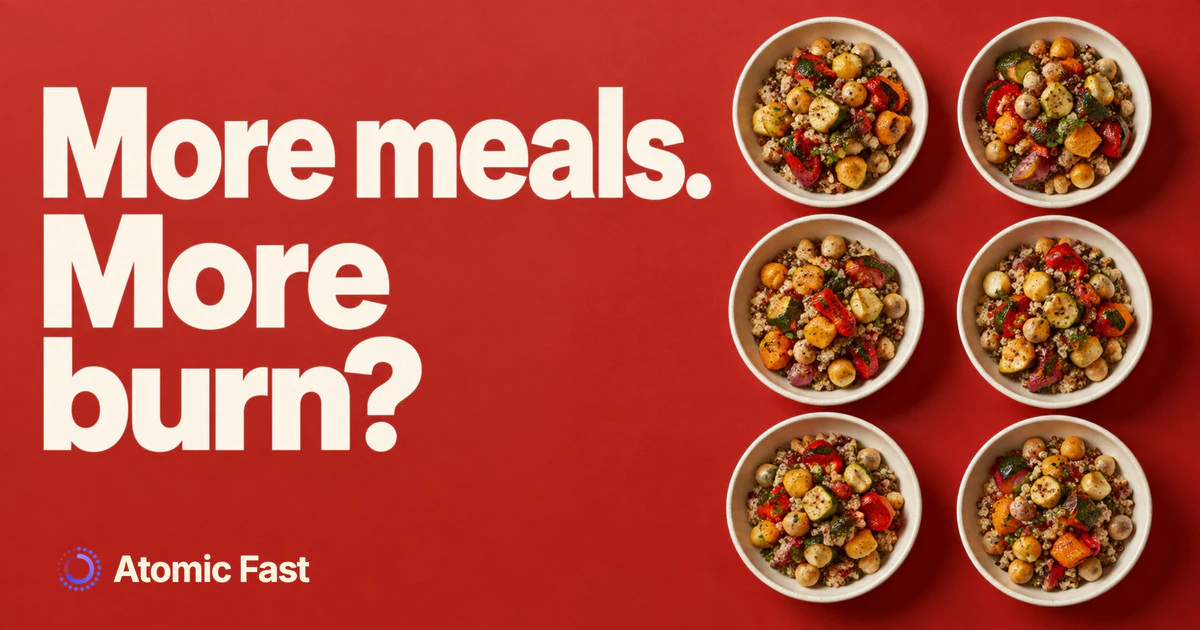
You’ve probably heard it from a trainer, a magazine or a well-meaning relative: eat small meals every two or three hours to keep your metabolism burning, like feeding logs into a fire. It sounds intuitive. It’s also one of the main reasons people flinch when they first hear about fasting. Surely going hours without food does the opposite and grinds your metabolism to a halt?
Both halves of that belief are wrong, for the same reason. Meal frequency isn’t a lever on your metabolism. What you eat over a day matters far more than how many sittings you split it into.
The short version
Dividing the same food into more meals has not reliably increased daily energy expenditure in small controlled studies. That does not mean timing has no biological effects or that every fasting schedule is equivalent. Choose meals around adequate intake, comfort and medical needs, rather than expecting an extra calorie burn from eating more often.
Where the “stoke the fire” idea comes from
There’s a kernel of truth underneath the myth, which is why it has lasted. Digesting and absorbing food costs energy. Nutrition researchers call it the thermic effect of food, and after a meal your metabolic rate does tick up for a while as your body does that work.
The leap is assuming that if one meal gives you a small bump, more meals must mean more bumps and a faster metabolism overall. It’s a tidy story. It doesn’t survive the arithmetic.
What the thermic effect of food does
Digesting and processing food uses energy. The amount depends on what and how much you eat, including the macronutrient mix; it is not a fixed ten-percent allowance to subtract from every meal.
In a 2013 randomized crossover experiment, fifteen lean adults ate matched diets as three or six meals while researchers measured a full day in a room calorimeter. Energy expenditure and fat oxidation did not differ significantly. Hunger ratings were actually higher with six meals, though this small, short experiment cannot forecast long-term appetite or weight.
This supports questioning a simple metabolism-boost claim. It does not show that the body cannot distinguish meal schedules or that timing is irrelevant to blood glucose, sleep or comfort.
Six small meals versus three big ones
Splitting a day’s food into more containers does not automatically create extra energy expenditure. The useful comparison holds both total food and its composition reasonably constant; changing protein or total intake at the same time asks a different question.
Breakfast is related but distinct. Our review of breakfast trials separates resting metabolism from weight and other outcomes. A null result on one measurement is not a complete health assessment of skipping a meal.
But doesn’t fasting slow your metabolism?
One often-cited study by Zauner and colleagues measured eleven lean adults during an 84-hour fast. Resting energy expenditure rose between days one and three. That is a small, uncontrolled observation of prolonged fasting, not proof that repeated 16:8 leaves metabolism unchanged, raises it, or is safe.
Weight change, body size, food intake, activity and illness can all affect energy expenditure. If weight loss stalls, do not diagnose a damaged metabolism from a timer. Review the broader pattern in our guide to a fasting plateau, and seek clinical advice for unexpected changes.
How much to trust this
The room-calorimeter experiment carefully measured short-term expenditure, but studied only fifteen lean adults. The starvation study had eleven. Neither establishes long-term weight effects, an optimal number of meals or safety for people taking glucose-lowering medicines.
The narrow conclusion is useful: a claim that everyone must eat every few hours to boost calorie burning is not supported by these comparisons. A universal claim that meal timing never matters would go too far in the other direction.
Picking a meal pattern
None of this makes frequent meals bad. “Boosts your metabolism” is just the wrong reason to choose them. There can be practical reasons to eat more often: it’s an easy way for an athlete to fit in more food, and some dieters find it takes the edge off hunger. Others like it for steadier energy through the afternoon, or because it fits around training or a doctor’s plan for blood sugar.
Plenty of people find the opposite easier: fewer, larger meals, less to think about, more satisfying when they do eat. That’s a lot of what draws them to a fasting window. Both work. It’s the same conclusion a Cochrane review of 22 fasting trials reached: results come from the food and the deficit, and the schedule’s job is to be one you’ll keep.
If you try a window, a fasting timer is just structure: fewer hours with the fridge open, fewer grazing calories that never registered. Atomic Fast’s timer is free and counts the hours from when you start and names the phase that puts you in. Logging what you ate takes a photo, a typed description or a barcode scan. Core records are stored locally. Optional AI requests and cloud services have separate data flows described in the privacy policy.
Frequently asked questions
Does eating every few hours speed up metabolism? The cited controlled comparison found no significant daily energy-expenditure advantage from six meals rather than three with matched food.
Does an 84-hour fasting study prove 16:8 boosts metabolism? No. The small study used a different intervention and cannot establish that conclusion.
Does meal timing matter at all? It can matter for comfort, daily routine, medication and particular health outcomes. Energy expenditure alone does not settle those questions.
Is snacking bad? Not inherently. The amount, nutritional content and fit with your needs matter more than attaching a good or bad label to the number of meals.
How many meals should I eat? These studies do not identify a universally correct number. Use a pattern that supports adequate nutrition and any individual clinical advice.
Sources
Sources checked: October 11, 2026.
-
Ohkawara et al. (2013) — Effects of increased meal frequency on fat oxidation and perceived hunger — Randomized crossover calorimeter experiment in fifteen lean adults.
-
Zauner C et al. (2000), Resting energy expenditure in short-term starvation is increased as a result of an increase in serum norepinephrine. The American journal of clinical nutrition — Eleven adults during an 84-hour fast; cannot be generalized into a guarantee about routine 16:8.
Atomic Fast is free on the App Store and Google Play, for whichever meal pattern you settle on.
This article is for general education and isn’t medical advice. If you’re pregnant, managing a health condition, taking medication (especially for blood sugar or blood pressure), have a history of disordered eating, or are considering fasts longer than 24 hours, talk to a healthcare professional first.
Try Atomic Fast free
Track your fasts, log your meals, and see how they affect each other, on iPhone and Android.


 Scan to download