Do You Need to Fast Before a Cholesterol Test?
Most routine cholesterol tests can be nonfasting. Learn when fasting is needed, how long to fast, and how to fit your eating window around the test order.
By Nazmul Hasan Rupok Published 12 min read

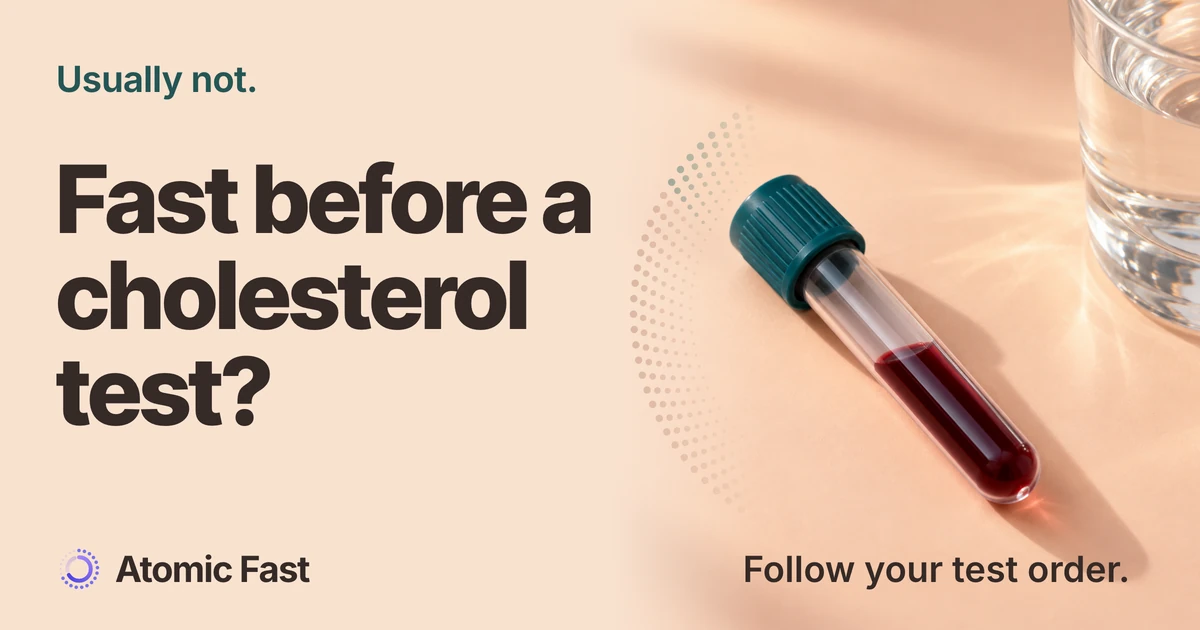
The lab slip says “lipid panel.” The appointment is at 8:15 a.m. Somewhere you picked up the rule that you can’t eat for 12 hours beforehand, and you’ve also been eating between noon and 8 p.m. for a few months. So does your usual overnight fast already count? Should you push it to 16 or 24 hours for a cleaner number? Or do you even need to fast at all?
The short version
For most people, a routine cholesterol test doesn’t need fasting. Studies covering hundreds of thousands of lab samples found that a usual meal changes the standard lipid numbers only slightly, and European and US guidance now accepts a nonfasting sample for most checks. Fasting still matters when your clinician asks for it, when triglycerides come back very high, or when the same blood draw includes a fasting glucose test. If fasting is ordered, follow its exact duration, commonly 8 to 12 hours, with plain water only; do not extend it to chase a better result.
Why fasting became the rule
A standard lipid panel measures total cholesterol, HDL cholesterol and triglycerides, and usually reports LDL cholesterol too. LDL is often not measured directly. Many labs calculate it from the other three, and the classic formula, the Friedewald equation, subtracts a share of the triglyceride value. Triglycerides are the number that rises most after a meal, so a fatty breakfast could, in theory, nudge the calculated LDL.
Newer LDL calculations are available: the 2026 ACC/AHA guideline prefers the Martin/Hopkins or Sampson/NIH equation over Friedewald. The lab method matters as well as whether you ate.
Concern about triglycerides helped make fasting the default. The large trials that set cholesterol targets also tended to draw fasting blood, so doctors copied the conditions. The European Atherosclerosis Society and European Federation of Clinical Chemistry and Laboratory Medicine consensus statement (Nordestgaard et al., European Heart Journal, 2016) lists the old reasoning plainly: fasting was believed to give more standardized results, nonfasting results were seen as less accurate, and nobody had agreed which nonfasting values to flag as abnormal.
Fasting also has costs: people put off tests they have to arrive hungry for, and some people with diabetes risk low blood sugar while waiting.
How results differ after a usual meal
The case for dropping the rule comes from very large datasets in which people had blood drawn whenever they happened to have last eaten, comparing different people at different times since their last meal. These were not controlled feeding experiments.
The biggest came from Calgary. Sidhu and Naugler (Archives of Internal Medicine, 2012) looked at lab results from 209,180 people, grouped by how long they had fasted, using hourly categories from 1 through 16 hours. The first included shorter fasts and the last included fasts longer than 16 hours. Average total cholesterol and HDL cholesterol barely differed between groups. Calculated LDL varied by up to about 10% and triglycerides by up to about 20%.
The 2016 consensus also reported an updated analysis of 92,285 Copenhagen adults. The largest average differences within one to six hours of habitual meals were about −0.2 mmol/L (−8 mg/dL) for LDL and +0.3 mmol/L (+26 mg/dL) for triglycerides. Those are differences between groups, not a forecast of what your breakfast will do to your own result.
The consensus statement put these and other cohorts side by side, including 26,330 women in the US Women’s Health Study and 12,744 children from the National Health and Nutrition Examination Survey (NHANES).
Six reported groups · nonfasting versus fasting
How do the results differ?
Largest average change seen 1 to 6 hours after people's usual meals, compared with fasting samples. Both panels use the same mg/dL scale.
Triglycerides higher in nonfasting samples
-
Calgary lab records
+26 mg/dL (+21%)
-
Copenhagen, no diabetes
+18 mg/dL (+14%)
-
Copenhagen general population
+26 mg/dL (+21%)
-
US Women's Health Study
+18 mg/dL (+16%)
-
US NHANES children
+9 mg/dL (+10%)
-
Copenhagen with diabetes
+18 mg/dL (+11%)
LDL cholesterol lower in nonfasting samples
-
Calgary lab records
−4 mg/dL (−4%)
-
Copenhagen, no diabetes
−12 mg/dL (−9%) · see note
-
Copenhagen general population
−8 mg/dL (−6%) · see note
-
US Women's Health Study
−8 mg/dL (−5%)
-
US NHANES children
−4 mg/dL (−4%)
-
Copenhagen with diabetes
−23 mg/dL (−25%) · see note
These are group averages from different people who had or hadn't eaten, not the change in one person.
There’s a twist in the LDL drop. In the Copenhagen data, the dip in total and LDL cholesterol a few hours after eating was no longer statistically significant once the researchers adjusted for albumin, a blood protein they used as a marker of how much fluid people had taken in. That is consistent with dilution from fluid intake, the explanation favored by the authors. Statistical adjustment does not by itself prove the cause. Since water is allowed before a fasting test too, the consensus authors note a similar dip can appear in a fasting sample.
These are maximal mean changes, the largest average gap seen at any point in the first six hours after eating. They are averages across thousands of people. The consensus says most people respond modestly but that, rarely, someone has an exaggerated response.
Can a nonfasting result still help assess heart risk?
Mora and colleagues (JAMA Internal Medicine, 2019) compared fasting and nonfasting samples from the same 8,270 people, taken four weeks apart before treatment began in ASCOT-LLA. Over a median 3.3 years, 212 major coronary events occurred. Higher LDL was associated with greater risk using either sample.
The calculated cardiovascular risk category agreed for 94.8% of participants under the study’s 2013 ACC/AHA risk classification. High agreement supports routine nonfasting testing; it does not mean every person’s values or treatment decision will be identical.
Participants had hypertension and other cardiovascular risk factors, were mostly men, and were mostly White. This was a secondary analysis of a drug trial; fasting status itself was not randomized. Four weeks between samples also allows ordinary day-to-day variation. The findings support the clinical guidance, with these limits on generalizing to everyone.
When fasting still matters
The 2016 European consensus recommends nonfasting samples for routine lipid testing, including first tests, cardiovascular risk checks, children, older adults, people on stable medication and people with diabetes (partly because fasting can bring on low blood sugar in people who use glucose-lowering drugs). It reserves fasting for specific situations:
- Very high triglycerides. If a nonfasting triglyceride result is above 5 mmol/L (440 mg/dL), the consensus suggests repeating the test fasting.
- Known or suspected triglyceride disorders. This includes people followed in a lipid clinic, people recovering from pancreatitis caused by high triglycerides, and people starting a medication that can push triglycerides very high.
- Other tests in the same draw. If the order also includes fasting glucose or another test that needs a fasting or morning sample, you fast for those anyway.
The 2026 ACC/AHA multisociety dyslipidemia guideline also accepts both types of sample in Section 3.2: either a fasting or nonfasting profile is acceptable for baseline testing, and a fasting profile should be done when a nonfasting triglyceride result is 400 mg/dL (4.5 mmol/L) or higher, or when there’s a family history of lipid disorders or premature heart disease, or a known or suspected triglyceride disorder. The European and US triglyceride cut-offs differ slightly, so follow whichever your clinician uses.
Fasting glucose is a separate case. That test, by definition, needs at least 8 hours without food or drinks other than water, according to MedlinePlus. An HbA1c test, which reflects average blood sugar over about three months, doesn’t need fasting.
None of this overrides the instructions on your test order. Many clinics still ask for a fast as a matter of routine, and MedlinePlus’s cholesterol test page still says you may need to fast for 9 to 12 hours. If your order says fast, fast. If it doesn’t say, ask; it is a quick question, and the answer may save you a hungry morning.
If you already fast every day
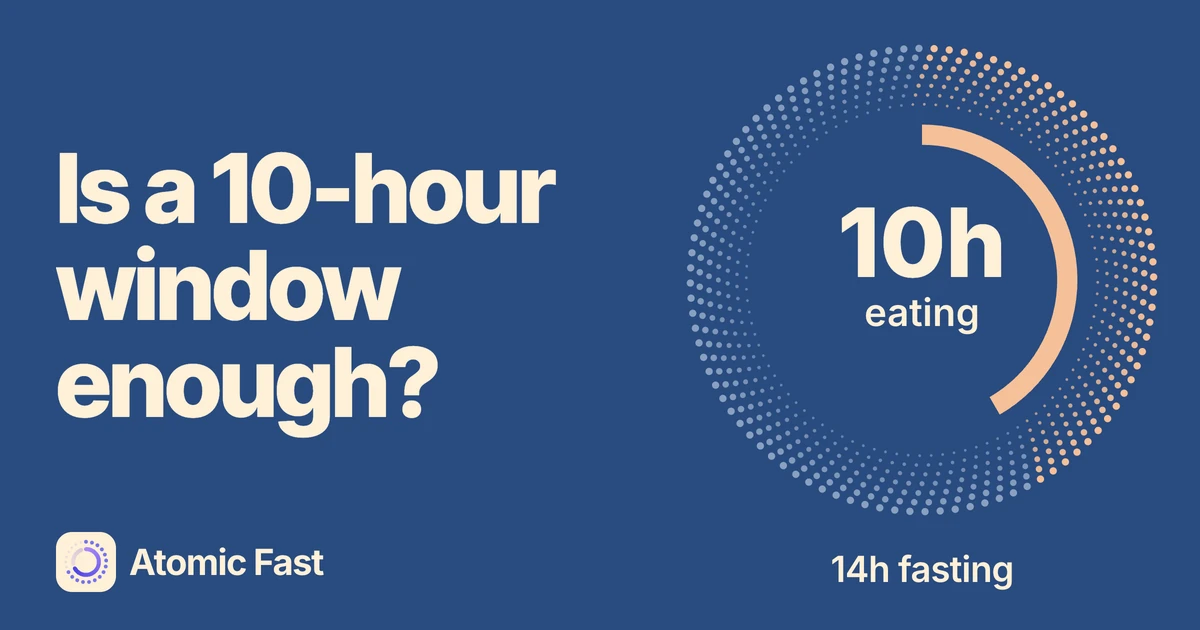
Compare your appointment time with the duration on the order. If you finish eating at 8 p.m. and have blood drawn at 8 a.m., that is 12 hours without food. It fits a 12-hour order even if you normally wait until noon to eat. You do not need to keep fasting after the blood draw for the test’s sake. If your appointment would make the fast longer than requested, ask the clinic how to arrange it.
Illustrative example · a noon to 8 pm eating window
Match the fast to the test order.
-
Fasting test ordered
Finish eating 8 pm, water only, blood drawn at 8 am: 12 hours.
-
Nonfasting test
Usual window both days, blood drawn at 3 pm after lunch.
Fasting for a blood test means plain water only: no coffee, gum, smoking or exercise. Ask beforehand about your usual medicines.
A few details matter:
- “Fasting” for a blood test means water only. MedlinePlus’s fasting guidance says juice, coffee, soda and other drinks can affect results, and also lists chewing gum, smoking and exercise as things to avoid. Many people count black coffee as fine during a daily eating-window fast; a fasting lab order is a different set of rules.
- Usual medicines are a question for your clinician. MedlinePlus advises not stopping prescribed medicines unless told to, and asking ahead of time whether to take them that morning. This matters most if you take insulin or other glucose-lowering drugs.
- A nonfasting order means eat normally. If your test doesn’t require fasting, you don’t need to skip breakfast or shift your window. The consensus does suggest avoiding a very high-fat fast-food meal right before a nonfasting test, since that behaves more like a deliberate fat challenge than a usual meal.
- Say what you did. If you fasted for 15 hours because that’s your routine, mention it. The consensus uses different triglyceride flags for fasting and nonfasting samples (1.7 versus 2 mmol/L, or 150 versus 175 mg/dL), so the label on the sample matters.
Do not extend a fast to prepare for the test
A longer fast is a different physiological condition, not a way to clean up a test result.
In Sävendahl and Underwood’s 1999 study, 14 healthy young adults without obesity entered a supervised seven-day fast. Four women withdrew after one to four days; the analysis included the 10 completers. They consumed mineral water and a daily multivitamin, with supervised walks.
Among completers, average LDL rose from 2.95 to 4.90 mmol/L (about 114 to 189 mg/dL). The authors reported a mean individual increase of 66%. Triglyceride and HDL changes were not statistically significant. This small uncontrolled study cannot tell us what a 24-hour fast would do, or how other groups would respond. It does show why a multiday fast should not be treated as ordinary preparation.
Extended fasting carries other changes too. If that is already part of your routine, tell your clinician before booking the test. Let them decide the appropriate sampling conditions rather than changing your diet to produce a particular number.
How much to trust this
Large datasets are useful for showing average differences. They are less useful for predicting an individual’s result. The Calgary study relied on people’s recall of when they last ate, had no detailed meal or medication information, and omitted calculated LDL when triglycerides exceeded 400 mg/dL. People arriving after different fasting lengths may differ in other ways too.
The paired ASCOT analysis addresses some of that uncertainty by testing the same people both ways, but its older, higher-risk population limits how broadly we can apply it. Neither modest average differences nor a nonsignificant comparison proves that fasting and nonfasting testing are interchangeable in every clinical situation.
The six rows in the first graphic summarize older studies in the European consensus. Some Copenhagen participants overlap between reports; the rows are not six independent replications. The larger LDL dip in people with diabetes is another reason to avoid treating an average as a personal prediction.
The practical recommendation rests on clinical guidance and the broader evidence, not on the small seven-day fasting experiment. This article addresses preparation, not whether a particular cholesterol result needs treatment.
What to do with this
- Read the order first. It decides whether you fast, for how long, and whether coffee or medicines are allowed. If it’s unclear, ask before the day.
- If fasting is required, aim for the stated window with water only. Work backward from the appointment time. If you track your overnight fast in Atomic Fast, the timer shows how many hours have passed since you started it, so you can see whether you’ve reached the length your order asks for. It counts time; it doesn’t measure anything in your blood.
- If fasting isn’t required, eat as you normally would. Skip an unusually heavy fast-food meal right before, but don’t rearrange your window.
- Don’t add an extended fast before a routine test. It can change the result rather than make it more representative of your usual routine.
- Be careful with glucose-lowering medicines. Long fasts with insulin or similar drugs can cause low blood sugar; this is one reason guidance favors nonfasting tests for many people with diabetes. Check with your clinician first, and look at who should talk to a doctor before fasting.
Frequently asked questions
Is 12 hours of fasting enough for a cholesterol test? When fasting is requested, yes for most orders: the usual instruction is about 8 to 12 hours, and MedlinePlus’s cholesterol page mentions 9 to 12. Follow the exact time on your order.
Can I drink black coffee before a fasting cholesterol test? Not if the order says to fast. Blood-test fasting means plain water only, and MedlinePlus lists coffee among the drinks that can affect results. For a nonfasting order, follow any other preparation instructions the clinic gives you.
Will eating before a cholesterol test make my results look worse? Usually not by much. In large lab datasets, nonfasting groups had triglycerides about 9 to 26 mg/dL higher on average and generally had slightly lower calculated LDL. Fluid intake may explain some of the LDL difference. A very high triglyceride result may need repeating while fasting.
Does intermittent fasting change cholesterol results? Tell the clinic your usual eating window and follow the requested sampling conditions. An overnight fast may already fit the order, but a longer fast should not automatically be treated as equivalent. Whether intermittent fasting changes cholesterol over months is a separate question.
Should I fast longer than 12 hours to be safe? Follow the duration you were given. Adding hours is not part of the usual preparation, and a multiday fast can alter lipid levels. If your appointment is delayed or your routine would exceed the requested time, check with the clinic.
Sources
Sources checked: October 23, 2026. Full research reports were reviewed for the central claims; the older six-cohort graphic follows the consensus table.
- Nordestgaard BG, Langsted A, Mora S et al. (2016), Fasting is not routinely required for determination of a lipid profile, joint consensus statement of the European Atherosclerosis Society and European Federation of Clinical Chemistry and Laboratory Medicine. European Heart Journal 37:1944–1958 — Full text read. Supports the maximal mean meal changes, the study comparison table, fluid-intake explanation, fasting exceptions and flagging thresholds. A consensus statement built on observational data, not a trial.
- Sidhu D, Naugler C (2012), Fasting time and lipid levels in a community-based population: a cross-sectional study. Archives of Internal Medicine 172:1707–1710 — Full text reviewed. Cross-sectional lab records from 209,180 people; self-reported fasting, different people at each interval, and no calculated LDL when triglycerides exceeded 400 mg/dL.
- Mora S, Chang CL, Moorthy MV, Sever PS (2019), Association of nonfasting vs fasting lipid levels with risk of major coronary events in ASCOT-LLA. JAMA Internal Medicine 179:898–905 — Full text reviewed. Paired samples in 8,270 participants before drug randomization; fasting itself was not randomized. Mostly White men with hypertension and other risk factors.
- Sävendahl L, Underwood LE (1999), Fasting increases serum total cholesterol, LDL cholesterol and apolipoprotein B in healthy, nonobese humans. Journal of Nutrition 129:2005–2008 — Full report reviewed. Supervised seven-day fast; 14 enrolled, 10 completed. Small uncontrolled experiment; not evidence for routine overnight preparation.
- ACC/AHA and partner societies (2026), Guideline on the Management of Dyslipidemia. Circulation — Section 3.2 of the primary guideline checked, along with the June and September corrections. Neither correction changes the fasting recommendations. Clinical guidance, not a new fasting trial.
- MedlinePlus, Fasting for a Blood Test — Patient instructions: water only, usually 8 to 12 hours, no coffee, gum, smoking or exercise, and medicine questions for your provider. General preparation guidance, not test-specific.
- MedlinePlus, Cholesterol Levels — Explains the test and says preparation may include a 9- to 12-hour fast. Your own order determines whether that applies.
- MedlinePlus, Blood Glucose Test — Fasting glucose requires at least 8 hours with water only; HbA1c doesn’t require fasting.
Want to see how long your overnight fast has actually been before a morning test? Atomic Fast’s free timer counts the hours. Download on the App Store or get it on Google Play.
This article is for general education and isn’t medical advice. If you’re pregnant, managing a health condition, taking medication, have a history of disordered eating, or are considering fasts longer than 24 hours, talk to a healthcare professional first.
Try Atomic Fast free
Track your fasts, log your meals, and see how they affect each other, on iPhone and Android.


 Scan to download