Acid Reflux While Fasting: Coffee, Bedtime and Big Meals
Heartburn during intermittent fasting? Learn what a small 16:8 study found, how coffee and meal timing may affect symptoms, and when to get medical advice.
Last updated
You started fasting because you wanted to feel lighter. Instead, there’s a burn behind your breastbone, and at night you taste something sour at the back of your throat. Some people feel better on a fasting routine; others feel worse. The research is too limited to predict your response.
The short version
Heartburn happens when stomach contents leak back up into your esophagus. A small 16:8 study found lower symptom scores over two fasting days, but the change in measured acid was uncertain. That doesn’t establish fasting as a reflux treatment or rule out worsening symptoms for some people. Check possible triggers such as coffee and eating close to bedtime, and get chest pain, trouble swallowing or symptoms that won’t settle assessed by a doctor.
What’s actually leaking
A ring of muscle at the bottom of your esophagus, the lower esophageal sphincter, normally closes after food passes into the stomach. MedlinePlus explains that when it doesn’t close all the way, stomach contents can leak back up. That’s reflux. Heartburn is how it often feels: a burning in the middle of the chest that can rise toward the throat, sometimes with food or acid coming back into your mouth.
Reflux now and then is normal. MedlinePlus notes that heartburn more than twice a week may mean GERD, the chronic form.
MedlinePlus also lists the risk factors, and one of them matters a lot for fasting: lying down within 3 hours after eating. It adds that symptoms often get worse when you bend over or lie down, after you eat, and at night.
What the one 16:8 study found
Researchers at Stanford took 25 people who were already booked for a 96-hour wireless pH test to check their reflux symptoms, off acid-suppressing medicine. For the first two days they ate normally. For the second two, they were asked to fast for 16 hours and eat in an 8-hour window. The study was published in the Journal of Clinical Gastroenterology.
Three findings are worth knowing:
- Sticking to it was hard. Only 9 of the 25 fully followed the fasting schedule, though 21 managed it at least partly.
- Symptoms eased. Combined heartburn and regurgitation scores dropped from 14.3 on the normal days to 9.9 on the fasting days.
- The acid result was uncertain. The share of time with acid in the esophagus went from 4.3% to 3.5%. The estimated change’s 95% confidence interval ran from a 2.32-percentage-point reduction to a 1.05-point increase. The authors called it “weak statistical evidence” that fasting “mildly reduces acid exposure.”
How much to trust this
Not much, and the authors don’t oversell it. Twenty-five people, two days of each pattern, no separate control group, and most didn’t fully stick to the schedule. People also knew when they were fasting, which matters when the main gain is in how they rated their own symptoms.
The useful observation is narrower: symptom scores improved on average during the two fasting days. That doesn’t show everyone improved, establish long-term safety, or tell you how your reflux will respond.
Where a fasting routine can make it worse
Black coffee as breakfast. Plain coffee is a common choice during fasting hours. But the NIDDK lists coffee and other sources of caffeine among drinks that can trigger reflux symptoms in some people. If your new routine includes more coffee, it could be one contributor. That doesn’t establish a special effect from drinking it on an empty stomach.
A late window. If your window runs noon to 8 p.m. and you go to bed at 9, your biggest meal is landing an hour before you lie flat. The NIDDK suggests eating meals at least 3 hours before you lie down or go to bed if your symptoms come at night. A later window makes that harder; an earlier one makes it easy.
One huge meal. Compressing a day’s food into a short window pushes people toward fewer, bigger meals, the same habit behind a lot of the bloating people blame on fasting. MedlinePlus notes that symptoms can get worse after eating, and a very full stomach before bed is a plausible way to make that worse. This is a reasonable inference rather than something the fasting studies tested, so treat it as a thing to try, not a rule.
Trigger foods in the first meal. The NIDDK’s list of common culprits includes citrus, tomatoes, alcohol, chocolate, mint, spicy food and high-fat food. Pizza and a beer to break the fast hits several at once.
Painkillers taken during the fast. MedlinePlus advises people with reflux to avoid aspirin, ibuprofen and naproxen where they can, and to take medicines with plenty of water. If you take any regular medicine with food, don’t move it into your fasting hours without asking whoever prescribed it.
What to do with this
Move your window earlier if you can. Ending the window 3 hours or more before bed is the single change the official advice lines up behind. If you’re still settling on a schedule, how to choose a window you’ll actually keep walks through it.
Cut the fasting-hours coffee down before you cut it out. Try one cup instead of three, or swap one for plain water or a non-mint herbal tea, and see if the morning burn changes.
Split the food. Two moderate meals in the window instead of one large one. Make the last one the smaller of the two.
Test one trigger at a time. If tomato sauce or wine seems to set you off, drop it for a week and watch. One change at a time tells you something; five at once tells you nothing.
Raise your head and upper back. For night symptoms, the NIDDK suggests lifting your head and upper back 6 to 8 inches with a foam wedge or extra pillows under them.
Check medicine timing when you move the window. If you take a proton pump inhibitor (PPI), ask your doctor or pharmacist how to time it when your eating window moves. American College of Gastroenterology guidance explains why timing relative to meals matters for many PPIs.
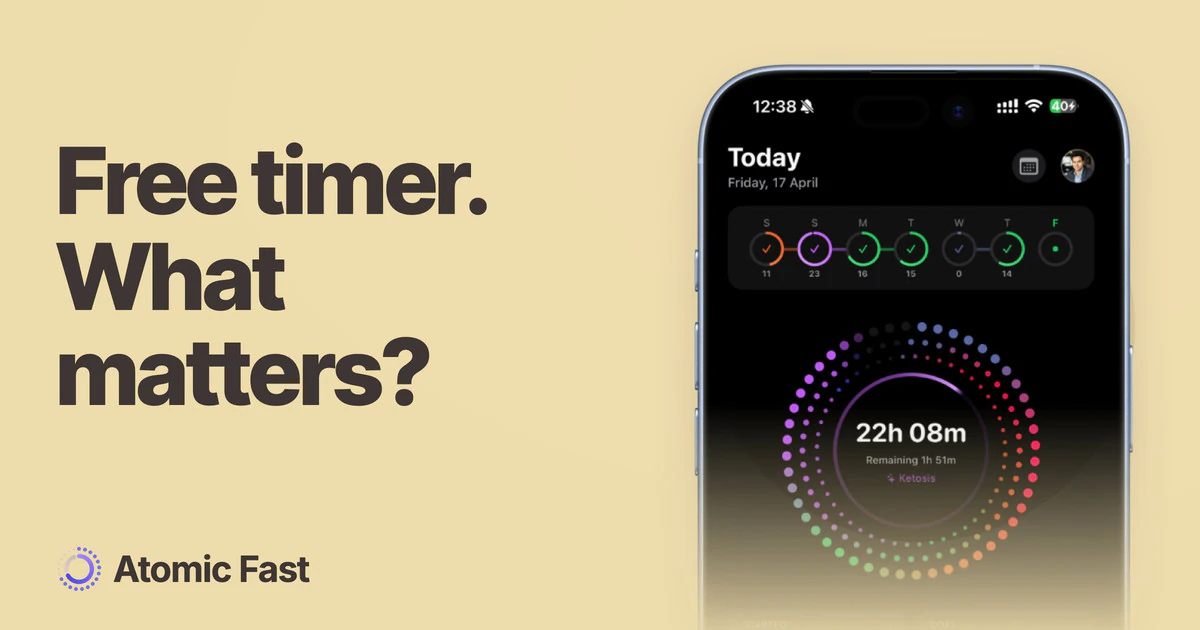
In Atomic Fast, the free timer shows how long you’ve been fasting, and the daily timeline puts today’s fast and meals on one row. It won’t tell you what’s causing your heartburn, but it makes it easy to see when you last ate.
When it isn’t just heartburn
The NIDDK says to see a doctor if you think you have GERD, or if symptoms don’t improve with over-the-counter medicines or lifestyle changes. It also lists signs that need a doctor sooner: chest pain, loss of appetite, persistent vomiting, trouble or pain swallowing, vomit with blood or that looks like coffee grounds, black or bloody stool, and unexplained weight loss.
And one that needs help right away: MedlinePlus warns that crushing chest pain could be a heart attack. Don’t sit through it assuming it’s the fast.
If you take medicine for blood pressure, asthma, sleep or anxiety, several of those can bring on reflux, per MedlinePlus. Talk to your doctor before changing anything yourself.
Frequently asked questions
Can intermittent fasting cause acid reflux? The evidence is too limited to give a firm answer. Coffee, meal size and eating close to bedtime may contribute when your routine changes. If symptoms worsen, don’t assume they’re harmless or something to push through to finish the fast.
Why do I get heartburn on an empty stomach? Coffee can be a trigger for some people, but an empty stomach doesn’t identify the cause. If burning happens often or without any food or drink, mention it to a doctor; other problems can feel similar.
Does fasting help GERD? There’s a hint, not a verdict. One two-day trial of 25 people found lower symptom scores on fasting days, but the change in measured acid was small and statistically weak. Don’t use fasting in place of treatment your doctor recommends.
Can I take antacids while fasting? An occasional antacid tablet is a medicine, not a meal, and it’s unlikely to matter for a fast aimed at weight or blood sugar. Check the label for added sugar. The NIDDK says not to use antacids every day or for severe symptoms unless you’ve discussed it with your doctor.
How long before bed should my window close? At least 3 hours if your reflux shows up at night, according to the NIDDK. On a 16:8 schedule with an 11 p.m. bedtime, that means finishing by 8 p.m. at the latest.
Sources
Sources checked: October 11, 2026.
-
Jiang Y et al. (2023), The Impact of Intermittent Fasting on Patients With Suspected Gastroesophageal Reflux Disease. Journal of clinical gastroenterology — The 25-person reflux study; only nine fully adhered, and the acid-exposure confidence interval crossed no change.
-
MedlinePlus — Gastroesophageal reflux disease — Explains reflux, common risk factors and medicine considerations.
-
MedlinePlus — Heartburn — Distinguishes recurrent heartburn and urgent chest-pain symptoms.
-
NIDDK — Eating, Diet, & Nutrition for GER & GERD — Lists individual food triggers and the three-hour pre-bedtime meal interval.
-
Katz PO et al. (2022), ACG Clinical Guideline for the Diagnosis and Management of Gastroesophageal Reflux Disease. The American journal of gastroenterology — Clinical guideline on diagnosis and treatment, including PPI timing relative to meals.
-
NIDDK — Symptoms & Causes of GER & GERD — Lists persistent symptoms and warning signs that need assessment.
-
NIDDK — Treatment for GER & GERD — Covers treatment options, upper-body elevation and limits on self-treatment.
Track your fasting window and meals with Atomic Fast, free on the App Store and Google Play.
This article is for general education and isn’t medical advice. Chest pain can be a heart problem, so get help right away if it’s severe or crushing. If you’re pregnant, managing a health condition, taking medication, have a history of disordered eating, or have reflux that won’t settle, talk to a healthcare professional before starting or changing a fasting routine.
Try Atomic Fast free
Track your fasts, log your meals, and see how they affect each other, on iPhone and Android.


 Scan to download