12:12 Fasting: The Gentlest Way to Start
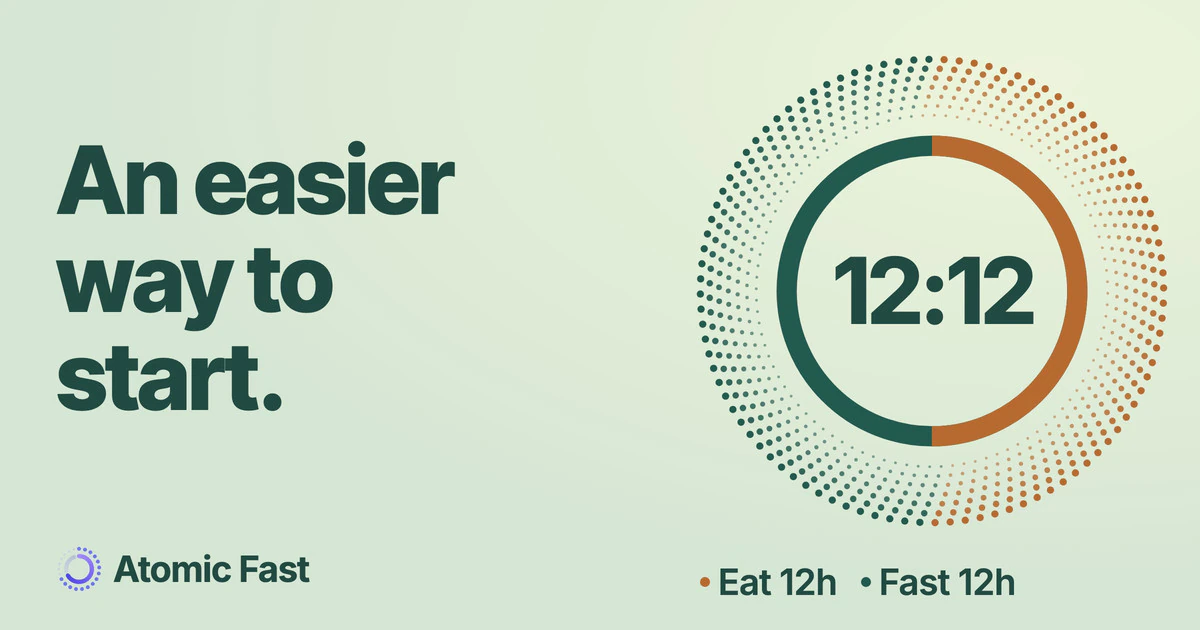
12:12 fasting means a 12-hour eating window and a 12-hour fast. It's the smallest, easiest step into intermittent fasting and a realistic on-ramp before 16:8.
Last updated
Most fasting advice drops you straight into 16:8, which means 16 hours without food on day one. If you normally eat from 7am to 10pm, that’s a big leap, and big leaps are where beginners quit by Thursday. 12:12 is the version nobody tries to sell you, because it sounds too easy to need a plan. It can be a manageable option for some adults; it is not a requirement or medical clearance.
The short version
12:12 means eating within twelve hours, such as 8 a.m. to 8 p.m., with the other twelve outside the eating window. For some adults it resembles an ordinary overnight interval; for others it would change meal timing. It does not promise weight loss or need to progress to a narrower window. Medical suitability and adequate meals matter more than completing the ratio.
What 12:12 actually is
12:12 splits your day in half. Twelve hours you eat, twelve hours you don’t. Pick a window that fits your life. 8am to 8pm is the common one, but 9am to 9pm or 7am to 7pm work just as well. Anything with calories happens inside the window; outside it, you stick to water, black coffee or plain tea.
The approachable part is that you’re already doing most of it, because you fast while you sleep. Finish dinner at 8pm, eat breakfast at 8am, and that’s a 12-hour overnight fast you didn’t plan. 12:12 just asks you to be deliberate about the edges: no midnight cereal, no eating the second your eyes open.
Why start gentle instead of jumping to 16:8
The usual pitch is 16:8, and it’s a fine target. But going from grazing all day to a 16-hour fast overnight sets up a rough first week, and a rough first week is when a lot of people give up. Your body needs a runway. Johns Hopkins neuroscientist Mark Mattson, who has studied intermittent fasting for 25 years, says it can take two to four weeks before the body becomes accustomed to it, and that you might feel hungry or cranky while you adjust. A smaller window makes that adjustment smaller, which is worth knowing before you decide how hard to push in the first week of a new fasting routine.
Mattson’s own advice points the same way. In an interview for the Johns Hopkins Patient Guide to Diabetes, he suggests easing in by narrowing the window gradually: fast for 10 hours for a month, then move up to 12.
There’s also the plain matter of sticking with it. A schedule only helps if you keep it, and the easiest one to keep is the one that barely touches your day. If 12:12 feels like nothing, good. You’re building the habit before you add the difficulty.
Does 12 hours do anything, or is it just training wheels?
Twelve hours is a way to organize meals, not a guaranteed metabolic threshold. If it reduces late snacking while leaving adequate meals in place, it may change intake. Someone already eating within twelve hours may change very little.
You do not need to treat it as training for a longer fast. The sources here do not establish that everyone should progress to 14:10 or 16:8, or that twelve hours produces a specific health benefit regardless of what happens during the rest of the day.
How to run your first two weeks
Keep it simple:
- Build the 12 hours around meals you already eat. If dinner is your anchor at 7pm, the window opened at 7am.
- Use the same window every day for the first week. Consistency matters more than which 12 hours you pick.
- Drink through the fasting hours. Water first; black coffee and plain tea are fine and help keep hunger in check.
- Don’t overhaul your food at the same time. Get the timing steady, then look at what’s on the plate.
- If a day falls apart, start again the next morning. Missing one window undoes nothing.
There is no two-week deadline for the routine to feel automatic, and no requirement to narrow it. Our example 16:8 day illustrates a different schedule rather than the next compulsory step. When you do tighten the window, it pays to pick one you’ll actually keep rather than the most aggressive number you can stand.
When 12:12 is a fine place to stay
Not everyone needs a 16-hour fast. If 12:12 fits your life and you feel good, no rule says you have to go further. Longer windows aren’t a scoreboard. Plenty of people get what they wanted (steadier eating, fewer late calories, a simple structure) from a 12-hour window and never tighten it. The best window is the one you’ll still be doing in six months.
Who should skip it or check with a doctor first
Gentle as it is, fasting isn’t for everyone. Cleveland Clinic lists groups for whom intermittent fasting isn’t safe: people who are pregnant or nursing, children, people who are malnourished or have hypoglycemia, and people with certain chronic diseases. It adds that anyone with a history of eating disorders needs medical supervision. If you take medication that has to be paired with food, insulin and some other diabetes drugs especially, a fasting window can change how it works, so that’s a conversation for your doctor, not an app.
Where Atomic Fast fits
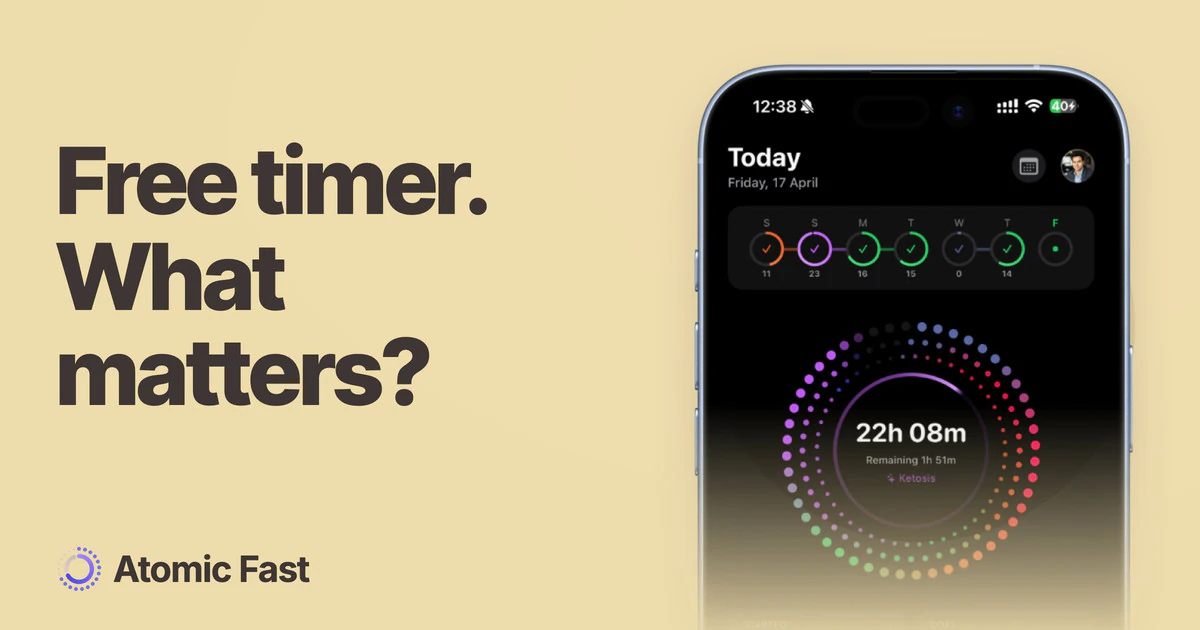
If you want something to hold you to the window, the app’s free timer does that job. You start the fast yourself (now, backdated to your last logged meal, or scheduled for later), and it counts the hours and names the stage you’ve reached. On a 12:12 day you’ll spend most of the fast in the early stages, and that’s the point. When you log dinner, by photo, a typed description or a barcode, the app estimates when digestion will be complete based on when you ate and what was in the meal, but this is separate from the timer. The fasting record starts at the time you choose, not when estimated digestion finishes.
Frequently asked questions
Is 12:12 really intermittent fasting? Yes. Any consistent daily eating window paired with a matching fasting window counts as time-restricted eating. Twelve hours is the gentle end of the range, not a different thing entirely.
Will I lose weight on 12:12? Maybe, if cutting the late-night eating leaves you in a mild calorie deficit. The window itself doesn’t burn fat; eating a bit less does. If the scale won’t move, look harder at the 12 hours you eat than the 12 you don’t.
Can I drink coffee during the fasting hours? Black coffee and plain tea are fine, at a few calories at most. What undoes it is what you add: milk, sugar, cream, sweet drinks.
How soon should I move to 16:8? There’s no deadline. A week or two of steady 12:12 is a reasonable point to try 14:10 if you want to narrow, but staying at 12:12 is a real choice, not a failure to advance.
What helps in the hungry moments? Hunger can vary, but it has no guaranteed expiry. Eat if you need to, and stop for dizziness, shakiness or feeling unwell rather than using water to suppress symptoms.
Sources
Sources checked: October 11, 2026.
-
Johns Hopkins Medicine — Intermittent Fasting: What is it, and how does it work? — General clinical education and groups advised not to fast; an adjustment estimate is not a symptom-safety rule.
-
Johns Hopkins Patient Guide to Diabetes — An Overview of Intermittent Fasting — Discussion of gradual schedule changes; does not establish exact biological thresholds.
-
Cleveland Clinic — Intermittent fasting types — Clinical precautions and groups for whom fasting may be unsuitable.
Start your first 12:12 day with Atomic Fast, free on the App Store and Google Play.
This article is for general education and isn’t medical advice. If you’re pregnant or breastfeeding, managing a health condition, taking medication (especially for diabetes), or have a history of disordered eating, talk to a healthcare professional before starting a fasting routine.
Try Atomic Fast free
Track your fasts, log your meals, and see how they affect each other, on iPhone and Android.


 Scan to download