Intermittent Fasting Glossary: 16:8, OMAD, TRE and More
16:8, OMAD, TRE, 5:2, autophagy, ketosis, clean fast: what the intermittent fasting terms actually mean, which claims are oversold, and the three you need to start.
Last updated
You decide to try fasting, read one forum thread, and walk away more confused than when you started. 16:8. OMAD. TRE. Clean fast, dirty fast. Autophagy. Somebody swears by 14:10 while somebody else says anything short of OMAD is a waste of time.
Most of it sounds like jargon because it’s written like jargon. Strip the labels away and almost all of these words describe one small idea: when you eat and when you don’t. Here’s what each term means, and which ones you can ignore on day one.
The short version
Nearly every fasting term names a schedule: how many hours you don’t eat versus how many you do. 16:8, 14:10, OMAD and 5:2 are all schedules, and TRE is the umbrella the daily ones sit under. The science words (ketosis, autophagy, the metabolic switch) describe real things, but they get quoted with far more certainty than the human evidence supports, so treat any exact “this happens at hour X” claim with suspicion. You need about three of these terms to start. The rest you’ll pick up as you go.
The schedules (the ones that actually matter)
Intermittent fasting (IF). The umbrella term for eating in a pattern of “eat” and “don’t eat” periods, rather than grazing from morning to midnight. It isn’t a diet in the “these foods are banned” sense. It’s about timing, not a menu.
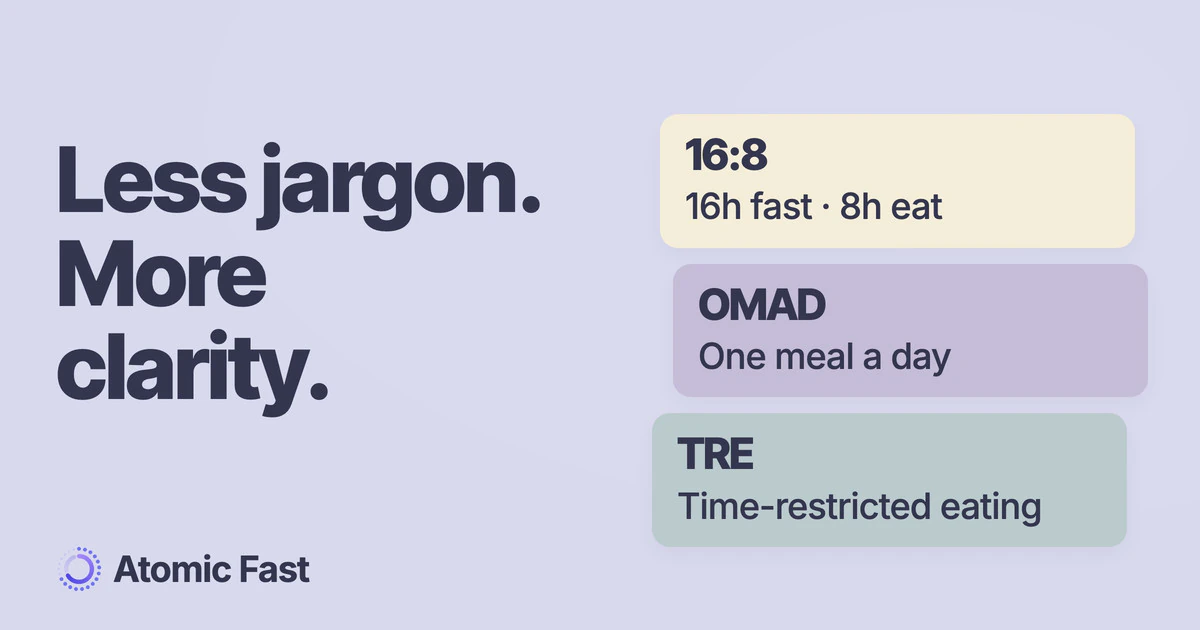
Time-restricted eating (TRE). The most common kind of IF: you eat within a set window each day and fast the rest. If someone says they do 16:8, they’re doing TRE. Research papers sometimes call it TRF, time-restricted feeding. Same idea.
Eating window / fasting window. The two halves of a TRE day. The eating window is when food is allowed; the fasting window is everything else, including the hours you’re asleep. An “8-hour window” means eight hours to eat and sixteen to fast.
16:8. The classic: sixteen hours fasting, eight eating. A typical version is eating between noon and 8 p.m., which for most people just means skipping breakfast. It’s popular because it’s livable, not because eight hours is a magic number.
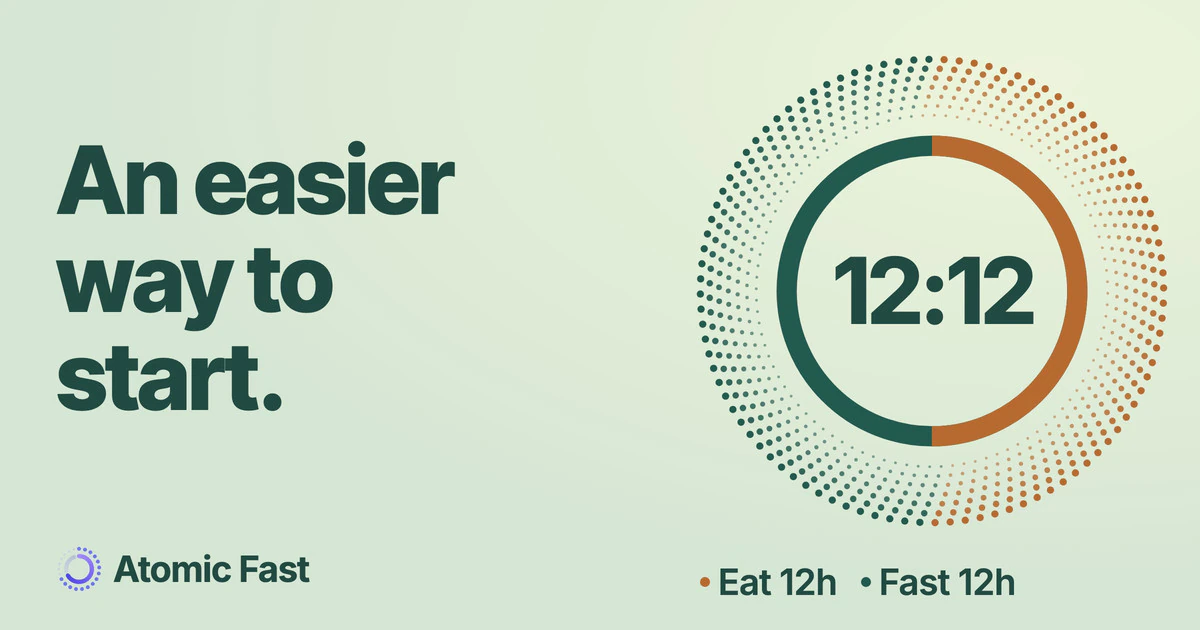
14:10 and 12:12. The gentler versions, with a 10- or 12-hour eating window. Easier to keep, especially at the start, and a 10-hour window still moves things: in a 2024 randomized trial in adults with metabolic syndrome, an 8- to 10-hour window modestly improved blood sugar on top of standard care. If 16:8 feels brutal, begin here.
OMAD. “One meal a day.” A very short eating window, often an hour or two, with everything packed into a single sitting. It’s demanding, it’s easy to under-eat on, and you don’t need it to get results. If you’re weighing it against gentler patterns, we compared which schedule tends to fit which kind of life.
5:2. A weekly pattern instead of a daily one. You eat normally five days a week and keep calories low, often around 500 to 600, on two non-consecutive days. Some people find “normal most days” easier to live with than a daily window.
Alternate-day fasting (ADF). Very-low-calorie days alternating with normal eating days. It’s one of the harder schedules to stick with. In a year-long trial in JAMA Internal Medicine, 38% of the alternate-day group dropped out, against 29% of people on ordinary daily calorie restriction, and weight loss ended up about the same.
Early TRE (eTRE). A window placed toward the earlier part of the day. The exact hours differ across studies, so check the study’s definition rather than assuming every early window means dinner at the same time.
The mechanism words (real, but oversold)
The metabolic switch. The point in a fast when your liver’s glycogen runs low and your body shifts toward burning fat and making ketones. A 2018 review in Obesity puts it “typically beyond 12 hours” after your last food, but that shifts with your last meal, your activity and your own metabolism. Treat 12 hours as a ballpark, not a stopwatch. For the longer version, here’s what shifts hour by hour during a fast.
Ketones and ketosis. When fat becomes a major fuel, your liver makes ketones, and ketosis is the state of running meaningfully on them. Ketone production varies with food intake, activity and health; reaching hour 16 does not confirm ketosis. Acetone can affect breath, but fruity breath is not automatically harmless. With vomiting, abdominal pain, unusual thirst or deep breathing, it can be a sign of diabetic ketoacidosis and needs urgent medical attention.
Autophagy. Cellular housekeeping, where cells break down and recycle their own worn-out parts. It’s the term fasting marketing loves most, and the most oversold. Much of what we know comes from animals, and the human timing isn’t settled, so a confident “autophagy switches on at hour 16” is running ahead of the evidence. It’s a promising area, not a proven clock.
Insulin sensitivity. How well your body responds to insulin, the hormone that manages blood sugar. Better sensitivity is generally good, and long breaks from food are one reason fasting gets studied for metabolic health.
Circadian rhythm. Your internal body clock, running on roughly a 24-hour cycle. It’s why meal timing gets attention at all: your body handles food a bit differently at 8 a.m. than at 11 p.m., which is part of the case for finishing eating earlier.
The forum lingo
Clean fast vs. dirty fast. An argument about what’s allowed during the fasting window. A clean fast means water, black coffee and plain tea only. A dirty fast allows small things like a splash of cream or a diet soda. These are informal forum labels, not standardized medical categories or measures of food quality. Medical tests and procedures have their own preparation instructions.
Breaking a fast. The first food that ends your fasting window. “What breaks a fast” is one of the most argued questions in fasting, mostly over coffee, gum and zero-calorie drinks.
Refeed. The first meals after a longer fast. Refeeding risk depends on nutritional status, duration of inadequate intake and other clinical factors, not only how many days you fasted. Someone at risk needs supervised nutrition advice. For an ordinary daily window in a well-nourished adult, it usually means the next meal.
Fasted vs. fed. Usually about workouts. Training fasted means exercising during your fasting window; fed means you ate first. Both have their place depending on the session.
NSV (non-scale victory). A win the scale doesn’t show: a looser waistband, steadier energy, fewer cravings. Useful shorthand, because these often show up before the number on the scale moves.
Which of these do you actually need?
Three, to start. TRE, so you know the game is a daily window. A schedule you can keep, which for most beginners means 12:12 or 14:10 before 16:8. And breaking a fast, so you know what ends the window. Everything else can wait until you’re a week or two in and curious. The most useful early move is matching the window to your real life rather than the strictest number you saw online; here’s how to go about picking a window you’ll actually keep.
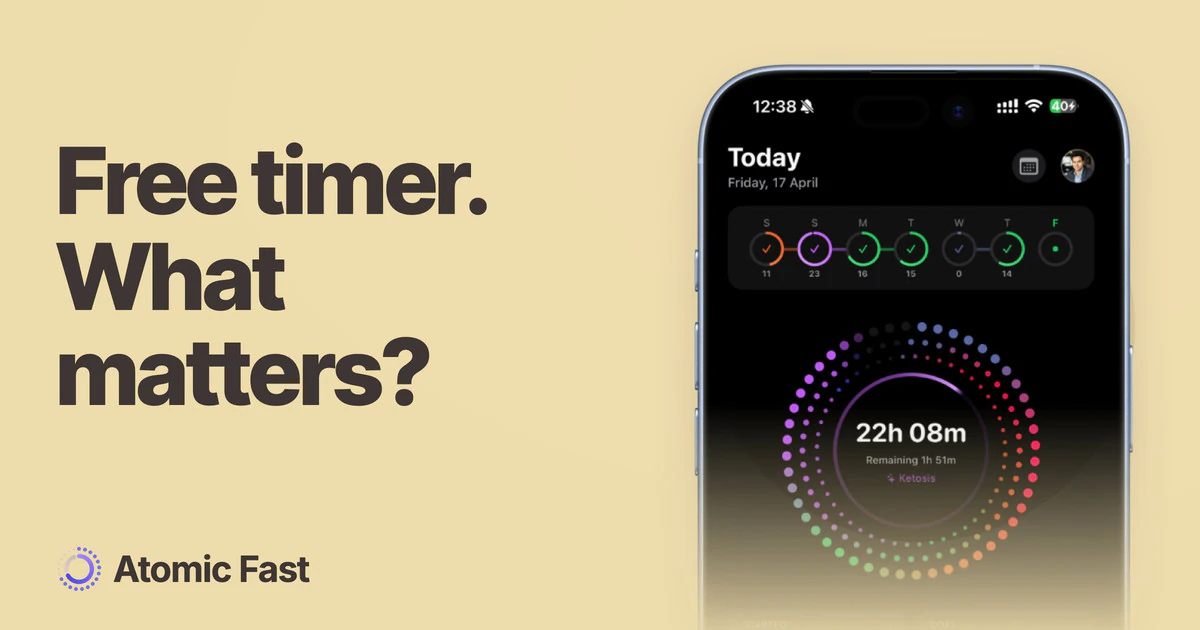
If you’d rather not keep the count in your head, Atomic Fast’s free timer counts the hours for you and applies fixed phase labels based on time elapsed. Those labels do not confirm a biological change. Optional AI meal logging can estimate food from a photo or typed description; check the result before saving.
Frequently asked questions
Is TRE the same as intermittent fasting? TRE is one type of intermittent fasting, the daily-window kind. IF is the broader family, which also includes weekly patterns like 5:2 and alternate-day fasting. All TRE is IF, but not all IF is TRE.
What’s the difference between 16:8 and OMAD? Both are daily windows; the difference is size. 16:8 gives you eight hours to eat, usually across two or three meals. OMAD squeezes everything into one short sitting. OMAD is much stricter, easier to under-eat on, and not required for results.
Does a fast really trigger autophagy at 16 hours? Nobody can put a firm human clock on it. Autophagy is real, but most precise-hour claims come from animal work or are extrapolated. It’s a reason to be curious, not a number to chase.
Do I need to memorize all of this before starting? No. Learn the terms that explain your question first. Knowing the vocabulary does not establish that fasting is suitable for you, especially with medication, pregnancy or an eating-disorder history.
What’s a “clean” fast? Water, black coffee and plain tea only during the fasting window, nothing with calories. A dirty fast allows small extras like a splash of cream. Those labels are informal. Follow your own plan’s definition, and follow separate clinical instructions for a medical fast.
Sources
Sources checked: October 11, 2026.
-
Manoogian ENC et al. (2024), Time-Restricted Eating in Adults With Metabolic Syndrome : A Randomized Controlled Trial. Annals of internal medicine — An 8–10-hour intervention in adults with metabolic syndrome; does not establish that every beginner benefits from the same window.
-
Trepanowski JF et al. (2017), Effect of Alternate-Day Fasting on Weight Loss, Weight Maintenance, and Cardioprotection Among Metabolically Healthy Obese Adults: A Randomized Clinical Trial. JAMA internal medicine — One year-long alternate-day fasting comparison; attrition describes this trial, not everyone who tries the schedule.
-
Anton SD et al. (2018), Flipping the Metabolic Switch: Understanding and Applying the Health Benefits of Fasting. Obesity (Silver Spring, Md.) — Reviews metabolic switching; its timing discussion is not an individual countdown.
-
Autophagy: Definition, Process, Fasting & Signs — Autophagy background and limitations of fasting evidence.
-
Mayo Clinic, Diabetic ketoacidosis: symptoms and causes — Explains ketoacidosis warning signs, including fruity breath.
-
Recommendations | Nutrition support for adults: oral nutrition support, enteral tube feeding and parenteral nutrition | Guidance | NICE — Refeeding-risk criteria depend on nutritional status and clinical history as well as inadequate intake.
Atomic Fast is free on the App Store and Google Play: a fasting timer plus a quick way to log what you eat, whichever of these schedules you pick.
This article is for general education and isn’t medical advice. If you’re pregnant, managing a health condition, taking medication (especially for diabetes or blood pressure), have a history of disordered eating, or are considering fasts longer than 24 hours, talk to a healthcare professional first.
Try Atomic Fast free
Track your fasts, log your meals, and see how they affect each other, on iPhone and Android.


 Scan to download