16:8 vs OMAD vs 5:2: Which Fasting Schedule Fits Your Life?
16:8, OMAD, and 5:2 all work by helping you eat less — so the real question isn't which is strongest, it's which one you'll actually keep. Here's how to pick.
Last updated
Search “intermittent fasting” and you’ll hit an alphabet soup of schedules: 16:8, OMAD, 5:2, 18:6 and alternate-day fasting. The labels describe different restrictions. Comparing them means looking at the actual protocols, rather than assuming the longest fast must produce the best result.
Here’s a plain-English breakdown of the three most common schedules, what the research actually says, and a simple way to pick the one that fits your life instead of fighting it.
The short version
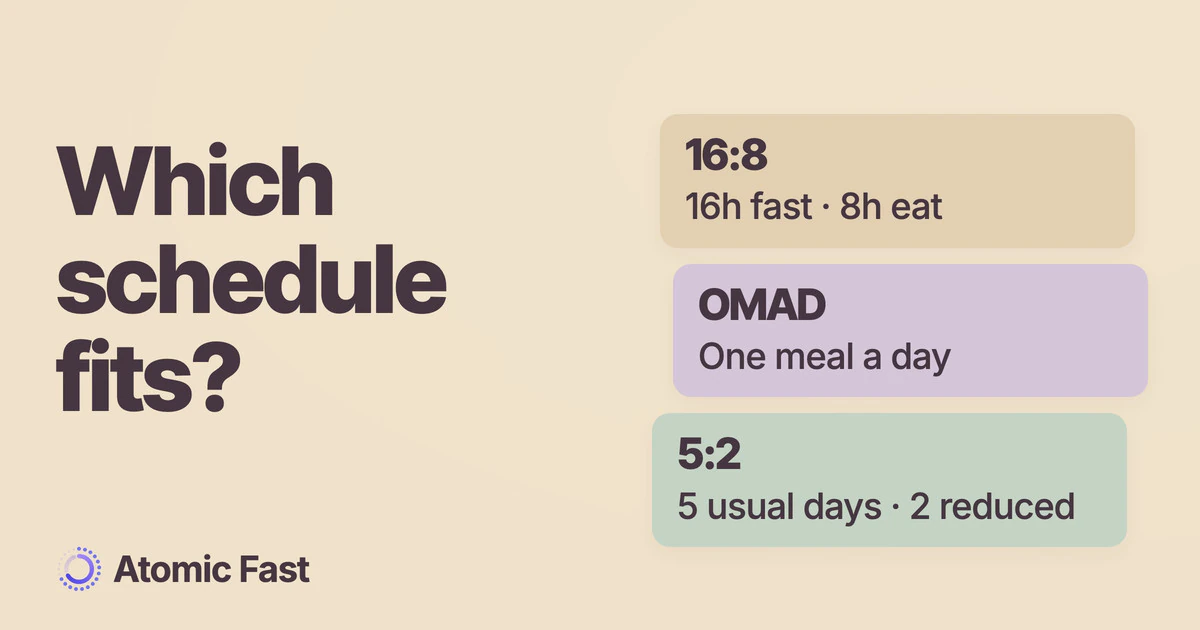
16:8 limits daily eating to eight hours, OMAD compresses it into one meal, and 5:2 uses two very-low-intake days each week. These are different restrictions, not a ladder everyone should climb. The evidence does not provide a reliable three-way ranking or establish 16:8 as the safest default. Choose a manageable pattern that allows adequate meals, and review medical suitability before starting.
What each one actually means
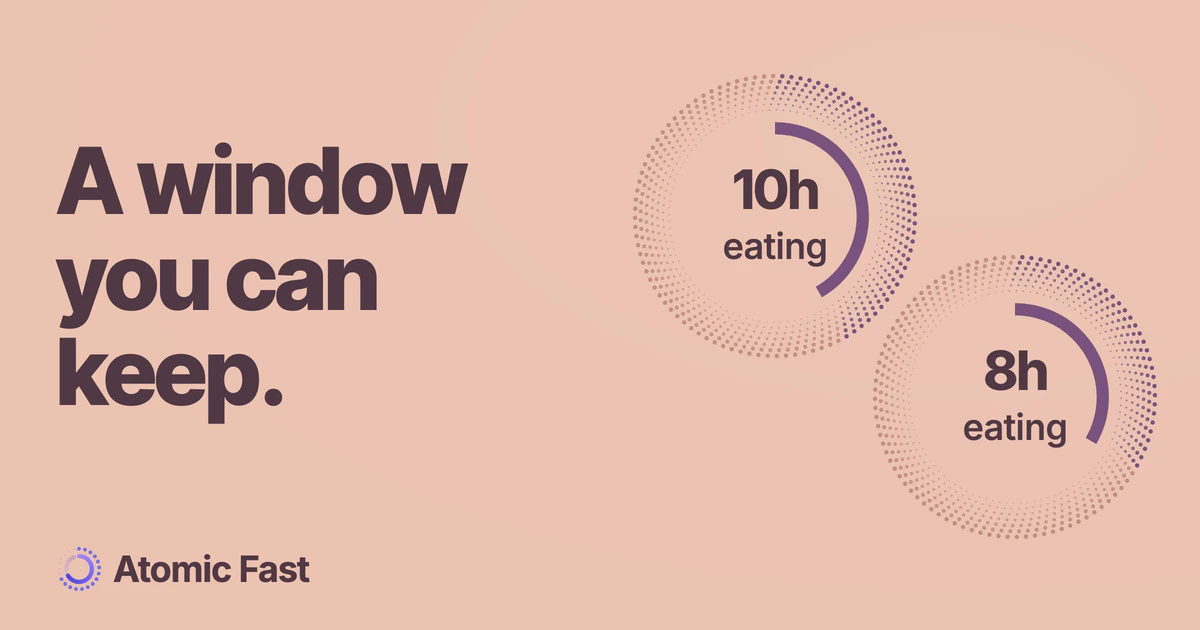
16:8 is time-restricted eating. You eat during an 8-hour window, such as noon to 8pm, and fast the other 16 hours, mostly overnight while you sleep. You’re not told what or how much to eat, just when. It’s the gateway version of fasting for a reason: skipping breakfast (or dinner) is a small behavior change, and the overnight fast does a lot of the heavy lifting for you. If you’re brand new, our realistic hour-by-hour walk-through of a first 16:8 day covers what the day actually feels like.
OMAD, or one meal a day, is 16:8 taken to the extreme. You compress all your food into roughly a one-hour window and fast the other 23. It’s simple to describe and surprisingly hard to do well. The appeal is total freedom from food decisions for most of the day; the catch is that fitting a full day of nutrition, and especially enough protein, into a single sitting is tough, and a lot of people either overeat at that meal or quietly under-eat for days.
5:2 is a different animal. Instead of a daily window, you eat normally five days a week and cut intake, often to around 500 to 600 calories, on two non-consecutive days. Some people call it fasting, but on those two days you’re still eating; it’s really modified fasting or intermittent calorie restriction. The pitch is that you only have to “be good” two days a week and can eat like yourself the other five.
What the research says (and doesn’t)
First, the part nobody puts on the label: no schedule is magic. A 2026 Cochrane systematic review pooled 22 randomized trials of intermittent fasting in nearly 2,000 adults and found it produced weight loss, but no clear advantage over standard, everyday calorie reduction. Certainty varied by outcome (Cochrane). The review does not establish a special weight-loss advantage, and it does not directly compare all three schedules discussed here. We wrote a whole piece on what that review means for a fasting app that won’t oversell, because it matters.
So if they all lean on the same mechanism, does going stricter win? The data says not really. When researchers at UIC compared a 4-hour eating window against a 6-hour one, both groups lost about the same 3% of body weight over eight weeks. The trial did not show a clear advantage for the tighter window (primary trial). That does not test OMAD, an eight-hour window or 5:2, and an absence of a significant difference is not proof that every schedule is equivalent.
A 2026 exploratory analysis examined a different plan: low intake and an early window on three days a week. It found different changes in eating-behavior questionnaires compared with daily restriction, not proof that 5:2 is easier. A one-year alternate-day trial also found no weight-loss advantage over daily restriction, with numerically more dropouts in the alternate-day group. Neither trial directly compared the three schedules in this headline.
Any eating schedule needs room for adequate nutrition. One meal can make that harder to arrange, but this evidence does not quantify an OMAD-specific muscle risk. The separate review of fasting and muscle explains what a small training study can and cannot establish.
How to pick the one that fits
There is no requirement to begin at sixteen fasting hours. A twelve-hour overnight schedule may be easier to organize, and some people should avoid fasting entirely.
Check meals before hours. Can you eat enough, take medicines as directed and avoid an uncomfortable rush to fit everything in? OMAD and very-low-calorie days deserve particular caution. They are not an advanced achievement to work toward.
Check the cost to daily life. A schedule that disrupts sleep, work, family meals or your relationship with food may be a poor fit even if a study reports average weight loss. Anxiety about eating is a reason to seek support, not to adopt a stricter rule.
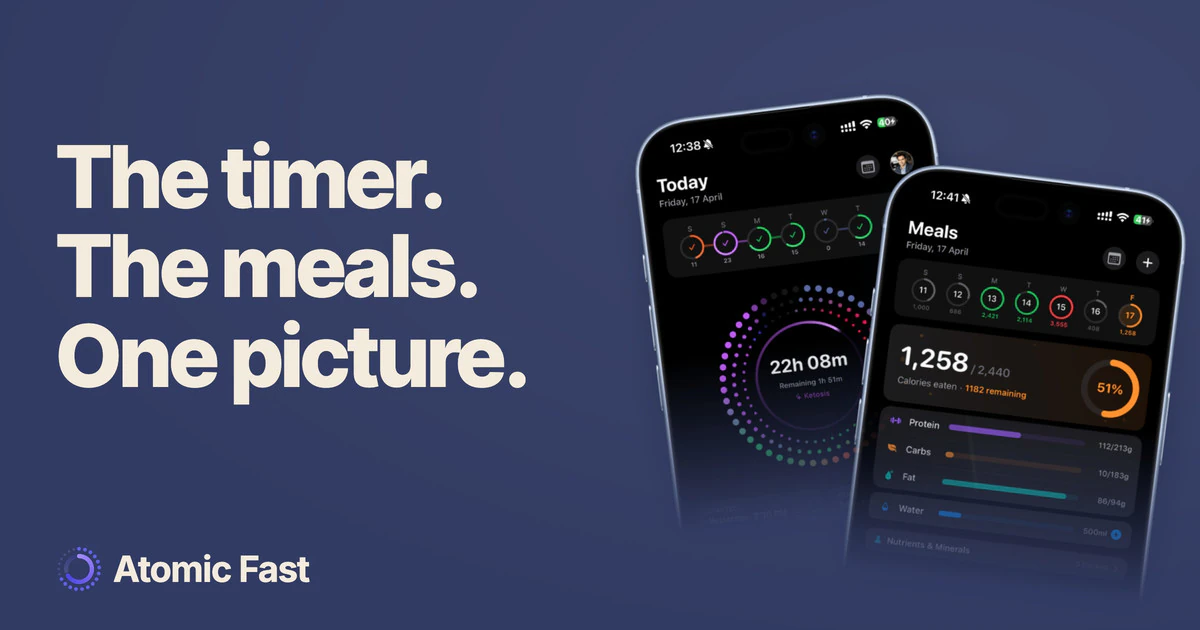
Keep the app’s role proportionate. Atomic Fast records elapsed time and meal entries. Phase labels use fixed hour bands; the meal-based digestion estimate does not recommend a start time or validate a schedule. A timer is useful for a plan you have already judged appropriate.
Who should be careful
Fasting isn’t for everyone, and the stricter schedules raise the stakes. If you’re pregnant or breastfeeding, have a history of disordered eating, are underweight, or are managing a condition like diabetes on medication, skip the DIY approach and talk to a clinician first, especially before anything as aggressive as OMAD or two very-low-calorie days a week. Fasting can affect blood sugar and medication timing in ways that need real supervision. A less restrictive option can reduce practical difficulty, but it does not establish individual medical safety.
Frequently asked questions
Which is best for weight loss: 16:8, OMAD or 5:2? There is no strong direct three-way comparison establishing a winner. Evidence from other fasting schedules cannot prove they are all equivalent.
Is OMAD an upgrade from 16:8? No. A longer fast is a greater restriction, not an automatic health improvement. Fitting adequate food into one meal can be difficult.
Is 5:2 a zero-food fast? Usually not. Common versions allow about 500–600 calories on two days. That describes the method, not a personal calorie prescription.
Can I choose a wider eating window? Yes, if an eating-window approach is appropriate for you. There is no requirement to keep tightening it.
Do I need advice if I take medication? Yes, especially for medicines affecting glucose or requiring food. Do not move or skip doses to fit a fasting schedule without professional guidance.
Sources
Sources checked: October 11, 2026.
-
Garegnani et al. (2026) — Intermittent fasting for adults with overweight or obesity — Review of 22 trials; certainty varies by outcome, with limited evidence beyond one year.
-
Cienfuegos S et al. (2020), Effects of 4- and 6-h Time-Restricted Feeding on Weight and Cardiometabolic Health: A Randomized Controlled Trial in Adults with Obesity. Cell metabolism — An eight-week comparison of four- and six-hour windows, not a test of OMAD or 5:2.
-
Teong et al. (2026) — Eating behavior, mood, sleep and quality of life with intermittent fasting versus calorie restriction — Exploratory analysis of 209 randomized participants. The 15% mediation estimate concerns disinhibition, not dietary restraint or proven ease of adherence.
-
Trepanowski JF et al. (2017), Effect of Alternate-Day Fasting on Weight Loss, Weight Maintenance, and Cardioprotection Among Metabolically Healthy Obese Adults: A Randomized Clinical Trial. JAMA internal medicine — Alternate-day restriction versus daily restriction over one year; a different protocol from a daily window.
Trying to find a fasting rhythm you’ll actually keep? Atomic Fast records elapsed fasting time and the meals you log, so you can review the schedule you actually kept. Download on the App Store or Google Play.
This article is for general education and isn’t medical advice. If you’re pregnant or breastfeeding, taking medication, managing a health condition like diabetes, have a history of disordered eating, or are considering fasts longer than 24 hours, talk to a healthcare professional before changing how you eat.
Try Atomic Fast free
Track your fasts, log your meals, and see how they affect each other, on iPhone and Android.


 Scan to download