Is a Shorter Fasting Window Better? A 4-Hour vs 6-Hour Study
A UIC trial pitted a strict 4-hour eating window against a looser 6-hour one for eight weeks. The stricter window didn't win. Here's what that means for the window you pick.
Last updated
There’s a quiet arms race in fasting. You start at 16:8, it goes fine, and then the nagging question shows up: what if I went harder? Eighteen hours. Twenty. One meal a day? The assumption underneath is that a tighter window is a stronger dose. More fasting, more results.
A group of researchers at the University of Illinois Chicago tested that idea head to head. They took two of the strictest daily windows people attempt and ran them against each other for eight weeks. If shorter really is better, this trial should have shown it.
It didn’t.
The short version
In a UIC trial, adults with obesity ate in either a 4-hour or a 6-hour afternoon window for eight weeks. Both groups lost about the same amount of weight, roughly 3%, with no extra payoff from the stricter schedule, and both improved insulin resistance compared with a control group. The practical read: squeezing your window smaller doesn’t reliably buy you more, and the window you can keep beats the one that looks hardcore on paper. This was a small, short study, mostly in middle-aged women with obesity, so treat it as a strong hint, not the last word.
What the study actually did
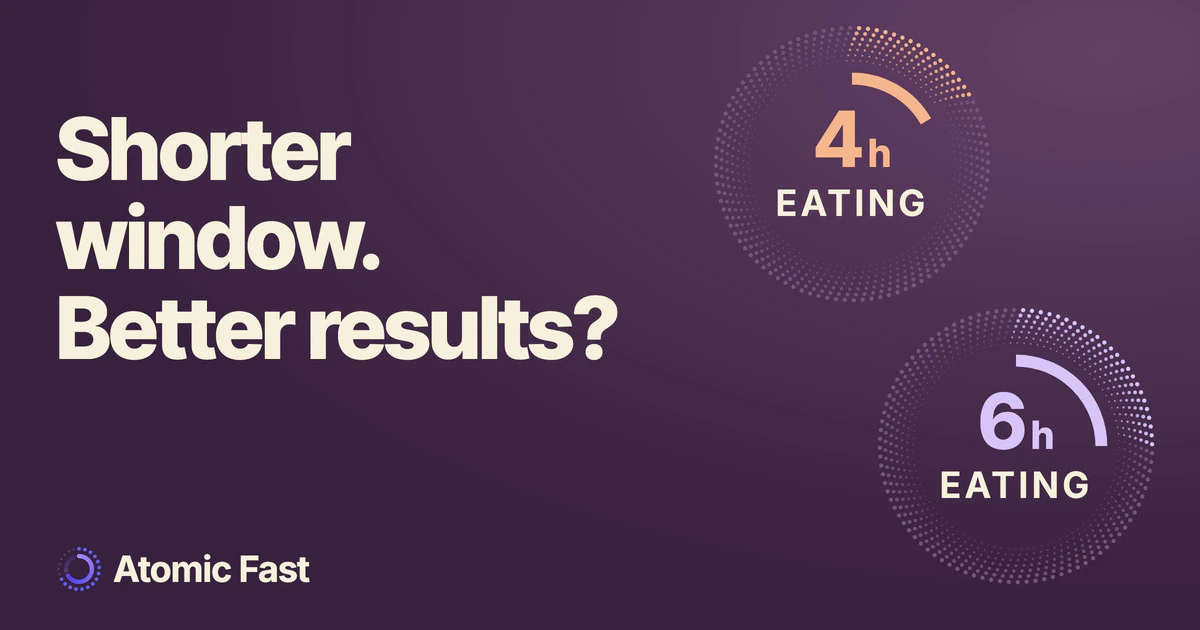
The trial, published in Cell Metabolism in 2020 by Cienfuegos, Varady and colleagues, randomized 58 adults with obesity into three groups. One ate only between 3 and 7 p.m., a 4-hour window. One ate between 1 and 7 p.m., a 6-hour window. The third changed nothing and served as the control. Inside their windows, the fasting groups could eat whatever they wanted; nobody counted calories or hit a target.
Eight weeks later, both fasting groups had lost about 3% of their body weight. The 4-hour group didn’t beat the 6-hour group. Two extra hours of fasting a day produced no measurable weight advantage.
Reported food intake offers one possible explanation. Without being told to, both groups ended up eating roughly 550 fewer calories a day. That’s the mechanism doing the quiet work: a short eating window makes it awkward to fit in as much food, so intake drifts down on its own. Similar reported intake reductions are consistent with the weight results, but do not prove the mechanism.
Insulin improved, but not everything did
Weight wasn’t the only measure. Both fasting groups saw fasting insulin and insulin resistance fall compared with the control group: a 29% drop in insulin resistance in the 4-hour group and 12% in the 6-hour group, with no significant difference between the two. Better insulin sensitivity is one of the main reasons people care about time-restricted eating, so that’s a real signal.
The cardiovascular markers stayed flat. Blood pressure, LDL and HDL cholesterol, and triglycerides didn’t change significantly in either group over the eight weeks. So the realistic picture is a modest one: meaningful movement on weight and insulin, not much on lipids and blood pressure, at least over two months.
What the comparison can tell you
This trial did not show an advantage from adding two more fasting hours. That is useful evidence against assuming that stricter always delivers more. It is not proof that a physiological switch has been fully activated at six hours or that all wider windows are equivalent.
Difficulty, meal adequacy and the ability to follow a schedule matter in practice. If you are reconsidering a tight window, our guide to choosing hours around your day starts with those constraints. This study cannot tell you that an eight- or ten-hour window would produce the same result in the same people.
Where this gets fuzzy
Some honest limits before you rebuild your routine around this. It’s a small trial: 58 people randomized and 49 finished, and eight weeks is short. Most participants were middle-aged women with obesity, so it doesn’t automatically speak to a lean person fasting for other reasons. Both groups ate in the afternoon, and there’s separate evidence that when in the day you eat can matter, so “3 to 7 p.m.” isn’t the only way to run this. And a tie between two groups this size isn’t proof that four and six hours are identical for everyone. It means the study didn’t find a meaningful gap, which is a different, humbler claim.
What it does support is a useful default: you probably don’t need the tightest possible window to get the benefit. If you’re weighing schedules, see how the common ones (16:8, OMAD and 5:2) stack up before assuming the most extreme one wins.
What to do with this
- Don’t tighten the window just because the current one feels easy. Easy is what makes it last.
- If you do try a shorter window, judge it on a few weeks, not a few days. The question is if you’re still keeping it, not if it felt heroic.
- Watch what you eat inside the window. In this study the benefit ran through eating less; a short window packed with extra food undoes that.
If you want to test a looser window against a tighter one, Atomic Fast’s free timer keeps the count honest. You start each fast yourself (now, from your last logged meal, or scheduled ahead), and it shows how long you’ve gone and the stage label assigned to elapsed hours. That records timing, but a side-by-side week cannot establish which schedule is medically better.
Frequently asked questions
Does a 4-hour eating window burn more fat than a 6-hour one? Not in this trial. Both groups lost about 3% of their body weight over eight weeks, and the stricter 4-hour window showed no weight advantage.
So why do shorter windows work at all? Mostly because they cut how much you eat. Both groups in the study dropped about 550 calories a day without counting, because a smaller window leaves less room for food. Past a point, shrinking it further doesn’t remove much more.
Is a shorter window worse for me? A small eight-week trial cannot establish long-term or individual safety. The catch is practical: a very tight window is harder to keep, and a plan you quit doesn’t work no matter how good it looks.
Which window should I pick, then? The one you can actually sustain. If 16:8 or a 10-hour window fits your life better than an extreme schedule, those are reasonable options to discuss; this trial did not test them directly.
I take medication for diabetes or blood pressure. Does this apply to me? The improvement in insulin resistance is exactly why you need to be careful. Fasting can change how glucose-lowering and other medications affect you, so talk to your doctor before starting or tightening a fasting schedule.
Sources
Sources checked: October 11, 2026.
- Cienfuegos S et al. (2020), Effects of 4- and 6-h Time-Restricted Feeding on Weight and Cardiometabolic Health: A Randomized Controlled Trial in Adults with Obesity. Cell metabolism — Primary trial of 58 randomized adults; similar weight reductions do not establish that all window lengths are interchangeable.
Try your window with Atomic Fast, free on the App Store and Google Play.
This article is for general education and isn’t medical advice. If you’re pregnant or breastfeeding, under 18, managing a health condition like diabetes, taking medication, or have a history of disordered eating, talk to a healthcare professional before changing how you eat.
Try Atomic Fast free
Track your fasts, log your meals, and see how they affect each other, on iPhone and Android.


 Scan to download