Alternate-Day Fasting: Do People Actually Stick to It?
A year-long trial put alternate-day fasting against plain daily calorie cutting. Weight loss tied, but more people quit fasting every other day. What that means for your plan.
Last updated
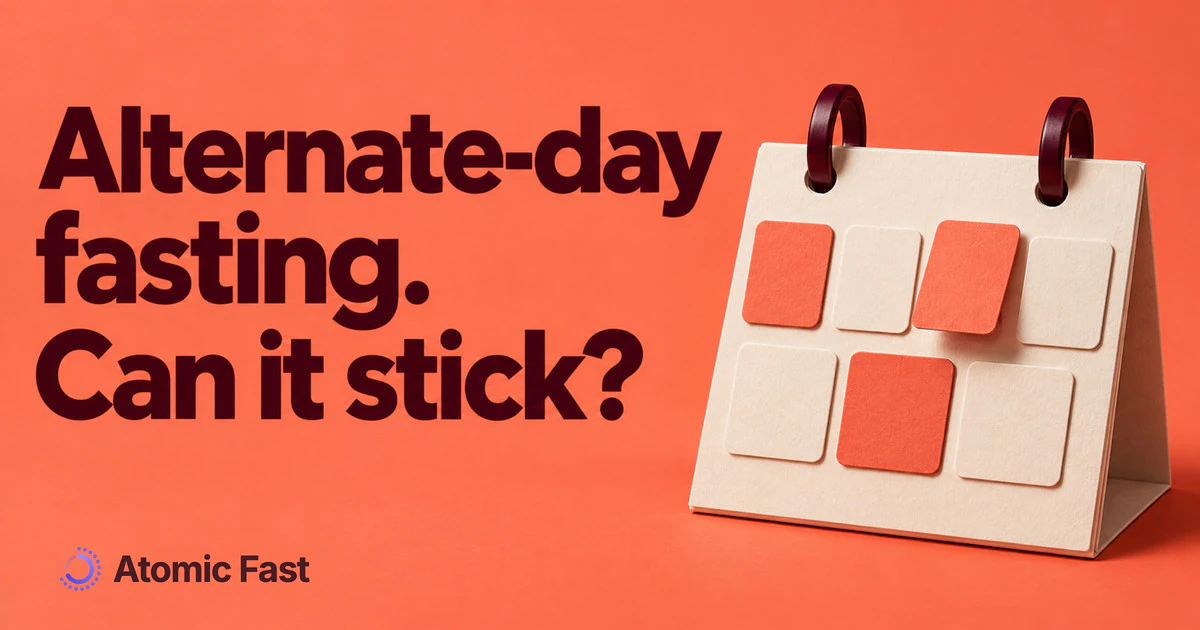
Alternate-day fasting has a tidy pitch. You don’t have to be good every day, only every other day. Eat very little on Monday, normally (or a bit more) on Tuesday, repeat. If you’ve failed at trimming every meal, half the days off sounds like a better deal.
That pitch is a claim about willpower, and it can be tested. A University of Illinois Chicago team ran a year-long trial: a year of alternate-day fasting against daily calorie restriction, counting dropouts as carefully as kilograms.
The weight results were almost a tie. Who stayed in the trial was not.
The short version
In a one-year randomized trial of 100 adults with obesity, alternate-day fasting and plain daily calorie restriction produced about the same weight loss: 6.0% versus 5.3% of body weight at 12 months, a gap that wasn’t statistically significant. The difference was adherence. 38% of the alternate-day group dropped out, against 29% of the daily group, and many who stayed drifted toward eating the same amount every day. The authors say alternate-day fasting “may be less sustainable in the long term” for most people with obesity. It was one center and didn’t test a daily window like 16:8, so read it as a lesson about adherence, not a verdict on all fasting.
What the study did
The trial, led by John Trepanowski and Krista Varady and published in JAMA Internal Medicine in 2017, randomized 100 adults with obesity (86 women and 14 men, average age 44) into three groups for a year:
- Alternate-day fasting. On fast days, a single lunch between noon and 2 p.m. worth 25% of their usual energy needs, roughly 500 calories for many people. On the alternating “feast” days, 125% of their needs, split over three meals.
- Daily calorie restriction. 75% of their energy needs every day, over three meals.
- Control. No changes.
Both diets were designed to cut the same amount over a week, about 25% a day on average. So the test wasn’t which diet cuts more, but which way of cutting the same amount works for real people over time.
The researchers backed both diet groups heavily. For three months they provided all the meals; for the next three, participants met a dietitian or nutritionist weekly. Then came six months of weight maintenance.
What they found after a year
At six months, both diet groups had lost 6.8% of body weight on average. At twelve months, the alternate-day group was at 6.0% and the daily group at 5.3%, both relative to the control group: no significant difference.
Heart-health markers mostly didn’t separate the diets either. Blood pressure, triglycerides, fasting glucose and insulin, insulin resistance and inflammation markers showed no significant difference. One number stood out: by month 12, LDL cholesterol was about 11.5 mg/dL higher in the alternate-day group than in the daily group. One finding in a modest sample, so don’t overread it, but not the direction anyone selling ADF would want.
The team’s own forecast is telling, too. They had planned on about 15% weight loss at six months for alternate-day fasting and 10% for daily restriction. Neither came close, and the gap never showed up.
Where it came apart: sticking with it
This is what makes the trial useful. The dropout rate was 38% in the alternate-day group (13 of 34), 29% in the daily restriction group (10 of 35) and 26% in the control group (8 of 31). More alternate-day dropouts cited dissatisfaction with the diet.
Food records showed why. On fast days, the alternate-day group ate more than prescribed at months 3 and 6. On feast days, they ate less than prescribed at every check. A higher share of the daily group stayed on target at every timepoint.
That leads to the study’s most interesting sentence. The authors wrote that many in the alternate-day group “converted their diet into de facto calorie restriction as the trial progressed.” People drifted back toward the middle until the plan looked like eating a bit less every day: the thing it was meant to replace.
The authors also noted that participants often ate extra food from stores or restaurants, and suggested that holding to roughly 500 calories every other day was hard for many early on. Hunger, environment or habit? The study didn’t settle it.
Why the “easier” plan was harder
The case for alternate-day fasting rests on the idea that restricting every other day is easier than every day. The paper names that assumption and says its data don’t support it.
The reasons aren’t exotic. A 500-calorie day collides with work lunches, family dinners and a long afternoon. A feast day sounds like a reward, but eating 125% of your needs on purpose is its own chore, and many people didn’t. And a plan that changes shape every 24 hours never settles into a routine.
That doesn’t make it a bad idea for everyone. The authors say it’s “still possible that a certain smaller segment” of people may prefer it, and they’d like to know which traits make it tolerable. It does not identify in advance who will prefer the method, and the numerical dropout difference should not be treated as a precise population forecast.
What the study doesn’t settle
This was one center, 100 people, mostly women with obesity who were otherwise metabolically healthy. Dropout ran higher than planned, which cut the trial’s power to detect a difference between the diets from 80% to 60%, and uneven dropout can skew who’s left in each group. The authors also flag a short maintenance phase and a control group that got less attention.
Most important for anyone doing 16:8: this trial didn’t test a daily eating window. The comparison was against three smaller meals every day. It suggests a steady daily pattern is easier to keep than a feast-and-famine swing, but can’t say how 16:8 would have done. The wider evidence points the same calm way: it tends to match ordinary calorie cutting rather than beat it, so the plan you can keep matters more than the plan’s name.
What to do with this
- Judge a schedule by month three, not week one. Almost any plan feels fine for a week. The trial’s real result was who was still going a year in.
- Be suspicious of plans built on big swings. If your schedule depends on very low days balanced by very high ones, expect the edges to soften. That’s not a personal failing; it happened to a carefully supported trial group.
- Prefer a pattern that looks the same every day. A window that starts and ends at about the same time is easier to build a routine around. If you’re weighing options, how 16:8, OMAD and 5:2 compare in daily life is a good place to start, and a window you’ll actually keep usually beats a stricter one you won’t.
- If you have diabetes or take blood-pressure or glucose-lowering medication, don’t start any fasting schedule, alternate-day or daily, without your doctor. Very low days can change how those medications act.
If you go the steady-window route, Atomic Fast’s free timer fits it. You start each fast yourself (right now, backdated to your last logged meal, or scheduled up to 24 hours ahead), and the timer shows how long you’ve gone and the phase label assigned to the elapsed hours, not a measured metabolic state. Logging what you eat, by photo, a quick typed description or a barcode, keeps the “eat a bit less” part visible, since that’s where the results come from.
Frequently asked questions
Is alternate-day fasting better than calorie counting for weight loss? Not in this trial. After a year it was 6.0% of body weight versus 5.3%, and the difference wasn’t statistically significant.
Why did more people quit alternate-day fasting? More of them were dissatisfied with the diet. Food records showed they ate more than planned on fast days and less on feast days, so the schedule drifted toward everyday restriction anyway.
Is alternate-day fasting the same as 16:8? No. Alternate-day fasting swings between a very low-calorie day and a high-calorie day. 16:8 is a daily eating window with no calorie target built in. This trial tested only the first.
Did alternate-day fasting affect cholesterol? By month 12, LDL cholesterol was about 11.5 mg/dL higher in the alternate-day group than in the daily restriction group. It’s one finding in a small trial, but a reason to get lipids checked if you fast this way long term.
Who might still do well on alternate-day fasting? The authors think a smaller group of people may prefer it. If that’s you and it’s working, this study doesn’t say stop.
Sources
Sources checked: October 11, 2026.
- Trepanowski JF et al. (2017), Effect of Alternate-Day Fasting on Weight Loss, Weight Maintenance, and Cardioprotection Among Metabolically Healthy Obese Adults: A Randomized Clinical Trial. JAMA internal medicine — The original randomized trial. Weight estimates are relative to the control group; dropout was 38% versus 29% in the two diet groups.
Try a steady daily window with Atomic Fast, free on the App Store and Google Play.
This article is for general education and isn’t medical advice. If you’re pregnant, managing a health condition, taking medication, have a history of disordered eating, or are considering fasts longer than 24 hours, talk to a healthcare professional first.
Try Atomic Fast free
Track your fasts, log your meals, and see how they affect each other, on iPhone and Android.


 Scan to download