16:8 Fasting and Exercise: More Fat Loss Together?
A 12-week trial tested 16:8 fasting, cardio and their combination in 104 midlife women. See the fat-loss results, exercise dose and limits before applying them.
Last updated
If you already follow 16:8, what might regular exercise add? A trial from Hong Kong tested the eating window and aerobic exercise separately and together, with a fourth group continuing its usual habits. That design lets us compare the approaches within one study.
The short version
Researchers randomly split 104 inactive women aged 40 to 60 with overweight or obesity into four groups for 12 weeks: a flexible 8-hour eating window, three brisk cardio sessions a week, both together, or no change. The combined approach produced about 2.9 kg more fat loss than the control condition, and more than either approach alone. Body weight fell about 3 kg, which the authors note is still short of the 5% mark usually called clinically meaningful. Blood sugar, blood pressure and cholesterol didn’t improve more than in the control group, and the combined group lost a little lean mass too.
What the study did
The paper is Dai and colleagues, Nature Communications, November 2025, from the Chinese University of Hong Kong, with the full text open on PubMed Central. It was funded by an internal university grant, and the people who measured outcomes didn’t know which group anyone was in.
Everyone enrolled was a Chinese woman in midlife, inactive (150 minutes a week of moderate exercise or less), with a BMI of 23 or above and a usual eating window of at least 10 hours. People with diabetes, heart disease or relevant medications were excluded. The four groups, 26 women each:
- Flexible 16:8. Eat whatever you like inside an 8-hour window, with no calorie counting. The window could move day to day, as long as it started between 8 am and noon and ended between 4 pm and 8 pm. Participants logged their start and stop times online, and the researchers checked the logs daily and sent reminders.
- Exercise. Three weekly sessions of brisk walking, jogging or running at a moderate heart rate, tracked with a heart-rate monitor. The main exercise progressed from 30 minutes per session in weeks one and two to 40 minutes thereafter. Adding five minutes each for warming up and cooling down brought the later sessions to 50 minutes, or 150 minutes a week in total. No diet advice.
- Both. The same window and the same exercise plan.
- Control. Carry on as usual.
Ninety-eight of the 104 finished, and the analysis included all 104.
What they found after 12 weeks
Fat mass, the main outcome, compared with the control group:
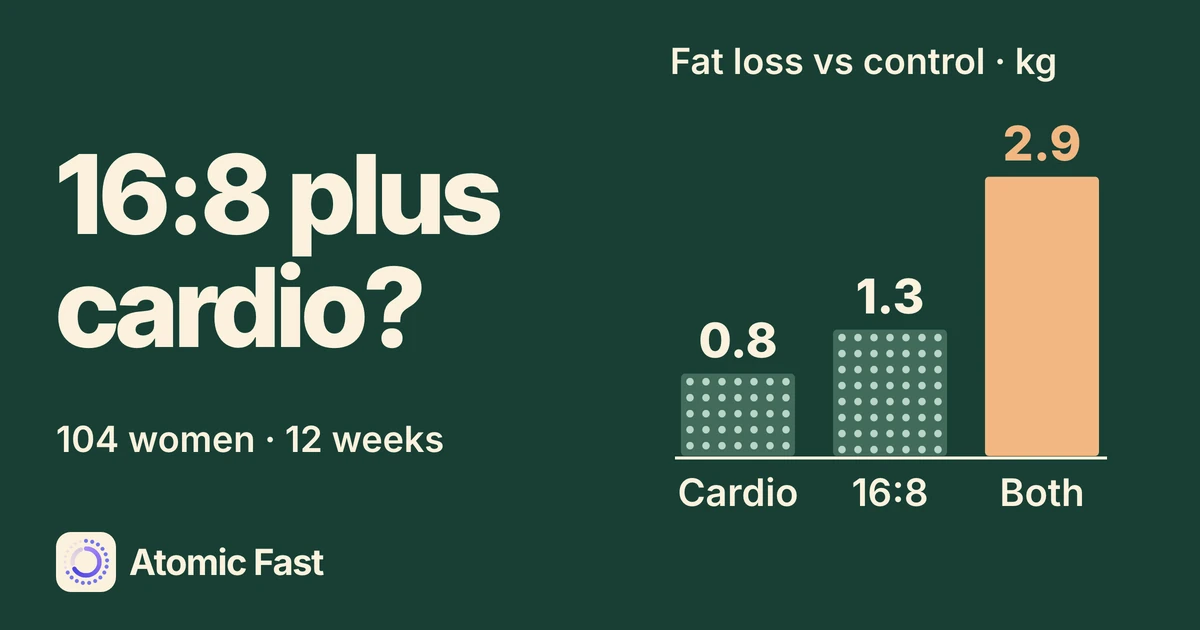
- Fasting only: about 1.3 kg less fat.
- Exercise only: about 0.8 kg less, with a less precise estimate: its 99% confidence interval ranged from 1.9 kg less to 0.2 kg more fat.
- Both: about 2.9 kg less.
The combined group also beat each single approach head to head, by about 1.6 kg against fasting alone and 2 kg against exercise alone. The roughly 2.9 kg figure is an adjusted difference from control, not the combined group’s before-and-after change or a promised personal result. Its 99% confidence interval was about 1.7 to 4.0 kg of additional fat loss. The combined group lost about 3 kg of body weight from baseline. Waists followed the same order: about 6 cm smaller than the control group with both, about 3 cm with either one.
Food intake may explain part of the story. Food diaries showed the two fasting groups eating roughly 190 to 240 fewer calories a day than the control group by the end, without being told to cut anything. The exercise-only group reported a smaller reduction, which wasn’t clearly different from control. Food diaries can miss intake, so these findings don’t establish exactly how the weight changes occurred.
Blood work was quieter than the headline. Fasting glucose, HbA1c, blood pressure and cholesterol didn’t change more in any group than in the control group. Fasting insulin and an insulin-resistance score came out lower in the combined group than in either single group, but not significantly lower than in the control group. These women mostly started with normal blood sugar, which leaves little room to improve.
Sticking with it went well, at least with daily check-ins. The combined group followed the window on about 89% of days and completed about 80% of workouts. Nobody had a serious side effect. Six women in the fasting groups reported sharper hunger, possibly affecting sleep, in the first two weeks, and it eased as they adapted.
Why the two might stack
Eating less while expending more energy is one plausible explanation. The diaries support reduced intake in the window groups, but this wasn’t a calorie-matched feeding experiment. It can’t establish how much of the result came from energy intake, exercise expenditure or meal timing itself.
How much to trust this
The fat was estimated, not imaged. Fat mass came from a bioelectrical impedance scale, the kind that sends a small current through your feet. It estimates body composition rather than measuring fat directly, and hydration can affect the estimate. Measurements were standardized, but this still limits precision.
Twelve weeks, one city, one group of women. All participants were Chinese women aged 40 to 60, and the authors say the results may not carry over to other populations. Nothing here tells you whether the loss lasts past three months or how men respond.
A little lean mass went too. Only the combined group lost significantly more fat-free mass than the control group, about half a kilo. Fat-free mass includes water and other tissues as well as muscle. Strength wasn’t measured, so this is neither proof of harmful muscle loss nor evidence that muscle was fully protected.
The support was heavy. Daily log checks and reminders, plus heart-rate monitors the team reviewed every week, are more structure than most people have at home. Adherence that high may be harder to repeat on your own.
What to do with this
- Build activity gradually. The study increased the exercise dose over two weeks and included warm-ups and cool-downs. It doesn’t mean everyone should immediately add the full program to a fast. Choose suitable activity with clinical advice when health conditions or medication make that necessary.
- Treat a window as an option. Both fasting groups reported eating less; that doesn’t mean a window is necessary for everyone who exercises. Here it could move with the day. We go through finding one that fits in how to pick a fasting window you’ll actually keep.
- Train when it suits you, not to prove a point. The combined group was simply advised to exercise between 8 am and 10 pm, and the study didn’t test fasted against fed sessions. If you’re unsure when to work out, the trade-offs of training on an empty stomach are a separate question.
- Keep adequate nutrition in view. This trial didn’t test resistance training or prescribe a protein target. The evidence from a separate 16:8 trial in trained lifters addresses a different training context; it doesn’t prove how to prevent the lean-tissue change here.
- Keep the window easy to see. Atomic Fast’s timer is free and runs off elapsed time, displaying a phase label at fixed elapsed-hour thresholds. You can log meals by photographing them, typing a quick description or scanning a barcode, and today’s fast and meals sit together on the daily timeline.
Frequently asked questions
Is it better to combine intermittent fasting and exercise? For fat loss over 12 weeks in this trial, yes. Whether the gap holds up past three months, or in men, wasn’t tested.
How much exercise did the study use? After two introductory weeks, the plan was three sessions of 40 minutes of moderate exercise, each with an additional five-minute warm-up and five-minute cool-down. That is 120 minutes of main exercise and 150 minutes including those additions.
Did 16:8 plus exercise improve blood sugar? Not compared with the control group. Fasting glucose and HbA1c didn’t change significantly. Insulin and insulin resistance were lower than in the single-approach groups, but not clearly lower than control. The participants mostly started with normal blood sugar.
Does this apply to men or younger women? The trial only included Chinese women aged 40 to 60 with overweight or obesity, so it doesn’t answer that. The authors flag that results may differ in other groups.
Sources
Sources checked: October 11, 2026.
- Dai et al. (2025) — Time-restricted eating and aerobic exercise in midlife women. Nature Communications — Original four-arm trial; publisher and PMC copies describe the same study.
Keep your eating window on the clock and your meals in one place with Atomic Fast on the App Store or Google Play.
This article is for general education and isn’t medical advice. If you’re pregnant, managing a health condition, taking medication, have a history of disordered eating, or are considering fasts longer than 24 hours, talk to a healthcare professional first.
Try Atomic Fast free
Track your fasts, log your meals, and see how they affect each other, on iPhone and Android.


 Scan to download