Intermittent Fasting and Your Thyroid: What the Trials Show
Does intermittent fasting slow your thyroid? What recent trials found for TSH, T3 and T4, why weight loss matters, and how to time levothyroxine around an eating window.
By Nazmul Hasan Rupok Published 11 min read

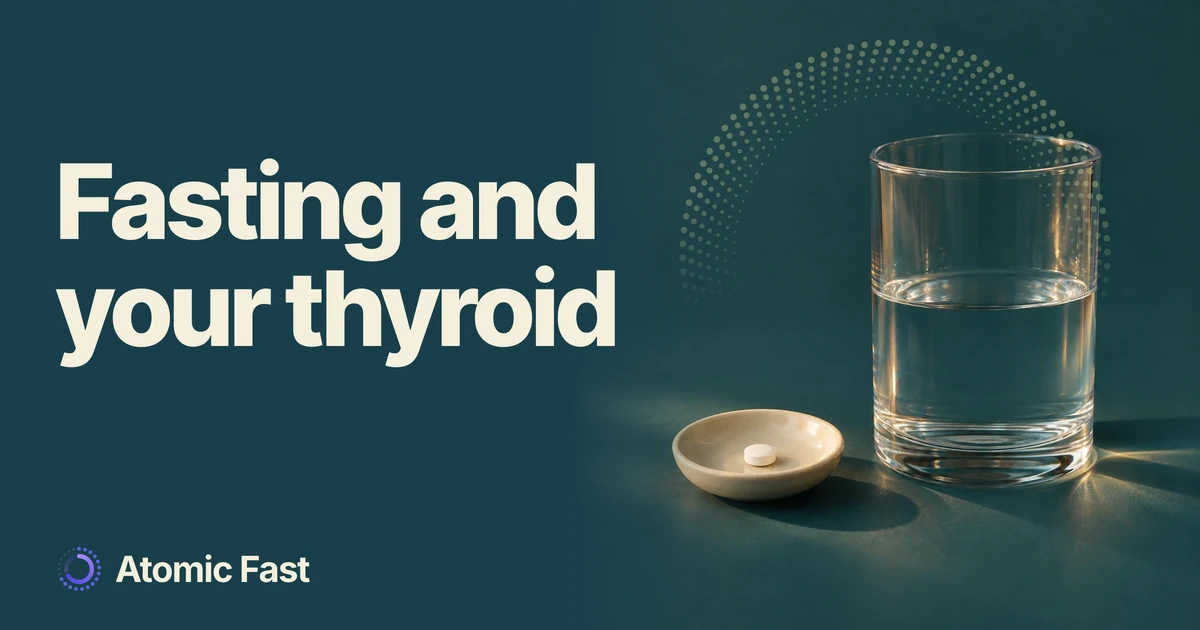
Two worries tend to show up together. One is that skipping breakfast for months will “slow down” your thyroid, the gland that sets part of your metabolic pace. The other is more practical: if you already take a thyroid pill every morning on an empty stomach, where does it go once your mornings become a fast?
The first question has better data than it used to. For the second, medication instructions give you a starting point to discuss with your pharmacist or prescriber.
The short version
Two short randomized trials found no statistically significant difference in thyroid-hormone changes between eating-window diets and their comparison diets. In the 2026 trial, the confidence intervals also made large average changes in free T3 and T4 unlikely by the authors’ chosen thresholds. Both trials involved people with metabolic conditions and very few with treated thyroid disease, so they cannot establish long-term safety for everyone. If you take levothyroxine, ask your doctor or pharmacist how your eating schedule fits its food, coffee and supplement instructions before changing your routine.
What thyroid tests measure
A routine thyroid check usually starts with TSH, the signal your pituitary gland sends to tell the thyroid to work harder. Free T4 is the main hormone the thyroid releases. Free T3 is the more active form, much of it converted from T4 in other tissues. Reverse T3 is an inactive form.
A lower T3 result during weight loss is not, by itself, a diagnosis of an underactive thyroid. The 2024 trial below found lower free T3 and higher free T4 after several different diets; the 2026 trial found little average change despite weight loss. Results depend on the population, diet and measurement period. A clinician interprets your tests alongside symptoms, medication and the laboratory’s reference ranges.
The useful research question is whether an eating window changes thyroid hormones compared with another eating pattern. These trials cannot cleanly separate timing from changes in calories, food choices and weight.
The newest trial: a 4-hour window, 6 weeks
Researchers at Mount Sinai Hospital in Toronto ran a randomized crossover trial in adults with overweight or obesity and early type 2 diabetes (Jeyakumar et al., Journal of the Endocrine Society, 2026). Each person spent 6 weeks eating only within a 4-hour window, 4 to 8 pm or 5 to 9 pm, and 6 weeks eating on their usual schedule, with a washout of about 4 weeks between the two. Water, tea and unsweetened coffee were allowed during the fast. Most participants took metformin or managed their diabetes with diet alone; nobody on insulin or a sulfonylurea took part.
The 4-hour window worked for weight. Compared with the usual-eating period, the difference in weight change was about 3.5 kg (7.7 lb). Average thyroid changes were small. Free T4, free T3, TSH and reverse T3 showed no significant difference between periods, and neither did the ratios researchers use to estimate how much T4 is converted to T3.
The more interesting part is what the authors did with that non-significant result. They compared the uncertainty around their estimates with predefined thresholds for a clinically meaningful difference: 2.0 pmol/L for free T4 and 1.5 pmol/L for free T3. The confidence intervals for both differences stayed inside those limits.
Crossover trial · 39 adults · 6 weeks per period
How large could the hormone change be?
−3.5 kg
Weight, eating window versus usual eating
Difference in each hormone between the two periods. Dots are the average difference, lines are 95% confidence intervals, and each shaded band runs between the authors’ negative and positive thresholds for a meaningful difference. These are not laboratory reference ranges.
-
Free T4
−0.55 pmol/L (95% CI −1.78 to 0.68)
-
Free T3
−0.57 pmol/L (95% CI −1.45 to 0.31)
Both intervals sit inside the shaded bands, making average free T3 and T4 effects exceeding the authors’ thresholds unlikely in this group over 6 weeks. It does not show that no effect exists, and it says nothing about people treated for thyroid disease.
That makes an average free T3 or T4 effect exceeding those thresholds unlikely in this group over six weeks. It doesn’t establish that the window does nothing to the thyroid. The trial was designed to measure insulin secretion, so the thyroid analysis is exploratory. Six weeks may be too short for slower adaptations, and the four-week washout may not have allowed TSH to fully stabilize. Only 39 people took part, 23 of them postmenopausal women and only two premenopausal. The paper contains a reporting inconsistency: the abstract reports the TSH difference as 0.49 mIU/L, while the results table gives −0.49. Neither direction was statistically significant.
A larger trial, and a headline that overstates it
A 2024 secondary analysis from Xi’an Jiaotong University covered more people over a longer stretch (Zheng et al., BMC Medicine, 2024). It randomized 169 adults with metabolic syndrome to a low-carbohydrate diet, an 8-hour eating window, or both, for 3 months. People in the window groups chose an early schedule, 8 am to 4 pm, or a later one, noon to 8 pm.
In all three groups, free T3 went down and free T4 went up. The paper’s title says eating windows “improved” thyroid function, but the analyses found no statistically significant differences in thyroid-hormone changes between diets. Both antibody measures rose in all three groups in the main analysis; in the per-protocol analysis, significant rises appeared only in the eating-window group. That does not establish that one diet caused more thyroid inflammation than another. That analysis included just 57 of the 162 people who started.
The trials show different patterns within their groups: little average change in Toronto, and falling free T3 with rising free T4 in Xi’an. Neither found a significant thyroid-hormone difference between eating patterns. That is limited evidence, not proof that timing has no effect or that weight loss caused every change. The Xi’an trial had no usual-diet control, and only three participants took levothyroxine.
Fitting levothyroxine around an eating window
Levothyroxine replaces the hormone an underactive thyroid doesn’t make. It’s absorbed best on an empty stomach, which is exactly what makes fasting schedules tricky. The NHS advice is to take it 30 to 60 minutes before your first meal of the day or any drink with caffeine, at the same time each day. MedlinePlus adds that calcium carbonate and iron supplements should be taken at least 4 hours before or after it.
That caffeine line is the one fasters miss. Black coffee doesn’t break a fast by the usual definitions, but it still counts as something to keep away from the tablet. A morning that goes pill, coffee two minutes later, first meal at noon can end with less of the dose absorbed, even though no food was involved.
Illustrative 16:8 day
Where a morning dose can sit in a fasting day
The eating window here runs 12:00 to 20:00. Each row shows a different example to discuss with a pharmacist, not two doses in one day. Both leave a full hour before any food or caffeinated drink.
Example A: agreed morning dose
Dose 7:00 · first coffee or tea 8:00 at the earliest
Example B: agreed pre-meal dose
Dose 11:00 · first meal 12:00
Calcium or iron supplements: MedlinePlus specifies at least 4 hours for calcium carbonate and ferrous sulfate. In this example, that means not with the first meal if the dose was at 11:00.
Bedtime dosing is another approach some clinicians use, taken well after the last meal of the day. Ask before switching: a change in timing can change your blood test.
Several studies of medication timing come from Ramadan, a religious fast with no water or food from dawn to sunset. Our guide to Ramadan fasting compared with 16:8 covers how different those two schedules are.
- A Saudi randomized trial assigned 87 people with hypothyroidism to take levothyroxine 30 minutes before the sunset meal, 3 to 4 hours after it, or with no specific advice (Mahzari et al., International Journal of Endocrinology, 2023). The analysis included 79 people after eight exclusions for low adherence. TSH and free T4 rose after Ramadan, but dose timing was not significantly linked to either in the adjusted model. People told to dose hours after the meal were less likely to stick with it: six of the eight dropped for taking under half their doses came from that group.
- A 2024 meta-analysis pooled 14 studies, 3 randomized and 11 before-and-after observational studies (Belal et al., Irish Journal of Medical Science, 2024). In people whose thyroid levels were in range before Ramadan, TSH rose by about 0.76 µIU/mL afterwards (95% CI 0.25 to 1.27). The pooled free T4 change was not statistically significant. The review did not establish a preferred dosing time; its studies varied considerably in adherence and blood-test timing.
- A Brazilian crossover trial in 201 adults aged 60 and over compared a dose 60 minutes before breakfast with one at bedtime, at least 60 minutes after the last meal (de Mello et al., Frontiers in Medicine, 2022). Average TSH was 2.95 mIU/L with morning doses and 3.64 with bedtime doses. That difference wasn’t statistically significant (p = 0.107), but it isn’t proof the two are interchangeable. Only 118 reached the final visit. The study’s one-hour bedtime gap is a protocol detail, not a recommendation to copy.
These studies do not identify one dosing time that suits everyone. Food gaps, other medicines and a routine you can follow all deserve attention. Agree any change with your doctor or pharmacist first, and ask whether and when they want repeat thyroid tests. Keep taking the prescribed dose unless your prescriber changes it.
How much to trust this
For adults without known thyroid disease, these findings offer some reassurance within the populations studied. Two randomized trials, 6 weeks and 3 months long, both carried out in people with metabolic conditions, and neither designed to detect thyroid effects first. Neither eating-window trial followed people for a year or tested multi-day fasting. Neither establishes safety for pregnancy, Hashimoto’s disease or treatment after thyroid cancer surgery.
The fasting-specific medication studies discussed here concern Ramadan; the Brazilian morning-versus-bedtime trial did not test fasting. Ramadan’s pattern, with no food or water from dawn to sunset and evening meals, differs from a 16:8 window where water and black coffee are allowed all day. The Ramadan studies measured TSH a short time after the month ended, often in single centers, and the meta-analysis combined mostly observational before-and-after studies.
What would change the answer: a longer trial with thyroid hormones as the main outcome, or one that enrolls people already treated for hypothyroidism and follows their dose needs on a daily eating window.
What to do with this
- Don’t blame the window for every symptom. Feeling chilly, tired or foggy can have several causes, and our piece on why fasting can make you feel cold covers when that warrants a check. Ongoing exhaustion, weight gain without explanation, hair thinning are reasons to see a clinician, fasting or not. Symptoms alone cannot diagnose a thyroid problem (MedlinePlus).
- Plan before changing your dose time. Ask your doctor or pharmacist how to fit your prescribed medicine around the new eating window, then follow the agreed routine consistently. An empty morning does not itself mean you need to move your tablet.
- Leave a gap before coffee or tea. Thirty to 60 minutes, per the NHS. Plain water is fine with the tablet.
- Check supplements too. MedlinePlus specifies at least 4 hours between levothyroxine and calcium carbonate or ferrous sulfate. Ask your pharmacist about your particular products and how to fit them in; do not squeeze every tablet into the first meal.
- Let your clinician interpret changes. Tell them about significant weight changes and new symptoms. A lower T3 result alone is not a reason to increase your dose, stop treatment or extend a fast.
Atomic Fast’s timer records your fasting hours and when you end a fast; it has no medication reminder, so keep the tablet on a phone alarm or an existing routine.
Frequently asked questions
Does intermittent fasting cause hypothyroidism? The two eating-window trials reviewed here did not establish that fasting causes hypothyroidism. They also cannot rule out long-term effects or answer the question for every thyroid condition: thyroid outcomes were exploratory or secondary, and follow-up was short.
Can I drink black coffee after taking levothyroxine during a fast? Wait 30 to 60 minutes first. The NHS advises taking levothyroxine that long before any caffeinated drink as well as food, because coffee can reduce how much of the dose you absorb.
Should I switch my levothyroxine to bedtime because I eat late? Some clinicians use bedtime dosing, and an older-adult trial didn’t find a significant TSH difference between bedtime and morning doses. Ask your prescriber before switching, since any timing change can move your TSH and they may want a follow-up test.
Does a lower T3 while dieting mean my metabolism is broken? Not on its own. The 2024 trial found lower free T3 and higher free T4 across different diets. That result alone cannot diagnose thyroid damage or tell you why an individual test changed. Ask a clinician to interpret it alongside TSH, free T4, symptoms and treatment.
Is a 16:8 window safe if I have Hashimoto’s disease? The trials don’t answer that directly. Most participants had no known thyroid disease. If you’re treated for Hashimoto’s, the practical issues are consistent dosing and regular monitoring, so plan the schedule with whoever manages your treatment.
Sources
Sources checked: November 3, 2026.
- Jeyakumar Y, Retnakaran R, Feig DS, Zinman B, Kramer CK (2026), The effect of time-restricted eating accompanied by weight loss on thyroid function in adults with type 2 diabetes, Journal of the Endocrine Society — Full text. Randomized crossover trial, NCT05717127; 39 adults with overweight or obesity and early type 2 diabetes; 6-week periods of a 4-hour evening window and usual eating. Supports the weight difference, the thyroid confidence intervals and the predefined meaningful-change limits. Exploratory analysis; short; abstract and table disagree on the sign of the TSH difference.
- Zheng Y et al. (2024), Time-restricted eating with or without a low-carbohydrate diet improved myocardial status and thyroid function in individuals with metabolic syndrome, BMC Medicine — Full text. Secondary analysis of a 3-month randomized trial, NCT04475822; 169 randomized, 162 in the main analysis, 57 per protocol. Supports within-group thyroid shifts across diets, without statistically significant between-group differences; the title’s “improved” rests on within-group changes.
- NHS (accessed 2026), Levothyroxine — Patient guidance to take the tablet 30 to 60 minutes before the first meal or any caffeinated drink, at a consistent time; lists calcium and iron supplements as interacting products. General guidance, not individual dosing.
- MedlinePlus, US National Library of Medicine (last revised 2019), Levothyroxine — Supports the empty-stomach instruction and the 4-hour separation from calcium carbonate and iron. Older page; your prescription label takes precedence.
- Mahzari M et al. (2023), Levothyroxine Timing during Ramadan: A Randomized Clinical Trial, International Journal of Endocrinology — Full text. 87 enrolled, 79 analyzed in a single Riyadh center; three timing instructions; TSH and free T4 rose after Ramadan without a significant timing effect; lower adherence with the later dose. Small; tests up to 2 weeks after Ramadan.
- Belal MM et al. (2024), Effect of Ramadan fasting on thyroid functions in hypothyroid patients taking levothyroxine: a systematic review and meta-analysis, Irish Journal of Medical Science — Full text. 14 studies, mostly observational before-and-after designs; pooled TSH rise, with no firmly established preferred dosing time. Ramadan only; quality rated fair.
- de Mello RB et al. (2022), Evaluation of Bedtime vs. Morning Levothyroxine Intake to Control Hypothyroidism in Older Patients: A Pragmatic Crossover Randomized Clinical Trial, Frontiers in Medicine — Full text. 201 adults aged 60 and over; TSH 2.95 versus 3.64 mIU/L, p = 0.107; 118 reached the final visit. Not a fasting study; a non-significant difference is not proof of equivalence.
Track your fasting hours and eating window with Atomic Fast on the App Store or Google Play.
This article is for general education and isn’t medical advice. If you’re pregnant, managing a health condition, taking medication, have a history of disordered eating, or are considering fasts longer than 24 hours, talk to a healthcare professional first.
Try Atomic Fast free
Track your fasts, log your meals, and see how they affect each other, on iPhone and Android.


 Scan to download