Does Intermittent Fasting Affect Bone Density?
Can intermittent fasting thin your bones? What eating-window trials found for bone density, what remains uncertain, and how to support bone health during weight loss.
By Nazmul Hasan Rupok Published 12 min read

You’ve been eating in an eight-hour window for a few months, the scale is moving, and then someone tells you fasting leaches calcium out of your bones. Maybe you’re 58, and your mother broke a hip. The worry is reasonable. Losing weight can cost a little bone, and skipped meals sound like a way to miss calcium.
The trials that measured bone on an eating window haven’t established that it causes bone loss. But most were small, short and focused on whole-body scans, which can miss changes at particular sites.
The short version
A 2024 review found no statistically significant difference in total-body bone density between eating-window and control groups over 4–24 weeks. The evidence was rated low certainty: it cannot establish long-term safety or rule out a small loss. A newer nine-month pilot included hip and spine scans, but did not test differences between groups. Separate weight-loss trials found bone loss at some sites, so nutrition, exercise and your existing fracture risk deserve attention alongside your eating schedule.
Why bones and weight loss are linked
Bone is living tissue that is broken down and rebuilt all the time. Carrying more body weight loads the skeleton, and people with higher weight tend to have denser bones, though not always stronger ones for their size. When weight comes off, that load drops. Diets can also lower calcium, protein and total energy intake.
The NHS lists the known risk factors for osteoporosis: older age, the menopause, a parent with osteoporosis, being underweight, low calcium or vitamin D, smoking, heavy drinking, little exercise, some conditions and steroid tablets. That list doesn’t settle whether meal timing matters. It does identify risks to discuss if restricting your window leaves you eating too little.
So there are two separate questions. Does the timing of meals do anything to bone? And does the weight loss that eating windows often produce do something to bone? The studies below address those questions with different designs; they cannot tell us which factor matters more for an individual.
What the eating-window trials found
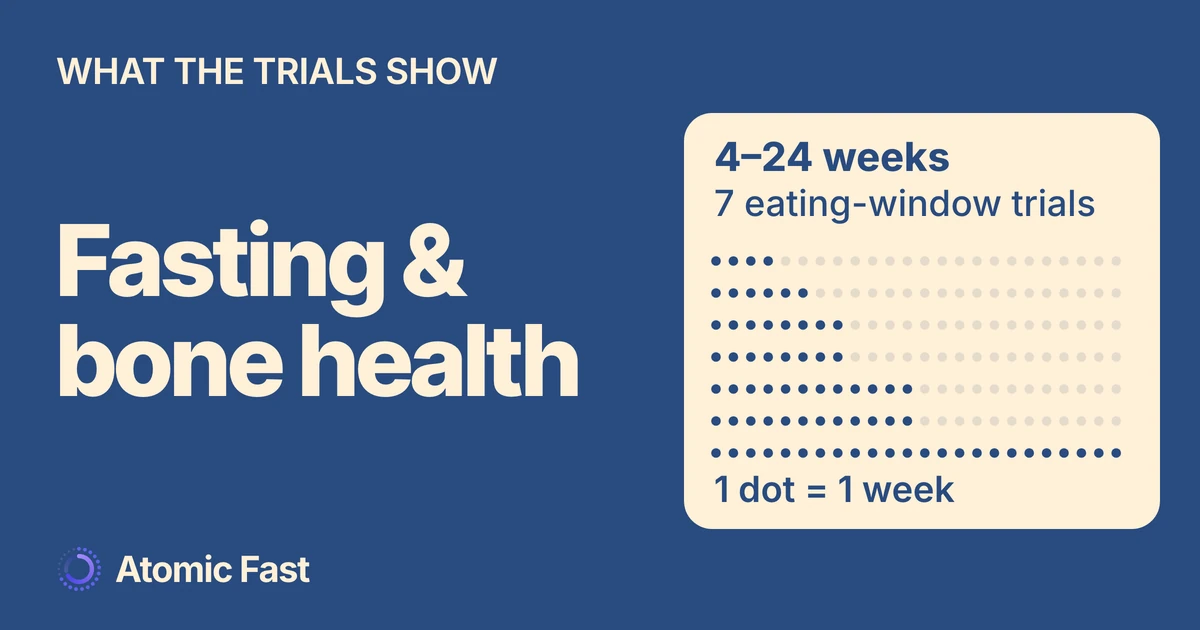
The best summary is a 2024 systematic review and meta-analysis in Nutrients by Fernández-Rodríguez and colleagues. They found seven randomized trials of time-restricted eating that measured bone, reporting 313 adults across the seven studies. Six of the seven used a 16:8 schedule, the trials lasted 4 to 24 weeks, and the average was about 10 weeks.
The pooled total-body bone mineral density analysis used five trials and six comparisons: 93 eating-window and 88 control observations, including a crossover study. The difference in change from baseline was 0.009 g/cm² lower than the comparison groups, with a 95% confidence interval from 0.026 lower to 0.009 higher. That difference was not statistically significant. No statistical heterogeneity was detected, but a small set of trials cannot establish that their effects are identical. Results held when the authors kept only 16:8 trials, or only trials in people with overweight or obesity.
The interval includes both a decrease and an increase, so the data cannot rule out a small loss. The authors rated certainty low because every trial had some risk-of-bias concerns and the estimate was imprecise. Bone was rarely the main outcome, so most trials were not sized to detect a bone change.
The longest of the seven came from Switzerland. Papageorgiou and colleagues analyzed 42 adults with at least one feature of metabolic syndrome: 39 had blood-marker data and 33 had bone-density data after six months. The parent trial randomized 54 people. One group ate within a 12-hour window of their choosing; the other got standard healthy-eating advice. The overall analysis found no statistically significant between-group differences in bone outcomes. Among people who lost more than 0.6 kg, total-body bone mineral content fell in the advice group but not in the eating-window group, and a blood marker of bone breakdown leaned the same way. That is a subgroup finding in a small trial, so treat it as a hint, not a protective effect.
Alternate-day fasting has also been studied, with similar limitations. In a six-month analysis of 62 participants with bone data, people alternating 25% and 125% calorie days lost about 8% of their weight, close to daily calorie restriction. The researchers found no statistically significant changes in total-body bone density, mineral content or turnover markers. Of 100 people randomized, 79 completed the trial; only 62 had the bone data used here. The analysis was not powered for bone, and it didn’t scan the hip or spine.
Fasting trials that measured bone
Most trials lasted weeks, not years
Each bar is how long the fasting schedule ran, on one shared scale in weeks. The dashed line marks 6 months, an elapsed-time reference, not advice about when to repeat a scan.
-
Richardson 2023 · 16:8
15 male runners, crossover
-
Martens 2020 · 16:8
22 midlife and older adults, crossover
-
Kotarsky 2021 · 16:8
21 inactive adults, with training
-
Liu 2023 · 16:8
77 young women, four groups
-
Lowe 2020 · 16:8
116 in parent analysis; scan subset
-
Lobene 2021 · 8-hour window
20 adults
-
Papageorgiou 2023 · 12-hour window
33 with density data; 39 with blood markers
-
Barnosky 2017 · Alternate-day
62 with bone data; 100 randomized
-
Houston 2026 · 8-hour window
90 randomized, aged 60+
Six of these nine trials ran for less than 6 months. Only the 9-month pilot in older adults scanned the hip and spine, the reference sites for judging osteoporosis risk, and it reported within-group estimates. None tested fracture prevention.
What these trials can’t tell you
The figure shows the main problem. Bone remodeling takes months. Most fasting trials stopped well before that, so a slow change could have been missed.
Then there’s where they looked. Almost all of these trials measured density across the whole body. Osteoporosis risk is judged from scans of the hip and lumbar spine, and those sites can change differently from the skeleton as a whole. A 2023 review in the British Journal of Nutrition lists the same gaps: short durations, small and mixed samples, total-body scans only, and little control over calcium, vitamin D and exercise. Its search, ending in September 2022, found no bone studies of the 5:2 diet; that is a dated evidence gap, not a claim about every study published since.
The people studied matter too. Few were postmenopausal women or older adults, the groups at highest risk of fracture. Several enrolled younger adults with overweight. The small pooled analysis over 4–24 weeks does not establish safety over years or in people already at high fracture risk.
One pilot scanned the hip and spine
One trial in older adults is HALLO-P, a 2026 pilot from North Carolina. It assigned 90 adults aged 60 and over with overweight or obesity to nine months of 20% calorie restriction in person, the same restriction by video, or an 8-hour eating window with no calorie target. It measured density at the hip, femoral neck and lumbar spine. Seven people withdrew; its models used the available measurements from all 90 randomized participants.
The eating-window group lost only about 1 kg, and its hip density barely moved (0.00 g/cm², 95% CI −0.01 to 0.01). The remote calorie-restriction group lost 6.7 kg, and its total hip density fell by about 0.01 g/cm² (95% CI −0.02 to −0.00). The authors note that hip density also fell in earlier calorie-restriction trials in older adults.
Read that carefully. The groups did not achieve the same weight loss. These within-group estimates cannot establish that the eating window protected bone or that weight loss caused the difference between groups. HALLO-P was a pilot designed to test feasibility. It estimated changes within each group, not differences between them, and its participants were mostly white and from one community.
What separate weight-loss trials found
Weight loss can affect bone even without fasting. A 2021 meta-analysis by Mesinovic and colleagues pooled nine randomized trials in adults with overweight or obesity who lost weight by diet, with or without supervised exercise. None used a fasting schedule.
9 trials · adults with overweight or obesity
Where weight loss showed up in bone
Pooled results: percentage change above, percentage-point differences below. Markers are estimates; lines are 95% confidence intervals. A line crossing zero includes no change or no difference, respectively. None of these diets was a fasting schedule.
Diet-only weight loss
Change from baseline (%)
-
Femoral neck
−1.73% (95% CI −2.39 to −1.07)
-
Total hip
−2.19% (95% CI −3.84 to −0.54)
-
Lumbar spine
−0.61% (95% CI −1.68 to +0.46) · not significant
Adding supervised exercise
Difference in changes (percentage points): diet alone minus diet plus exercise. Below zero means more loss with diet alone.
-
Femoral neck
−0.88 pp (95% CI −1.73 to −0.03)
-
Total hip
−1.96 pp (95% CI −4.59 to +0.68) · not significant
-
Lumbar spine
−0.48 pp (95% CI −1.81 to +0.86) · not significant
The clearest exercise result was at the femoral neck, the top of the thigh bone: less than one percentage point, which the authors say may not matter clinically. The result was sensitive to excluding some individual studies. An inconclusive result at other sites does not establish equivalence.
With diet alone, density fell by an average of 1.73% at the femoral neck and 2.19% at the total hip. The lumbar spine change was smaller and not statistically clear. Supervised exercise reduced the femoral-neck loss by 0.88 percentage points, with an interval that only just excluded zero. Differences at the hip and spine were not statistically significant, and results varied a lot between trials. The authors say a difference of under 1% may not matter clinically, and the femoral-neck result was sensitive to excluding some individual studies.
These averages cannot predict your own bone loss or fracture risk. Starting bone density, age and previous fractures matter when a clinician weighs the benefits and risks of weight loss. Muscle also deserves attention; see our guide to whether fasting costs you muscle.
Who should be more careful
Bring this up with a doctor before starting, or before pushing for faster loss, if any of these apply to you:
- You’re past menopause, or an older adult. Both raise the risk of osteoporosis, and these are the groups the fasting trials mostly left out.
- You’ve had a fracture from a minor fall, or have osteoporosis or osteopenia. Your plan for weight loss should fit around your bone treatment, not the other way round.
- You’re already lean or underweight. Being underweight is itself a risk factor. Avoid pursuing further weight loss without appropriate advice.
- You take steroid tablets or have a condition that affects bone, such as rheumatoid arthritis or diabetes.
- You have a history of disordered eating. Restriction and low body weight are hard on bone, and rigid food rules can bring old patterns back. Our guide to who should skip intermittent fasting covers this in more detail.
How to support bone health on an eating window
These steps follow NHS bone-health guidance. Whether you need supplements, treatment or a different eating plan depends on your circumstances.
- Put calcium-rich foods inside your window. Milk, cheese and other dairy foods, soya drinks with added calcium, green leafy vegetables such as kale, and fish eaten with the bones, like sardines, all count. The NHS calcium page says most people can get enough from a varied diet and warns that very high doses from supplements can cause problems. With two meals a day, plan for calcium at both rather than hoping it turns up.
- Cover vitamin D. For bone health, the NHS suggests sunlight in summer and a supplement in winter, and your doctor may suggest one all year. Guidance differs by country, so check yours.
- Eat enough protein. Short windows make it easy to fall short. Our guide to protein on intermittent fasting explains targets and how to fit them into fewer meals.
- Lift, step and balance. The NHS recommends weight-bearing, strengthening and balance exercises for bone, along with steps that lower your chance of a fall. If you have osteoporosis or a previous fracture, ask which exercises and movements are suitable for you.
- Discuss your weight-loss plan. Atomic Fast’s free Auto Calculate Goals tool offers Slow, Recommended, Moderate and Fast pace settings for the Lose goal. Open Me → Personal Details; the button is below Nutrition Goals on iPhone and inside the expanded section on Android. A slower setting uses a smaller requested calorie deficit, although the minimum-calorie floor can limit the difference. Neither the pace nor the app’s calorie floor is a bone or medical assessment, and the timer counts hours; it doesn’t measure anything about your skeleton.
- Ask about a bone density scan if you have risk factors. Your clinician can assess your risk and decide whether a DEXA scan is appropriate. A trial average is not a substitute for that assessment.
Frequently asked questions
Does intermittent fasting cause osteoporosis? The trials reviewed here do not establish that it causes osteoporosis. The 2024 review found no statistically significant difference in total-body bone-density change between eating-window and control groups. But those trials were small and short, rarely scanned the hip or spine, and didn’t test fracture prevention, so they can’t rule out a slow effect over years.
Is 16:8 safe for bones after menopause? These studies do not establish long-term safety specifically after menopause. The Swiss analysis included only nine postmenopausal women, too few for a meaningful subgroup comparison. Discuss your fracture risk, nutrition and activity with your doctor rather than treating a 16:8 schedule as proven safe for your bones.
Does skipping breakfast hurt your bones? The eating-window trials cannot isolate the effect of skipping breakfast: they used different schedules and often lacked detailed dietary data. If breakfast supplies much of your calcium or protein, plan how to include those foods elsewhere. The absence of a statistically significant trial result does not prove that every way of skipping meals is equivalent.
Should I take a calcium supplement while fasting? Not automatically. The NHS says most people can get enough calcium from food, and very high supplement doses can cause side effects. If your eating window leaves calcium-rich foods out, or you avoid dairy, ask a doctor or dietitian whether a supplement makes sense for you.
Can exercise protect bone during weight loss? In the nine-trial weight-loss review, supervised exercise lessened femoral-neck bone loss by 0.88 percentage points on average (95% CI 0.03–1.73). Results at the total hip and spine were inconclusive. This is not a reason to increase exercise intensity without guidance, especially if you have osteoporosis or a previous fracture.
Sources and product notes
Sources checked: November 13, 2026.
- Fernández-Rodríguez R, Garrido-Miguel M, Bizzozero-Peroni B, et al. (2024), Time-restricted eating and bone health: a systematic review with meta-analysis, Nutrients — Full text. Seven RCTs, 313 adults, 4 to 24 weeks. Total-body BMD mean difference −0.009 g/cm² (95% CI −0.026 to 0.009), I² 0%; GRADE certainty low. Bone mineral content and turnover markers were not pooled. Does not cover hip or spine sites, fractures, or periods beyond six months.
- Papageorgiou M, Biver E, Mareschal J, et al. (2023), The effects of time-restricted eating and weight loss on bone metabolism and health: a 6-month randomized controlled trial, Obesity — Full text. Secondary analysis of a Swiss trial (NCT03241121), 42 in the secondary analysis, including 33 with bone-density data and 39 with blood markers; 12-hour window versus standard advice. No statistically significant between-group bone differences overall; the weight-loss responder subgroup finding is exploratory. Total-body scans only.
- Barnosky A, Kroeger CM, Trepanowski JF, et al. (2017), Effect of alternate day fasting on markers of bone metabolism: an exploratory analysis of a 6-month randomized controlled trial, Nutrition and Healthy Aging — Full text. 100 randomized, 79 completed, 62 had bone data; no statistically significant change in total-body bone density, mineral content or turnover markers with alternate-day fasting or daily restriction. Secondary analysis, not powered for bone, no site-specific scans.
- Clayton DJ, Varley I, Papageorgiou M (2023), Intermittent fasting and bone health: a bone of contention?, British Journal of Nutrition — Full-text narrative review. Supports the summary of evidence gaps and the absence of 5:2 bone studies in its search through September 2022. One author also led the Swiss trial above.
- Houston DK, Fanning J, Nicklas BJ, et al. (2026), Caloric restriction and time-restricted eating in older adults with overweight or obesity: the Health, Aging, and Later-Life Outcomes Pilot Study, Journals of Gerontology Series A — Full text. 90 adults aged 60 and over, nine months (NCT05424042). Hip, femoral neck and lumbar spine BMD by DXA; weight change −4.4, −6.7 and −1.0 kg. Pilot with within-group estimates; not designed to test differences between groups.
- Mesinovic J, Jansons P, Zengin A, et al. (2021), Exercise attenuates bone mineral density loss during diet-induced weight loss in adults with overweight and obesity: a systematic review and meta-analysis, Journal of Sport and Health Science — Full text. Nine RCTs; pooled percentage changes and differences shown in the figure. No fasting regimens; high heterogeneity at the hip and spine; authors question the clinical relevance of the femoral-neck difference.
- NHS (accessed 2026), Osteoporosis — Supports the risk factors, DEXA scan, and the calcium, vitamin D, protein and exercise advice. UK general guidance.
- NHS (page last reviewed 2020), Calcium — Supports the food sources and the caution about high-dose supplements. UK intake figures differ from some other countries, so this article gives no number.
Product note, checked November 13, 2026: the Auto Calculate Goals entry points, pace tiers and calorie calculation were verified in the iPhone and Android source code and product documentation. This was a source review, not a mobile runtime test. The app does not assess bone health.
Track your eating window, meals and pace with Atomic Fast on the App Store or Google Play.
This article is for general education and isn’t medical advice. If you’re pregnant, managing a health condition, taking medication, have a history of disordered eating, or are considering fasts longer than 24 hours, talk to a healthcare professional first.
Try Atomic Fast free
Track your fasts, log your meals, and see how they affect each other, on iPhone and Android.


 Scan to download