How to Deal With Hunger While Fasting (It Comes in Waves)
Hunger can fluctuate during fasting, but it has no twenty-minute deadline. Review your meals and schedule, and learn why shakiness or dizziness needs attention.
Last updated
Hunger can be more noticeable around the times you usually eat. It can also fluctuate. Neither fact means you must ignore it until a fasting timer finishes.
The useful question is whether the schedule leaves you adequately fed and able to get through the day comfortably, not whether you can outlast a sensation.
The short version
Hunger does not always rise steadily, but there is no reliable rule that a wave disappears in fifteen or twenty minutes. A small ghrelin study found an association with habitual meal timing; it did not prove that fasting hunger is only habit. Eat if you need to, widen the window if it regularly feels too restrictive, and take shakiness, dizziness or confusion seriously.
What the hunger-wave idea is based on
A study by Frecka and Mattes examined ghrelin and appetite around people’s habitual meals. Ghrelin peaks occurred before each group’s usual lunchtime. The study suggests anticipation of eating, rather than establishing that ghrelin alone causes hunger.
It did not test whether skipping a meal makes every hunger wave disappear within twenty minutes. It also does not show that hunger is unrelated to energy needs. Appetite has more than one influence, and a timer cannot identify the cause of a particular sensation.
Make room for food before making rules about hours
Review whether the eating window allows enough meals for your needs. If you routinely reach the end feeling ravenous, distracted or unable to eat comfortably, a wider window or a different schedule may be more useful than another strategy for suppressing appetite.
Our window-planning guide starts with work, sleep, meals and medication. You do not need to graduate from twelve hours to sixteen, and you do not need to make up for eating early by fasting longer tomorrow.
Fluids and distraction have limits
Drink according to your needs and any prescribed limits. Water is useful for thirst, but it does not replace food. Coffee or tea is optional, and caffeine can worsen jitters, reflux or sleep.
A change of activity may make ordinary appetite less distracting. Treat that as a comfort option, not a requirement to ignore hunger. If thinking about food occupies the whole day, review the restriction itself rather than adding more ways to avoid eating.
Shakiness is not a salt diagnosis
Faintness, dizziness, sweating, trembling or confusion should not be treated as an ordinary hunger wave. Stop the fast, get somewhere safe and follow any existing glucose-monitoring and treatment plan. NIDDK’s hypoglycemia guidance explains why missed food can matter with certain diabetes medicines.
Do not wait for water or a pinch of salt to work before addressing concerning symptoms. Severe symptoms need urgent care; recurring symptoms need assessment. A fasting label cannot tell whether glucose, blood pressure or another problem is responsible.
There is no adaptation deadline
Some people find a new routine easier over time. Others find it unsuitable. The sources here do not establish that hunger drops away after two weeks, or that continuing longer is the right answer when it does not.
The first-week guide focuses on reviewing the plan instead of predicting symptoms. If fasting increases distress around food, seek support and reconsider the routine.
What the app can show
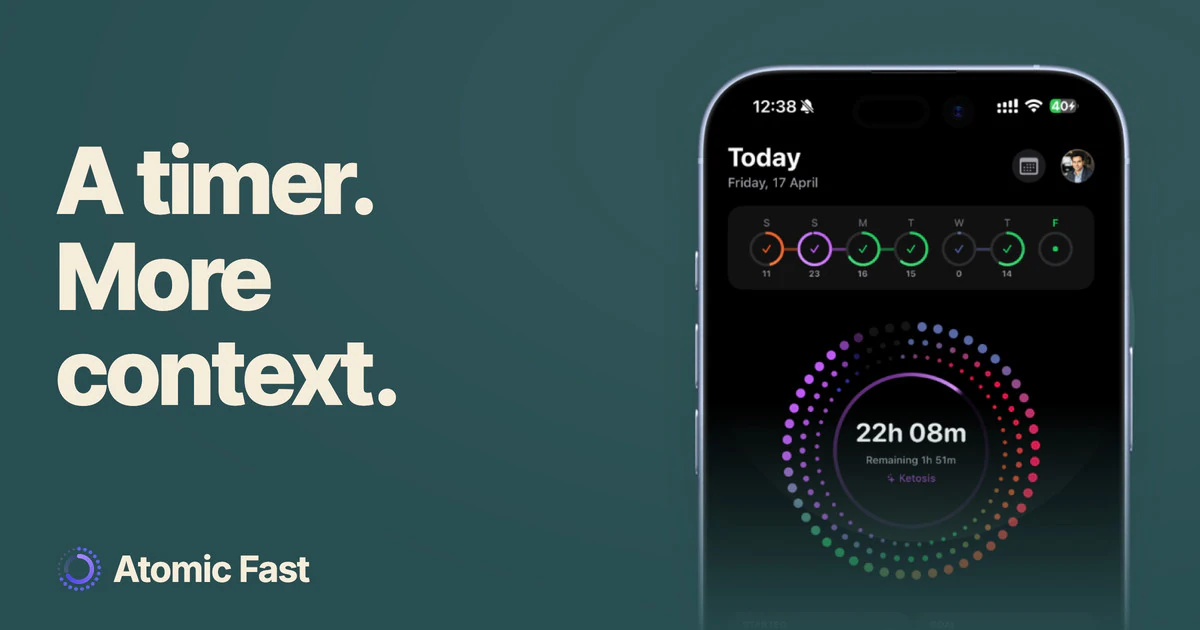
Atomic Fast records elapsed time. Its Glycogen Depletion sheet includes a general statement about hunger waves, but that statement does not establish how long your hunger will last or whether it is safe to continue. The phase itself is assigned by fixed hour thresholds.
Today’s fasts, meals and water entries can appear together on the Daily timeline. That is a record of what you entered, not a measurement of appetite or proof that a particular meal prevented symptoms.
Frequently asked questions
Does hunger always pass in twenty minutes? No. That precise timetable is not established by the study cited here.
Is hunger mostly habit? Habitual meal timing can influence appetite, but hunger has several contributors. You cannot diagnose it as habit from the clock alone.
Should I drink water instead of eating? Drink for your fluid needs, but do not use it to replace needed food or delay treatment for symptoms.
Should I add salt if I feel shaky? Shakiness has several possible causes. Stop and assess it rather than assuming sodium loss; follow any existing medical plan.
Does ending early ruin the routine? No. A fasting target is optional and should yield to food, medication and wellbeing needs.
Sources
Sources checked: October 11, 2026.
-
Frecka JM et al. (2008), Possible entrainment of ghrelin to habitual meal patterns in humans. American journal of physiology. Gastrointestinal and liver physiology — Association between ghrelin peaks and habitual meals; not a trial of waiting out hunger while fasting.
-
NIDDK — Low Blood Glucose (Hypoglycemia) — Symptoms and treatment planning for low blood glucose; do not substitute salt or waiting for an agreed treatment.
Record the schedule you choose with Atomic Fast on the App Store or Google Play.
This article is for general education and isn’t medical advice. If you’re pregnant, managing a health condition, taking medication, have a history of disordered eating, or are considering fasts longer than 24 hours, talk to a healthcare professional first.
Try Atomic Fast free
Track your fasts, log your meals, and see how they affect each other, on iPhone and Android.


 Scan to download