Can Intermittent Fasting Cause Gallstones?
Can fasting raise gallstone risk? Learn what research says about rapid weight loss and meal timing, what remains uncertain, and when to seek medical care.
By Nazmul Hasan Rupok Published 13 min read

If you start fasting and then hear that skipping meals can cause gallstones, the obvious question is whether your eating window is putting you at risk. The answer depends on more than the hours on a timer.
The research is clearer about rapid weight loss than about the eating window itself.
The short version
Rapid weight loss is a recognized gallstone risk factor. In a Swedish cohort, a program starting with a 500-calorie liquid diet was associated with about three times the rate of hospital-treated gallstones of a 1,200 to 1,500-calorie program; both absolute rates were low. Observational studies also link longer overnight fasts or later first meals with gallstones, but do not establish cause. The research reviewed here cannot tell us the risk of a specific 16:8 schedule. Avoid crash dieting, discuss a gallstone history with your clinician, and seek prompt care for possible gallbladder symptoms.
What gallstones are, and why fasting comes up
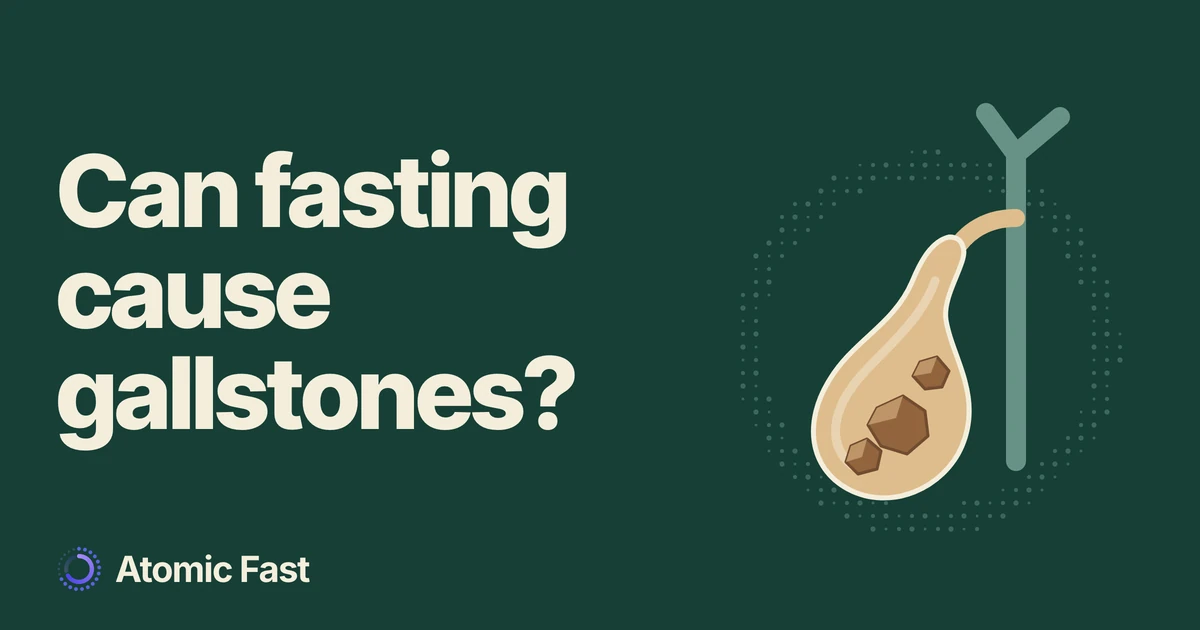
Gallstones are hard pieces of material, usually cholesterol or bilirubin, that form in the gallbladder. Most never cause trouble. When one blocks a bile duct, it can cause a gallbladder attack: pain in the upper right abdomen that can last several hours and often follows a heavy meal (NIDDK).
The fasting connection comes from how the gallbladder works. It stores bile between meals and squeezes it out after you eat. The US National Institute of Diabetes and Digestive and Kidney Diseases puts the concern plainly: when you don’t eat for a long period or lose weight quickly, the liver releases extra cholesterol into bile, and fast weight loss can stop the gallbladder from emptying properly (NIDDK, Dieting and gallstones).
That gives two separate questions. Does a long daily gap between meals matter on its own? And does the weight loss that often comes with fasting matter? The evidence behind each is quite different.
The clearest signal: how fast the weight comes off
One useful comparison comes from a commercial weight-loss program at 28 Swedish centers. Johansson and colleagues (2014) analyzed 3,320 matched participants per group. One program began with a 500-calorie liquid diet for 6 to 10 weeks, followed by two weeks of gradual food reintroduction. The other provided 1,200 to 1,500 calories a day, using two ordinary meals and two meal replacements, for up to three months. Both had an initial three-month weight-loss phase and then nine months of maintenance.
The average participant was 46, the average BMI was 33.4, and 83% were women. Participants chose and paid for their program. Researchers matched the groups on age, sex, BMI, waist size and gallstone history, then checked Sweden’s national patient register. The endpoint included inpatient and specialist outpatient gallstone care, rather than hospital admissions alone.
After a year, the very-low-calorie group had lost more weight (11.1 kg versus 8.1 kg). It also had 48 gallstone events needing hospital care, against 14 in the low-calorie group. That is a hazard ratio of 3.4 (95% CI 1.8 to 6.3). A separate analysis excluding people with previous gallbladder removal recorded 29 new removals in the very-low-calorie group and nine in the comparison group.
Swedish matched cohort · 3,320 matched participants per group · 1 year
Two diets, different gallstone rates
Gallstones needing inpatient or specialist outpatient care, per 10,000 person-years. Both bars start at zero. The programs were chosen, not randomly assigned.
Very-low-calorie start
500 kcal/day liquid diet for 6–10 weeks, then food reintroduction
- Events
- 48 of 3,320
- Proportion
- 1.45% of the group
- Weight lost at 1 year
- 11.1 kg
Low-calorie start
1,200–1,500 kcal/day for up to 3 months
- Events
- 14 of 3,320
- Proportion
- 0.42% of the group
- Weight lost at 1 year
- 8.1 kg
3.4×hazard ratio, 95% CI 1.8 to 6.3
2.5×after adjusting for 3-month weight loss, 95% CI 1.3 to 5.1
The absolute numbers help put the relative difference in perspective: 48 out of 3,320 is about 1.45%, compared with 14 out of 3,320, or 0.42%. These are simple proportions over follow-up, not a prediction of your personal risk. The graph uses the paper’s rates per 10,000 person-years, which account for time under observation.
When the researchers adjusted for how much weight people lost in the first three months, the risk gap shrank but stayed (hazard ratio 2.5, 95% CI 1.3 to 5.1). That does not isolate a direct effect of the diet: unmeasured differences between people choosing the programs could still matter. The authors discuss low fat intake, about 7 to 9 grams a day, as another possible contributor. They did not randomly assign fat intake, so this comparison cannot prescribe a protective amount.
NIDDK draws the practical line from evidence like this: diets or surgery that cause fast weight loss are more likely to lead to gallstone problems than slower approaches, and repeatedly losing and regaining weight may add to the risk (NIDDK).
What about the fasting window itself?
Here the evidence is less direct. The studies ask different questions, and they should not be treated as repeated tests of the same fasting plan.
A 1991 cohort of American women. Sichieri and colleagues followed 4,730 women aged 25 to 74 from a national health survey for about 10 years. Hospital records confirmed gallstone disease in 216 who hadn’t reported it at the start. The abstract reports that the hazard of hospitalization rose with a longer overnight fasting period and with dieting, and that fiber had a small protective effect. Diet was measured with a single 24-hour recall at the start, so one day’s eating stood in for a decade. We could read only the abstract, not the full scanned paper, so we can’t report the size of the effect or where the fasting categories were cut.
A 2024 survey analysis of first meal time. Sun and colleagues used US national survey data from 2017 to March 2020, roughly 6,500 adults (the paper gives both 6,547 and 6,457). People whose first meal of the day came later were more likely to say a doctor had ever told them they had gallstones. Each hour of delay was associated with 5% higher odds of a past diagnosis (OR 1.05, 95% CI 1.02 to 1.08). That is an odds comparison, not a 5% increase in the chance of developing new stones. The analysis excluded several drinks, including juice and soda, from its definition of a meal, so first-meal time was not necessarily the time someone broke a calorie-free fast.
The authors also fitted a change in the association at 13.4 hours, or about 1:24 p.m. After that point, the estimate was imprecise (OR 1.04, 95% CI 0.90 to 1.19). A nonsignificant result does not establish that risk stops rising, and this clock time is not a safe fasting-duration threshold.
This was not a test of 16:8. The survey asked about gallstones ever diagnosed, alongside a single day of eating recorded at the time. Someone who had a painful attack might well have changed when they eat afterward, so the arrow could point either way. The authors themselves say the design can’t establish cause.
A second analysis of overlapping data. Zhang and colleagues (2024) grouped about 4,700 adults from the 2017 to 2018 survey into eating patterns. A “later breakfast” pattern was linked to higher odds of self-reported gallstones than a conventional one. Its reported confidence intervals are implausibly narrow for a sample this size, and one subgroup estimate even falls outside its stated interval. Those reporting problems limit confidence in the numerical results. Its participants also overlap with the other survey analysis; two papers are not two independent populations. We do not use its estimates to recommend a breakfast time.
None of these studies randomized people to a 16:8-style window and measured new gallstones. A targeted literature search did not identify such a trial, but this was not a systematic review and cannot prove none exists. The practical limit is narrower: these sources do not establish a safe daily fasting duration, or show that changing breakfast time prevents stones.
The evidence behind the claim
What each kind of study can tell you
-
Recorded care
Matched weight-loss programs
Johansson 2014 · 3,320 matched participants per group
- Compared
- A 500 kcal/day start for 6–10 weeks vs 1,200–1,500 kcal/day for up to 3 months
- Measured
- Inpatient and specialist outpatient gallstone care over 1 year
- What it shows
- More events in the very-low-calorie program. Programs were not randomly assigned; eating windows were not compared.
-
Recall + follow-up
Prospective cohort
Sichieri 1991 · 4,730 women · abstract only
- Compared
- Overnight fasting, recorded with one day of diet recall
- Measured
- Gallstone hospitalization over about 10 years
- What it shows
- An association with longer overnight fasts. Full-text effect sizes and fasting cut-offs were not verified.
-
Past diagnosis
Cross-sectional surveys
Sun 2024 · Zhang 2024 · overlapping NHANES data
- Compared
- Meal timing on one recorded day
- Measured
- A self-reported previous gallstone diagnosis
- What it shows
- Timing and diagnosis were associated. These surveys cannot tell which came first, and both papers have reporting limitations.
-
Unanswered here
Risk of a specific eating window
For example, 16:8 with ordinary meals
- Compared
- An assigned daily eating window vs a comparison schedule
- Measured
- New gallstones or gallbladder events over follow-up
- What it shows
- The studies above do not test this. They cannot establish a safe fasting duration or a protective breakfast time.
How much to trust this
The Swedish study gives a clearer comparison of weight-loss programs than the surveys give of fasting schedules. Johansson’s study was large, matched carefully and used hospital records rather than memory. It still wasn’t randomized, and people choosing a 500-calorie liquid diet may differ from those choosing a gentler plan in ways matching didn’t catch. It captured inpatient and specialist outpatient care, but not primary-care-only or silent stones. It compared calorie-restricted programs, not eating windows. A 16:8 schedule with ordinary meals is a different exposure from a liquid diet of 500 calories a day.
The timing evidence has other limitations. The 1991 cohort used one day of diet data and we could check only its abstract. The 2024 survey papers are cross-sectional, rely on people remembering a past diagnosis and can’t tell which came first. Being linked to a later first meal does not mean a later first meal causes stones. It also doesn’t mean an eating window is safe. Both readings go beyond the data.
Two practical points survive the uncertainty. Fast, large weight loss raises the risk, and weight cycling may too. And a known gallstone history changes the picture, because people who already have stones are more likely to develop symptoms during rapid weight loss (NIDDK). That is why our guide to who should check with a doctor before fasting lists gallstones.
What changes the answer
These details are worth taking to your clinician when discussing a fasting or weight-loss plan.
The size of your deficit. Eating your usual amount within a window differs from squeezing intake into one small meal. Both intake and speed of weight loss belong in the discussion.
Previous gallstones or gallbladder symptoms. Existing stones raise the chance of trouble during rapid weight loss. Talk to your doctor before starting an aggressive plan.
A medically supervised very-low-calorie diet or weight-loss surgery. Ask the treating team whether you need gallstone prevention. A 2022 European guideline recommends the bile-acid drug ursodeoxycholic acid to prevent gallstones during weight-reduction treatment (Bischoff et al., ESPEN/UEG guideline). Much of that evidence comes from bariatric surgery, and the drug is a prescribing decision for your clinician, not something to start on your own.
Repeated crash diets. If your history looks like losing a lot quickly, regaining and starting again, the cycling itself is worth discussing with a professional.
What to do with this
- Aim for steady weight loss, not speed. NIDDK points to an initial goal of 5 to 10% of starting weight over six months for people with overweight or obesity. This is a starting goal to discuss with a clinician, not a threshold below which gallstones cannot occur. For example, 5 to 10% of a starting weight of 80 kg is 4 to 8 kg over six months. That arithmetic example is not an individual prescription. Atomic Fast’s nutrition-goal settings can record targets, but a calculator estimate does not assess gallstone risk.
- Review what you eat as well as when. A timing plan can become a crash diet if you repeatedly miss substantial meals. Do not treat the Swedish diet comparison as a reason to copy either calorie level. Our guide to planning a meal after a fast covers general meal choices; it is not a treatment plan for gallstones.
- Review rapid loss rather than chasing it. If weight is falling quickly or you are struggling to eat enough, discuss the plan with your clinician. NIDDK advises avoiding crash diets. These studies cannot tell you that adding or removing a particular number of fasting hours changes gallstone risk.
- Know the warning signs. NIDDK lists belly pain lasting several hours, nausea and vomiting, fever or chills, yellowing of the skin or eyes, and tea-colored urine with light stools as reasons to see a doctor right away (NIDDK). Don’t fast through them.
The fasting timer in the app counts hours. It can’t detect anything about your gallbladder, and an uneventful fast tells you nothing either way about stones.
Frequently asked questions
Does 16:8 intermittent fasting cause gallstones? The sources reviewed here do not establish that it does or that it does not. Population studies link later first meals and long overnight fasts with gallstones, but they can’t separate cause from coincidence. The better-supported risk is rapid weight loss, whatever schedule produces it.
Is skipping breakfast bad for your gallbladder? A 2024 survey analysis linked later first meals with a past gallstone diagnosis. The survey can’t tell whether late meals came before the stones or after. It does not prove that eating breakfast prevents stones or identify a protective clock time.
Can I do intermittent fasting if I’ve had gallstones? Check with your doctor before starting or changing a fasting plan. Existing stones can be more likely to cause symptoms during rapid weight loss. Your history, symptoms and treatment matter; no particular eating window can be cleared as safe from these studies.
How fast is too fast to lose weight for gallstone risk? No single safe threshold applies to everyone. NIDDK suggests starting with 5 to 10% of body weight over six months. In the Swedish study, a 500-calorie liquid diet carried about three times the risk of hospital-treated gallstones of a 1,200 to 1,500-calorie diet, though both risks were low.
What does a gallbladder attack feel like? Usually pain in the upper right abdomen that can last several hours, often after a heavy meal and often in the evening or at night. Pain lasting hours, fever, vomiting, yellow skin or eyes, or dark urine with pale stools need prompt medical care.
Does fasting help dissolve gallstones? No evidence we found shows that fasting dissolves gallstones. Do not use fasting as a substitute for assessment or treatment.
Sources and product notes
Sources checked: November 7, 2026.
- Johansson K, Sundström J, Marcus C, Hemmingsson E, Neovius M (2014), Risk of symptomatic gallstones and cholecystectomy after a very-low-calorie diet or low-calorie diet in a commercial weight loss program: 1-year matched cohort study, International Journal of Obesity — Full text. 3,320 matched pairs at 28 Swedish centers; 48 versus 14 hospital-treated gallstone events, hazard ratio 3.4 (95% CI 1.8 to 6.3), 2.5 after adjusting for early weight loss; rates 152 versus 44 per 10,000 person-years. Supports the rapid-weight-loss comparison. Observational, a commercial liquid-diet program, inpatient and specialist outpatient events only, not an eating-window study. The 500-calorie phase lasted 6 to 10 weeks, followed by food reintroduction.
- Sichieri R, Everhart JE, Roth H (1991), A prospective study of hospitalization with gallstone disease among women: role of dietary factors, fasting period, and dieting, American Journal of Public Health — Abstract only; the full paper is a scanned PDF we did not read. 4,730 women, about 10 years, 216 confirmed hospitalizations; risk rose with longer overnight fasting and dieting. Effect sizes and category cut-offs not checked; diet from one 24-hour recall.
- Sun T et al. (2024), Non-linear relationship between the first meal time of the day and gallstone incidence in American adults: a population-based cross-sectional study, Frontiers in Nutrition — Full text. NHANES 2017 to March 2020; OR 1.05 per hour of later first meal and 1.49 for a 9 a.m. to 2 p.m. first meal versus before 9 a.m. Cross-sectional, self-reported lifetime diagnosis, one day of diet. The paper reports two sample sizes and two slightly different intervals for the 1.49 estimate; despite the title, it measures prevalence, not incidence.
- Zhang H et al. (2024), Associations between temporal eating patterns and energy distribution patterns with gallstones: a cross-sectional study based on NHANES 2017-2018, BMC Public Health — Full text. 4,692 adults; “later breakfast” pattern OR 1.435 versus conventional. Discussed as limited evidence, not used for numerical guidance: overlapping survey participants, self-reported diagnosis, implausibly narrow intervals and an inconsistent subgroup interval.
- Bischoff SC et al. (2022), European guideline on obesity care in patients with gastrointestinal and liver diseases, ESPEN and UEG, United European Gastroenterology Journal — Recommendation 86 and its supporting commentary checked in full text. Recommendation 86 supports the statement on ursodeoxycholic acid during weight-reduction treatment. Evidence base is largely bariatric surgery; not a recommendation for self-treatment or for ordinary eating windows.
- National Institute of Diabetes and Digestive and Kidney Diseases (page last reviewed 2017), Dieting and gallstones — Supports the mechanism summary, fast weight loss and weight cycling as risks, prior stones as a risk during rapid loss, and the 5 to 10% over six months starting goal. General guidance.
- National Institute of Diabetes and Digestive and Kidney Diseases (page last reviewed 2017), Symptoms and causes of gallstones — Supports the description of a gallbladder attack and the symptoms that need prompt care.
Product note, checked November 7, 2026: Atomic Fast nutrition-target fields and their save actions were verified in the iPhone and Android source code and documentation. This was a source review, not a mobile runtime test or evidence of a clinical benefit.
Track your eating window, meals and pace with Atomic Fast on the App Store or Google Play.
This article is for general education and isn’t medical advice. If you’re pregnant, managing a health condition, taking medication, have a history of disordered eating, or are considering fasts longer than 24 hours, talk to a healthcare professional first.
Try Atomic Fast free
Track your fasts, log your meals, and see how they affect each other, on iPhone and Android.


 Scan to download